
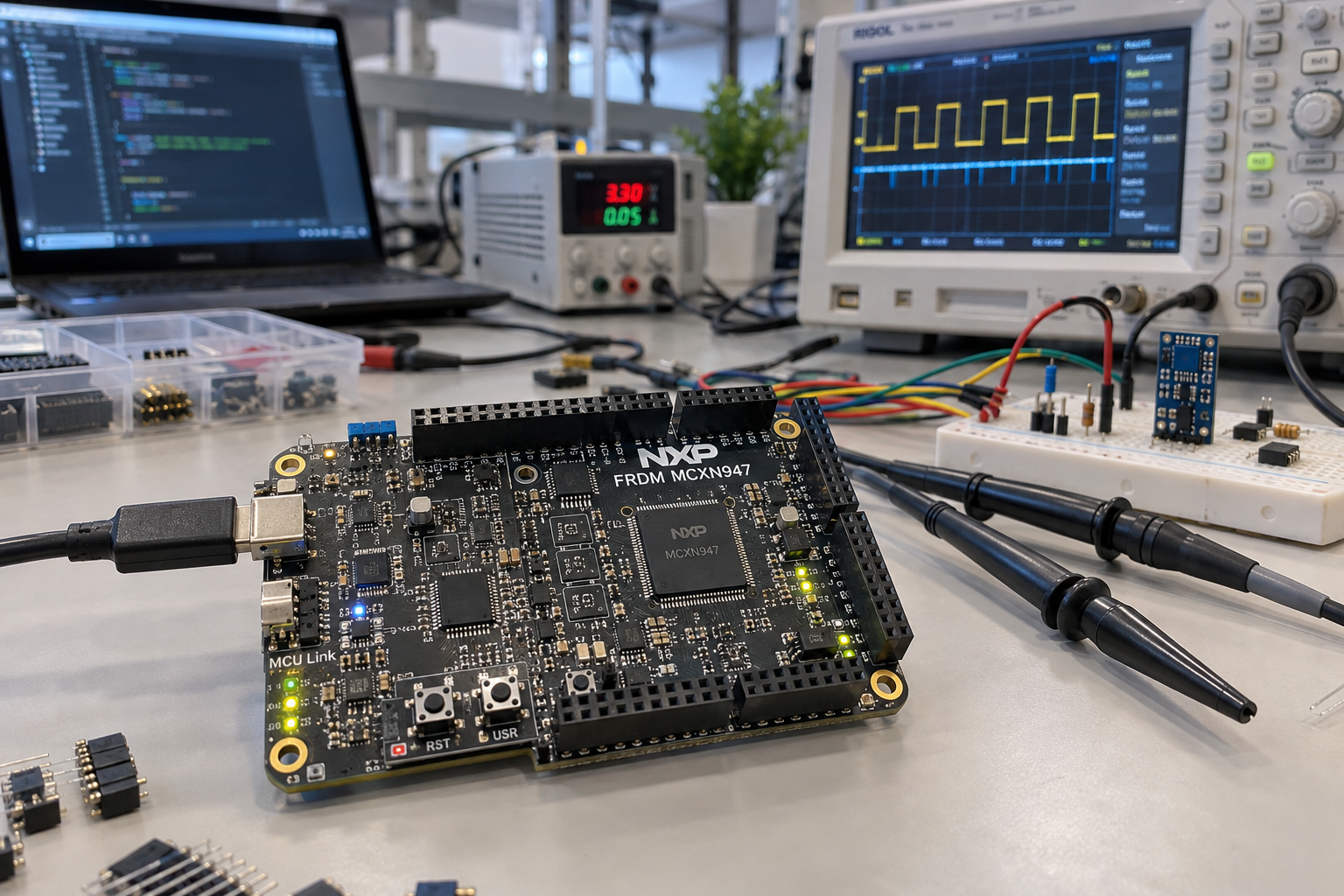
What Is an NXP MCX Microcontroller?
An NXP MCX microcontroller is a modern family of 32 bit Arm based MCUs designed for embedded systems that require a combination of processing performance, low power operation, intelligent peripherals, connectivity, security, and, in selected devices, edge AI acceleration.
The MCX portfolio is divided into multiple series, with each family targeting different requirements. NXP currently describes MCX N as an advanced series, MCX A as mainstream, MCX W as wireless, MCX E as robust, MCX C as value focused, and MCX L as ultra low power. This makes MCX a broad portfolio rather than a single microcontroller.
What Does MCX Mean?
MCX is NXP’s microcontroller portfolio designed around a common development experience and different hardware configurations for specific embedded applications.
The portfolio builds on NXP’s earlier microcontroller technologies and combines capabilities from platforms such as Kinetis and LPC. Depending on the series, developers can find features such as Cortex M33 processing, intelligent peripherals, wireless connectivity, precision analog functions, security hardware, and low power operation.
This approach allows engineers to select an MCX device according to the application’s requirements instead of using the same MCU architecture for every product.
How Does an MCX Microcontroller Work?
An MCX microcontroller executes firmware stored in Flash memory and uses SRAM for temporary application data. The processor communicates with integrated peripherals through the MCU’s internal buses and control systems.
Depending on the device, firmware can read sensors through ADC inputs, control motors using PWM, communicate through UART, SPI, I2C, I3C, USB, or CAN FD, and process data using hardware accelerators.
Some MCX N devices go further by combining Cortex M33 processing with on chip accelerators, intelligent peripherals, and an NPU for machine learning workloads. NXP also provides security features such as secure boot, hardware accelerated cryptography, and an EdgeLock Secure Enclave on MCX N devices.
Why Are MCX Microcontrollers Important?
MCX represents a newer generation of NXP microcontrollers focused on combining conventional embedded control with more advanced processing, connectivity, security, and intelligent edge capabilities.
Instead of treating AI, wireless communication, security, and real time control as completely separate hardware requirements, the MCX portfolio provides different MCU families that integrate these capabilities to varying degrees.
32 Bit Arm Cortex M Performance
MCX devices use Arm Cortex M processor technology, with different cores and performance levels depending on the series.
For example, MCX N devices use dual Arm Cortex M33 cores in several families, with additional accelerators and intelligent peripherals. The MCX A26 family uses a Cortex M33 core with operating speeds up to 240 MHz and provides features such as SmartDMA, FlexIO, dual FlexPWM, ADCs, USB, CAN FD, and I3C.
Other MCX families target lower complexity or specialized requirements. MCX C devices, for example, include Cortex M0+ based products with Flash, SRAM, USB on selected devices, timers, ADC, UART, SPI, and I2C peripherals.
This range gives developers multiple processing options within the same broader MCX ecosystem.
Edge AI and Machine Learning
One of the most notable aspects of the MCX portfolio is its focus on intelligent edge processing. Selected MCX N devices integrate NXP’s eIQ Neutron Neural Processing Unit, or NPU, to accelerate machine learning workloads directly on the microcontroller.
The NPU can handle supported neural network operations without requiring every calculation to run on the main CPU. MCX N devices also include additional accelerators and intelligent peripherals designed to improve processing efficiency.
This architecture can be useful for applications such as smart sensing, industrial monitoring, predictive maintenance, voice or audio processing, and other embedded systems that need local data analysis.
Intelligent Peripheral Processing
MCX devices can also reduce the workload placed on the main processor by using intelligent peripherals and hardware accelerators.
For example, MCX N integrates SmartDMA and other processing resources that can help move and process data efficiently. MCX A devices also provide peripherals such as SmartDMA, FlexIO, FlexPWM, ADCs, CAN FD, USB, and I3C depending on the specific family.
This can improve responsiveness in real time systems because the CPU does not have to handle every low level peripheral operation directly.
Low Power Operation
Power efficiency remains important even when a microcontroller provides advanced processing capabilities. Different MCX families therefore target different power requirements.
MCX N combines high performance with low power features, while MCX L is specifically positioned for ultra low power applications and always on operation. NXP’s MCX portfolio documentation identifies low active power and leakage as key characteristics of the L series.
This makes the MCX portfolio suitable for both performance oriented embedded systems and battery powered products, depending on the selected family.
Architecture of an MCX Microcontroller
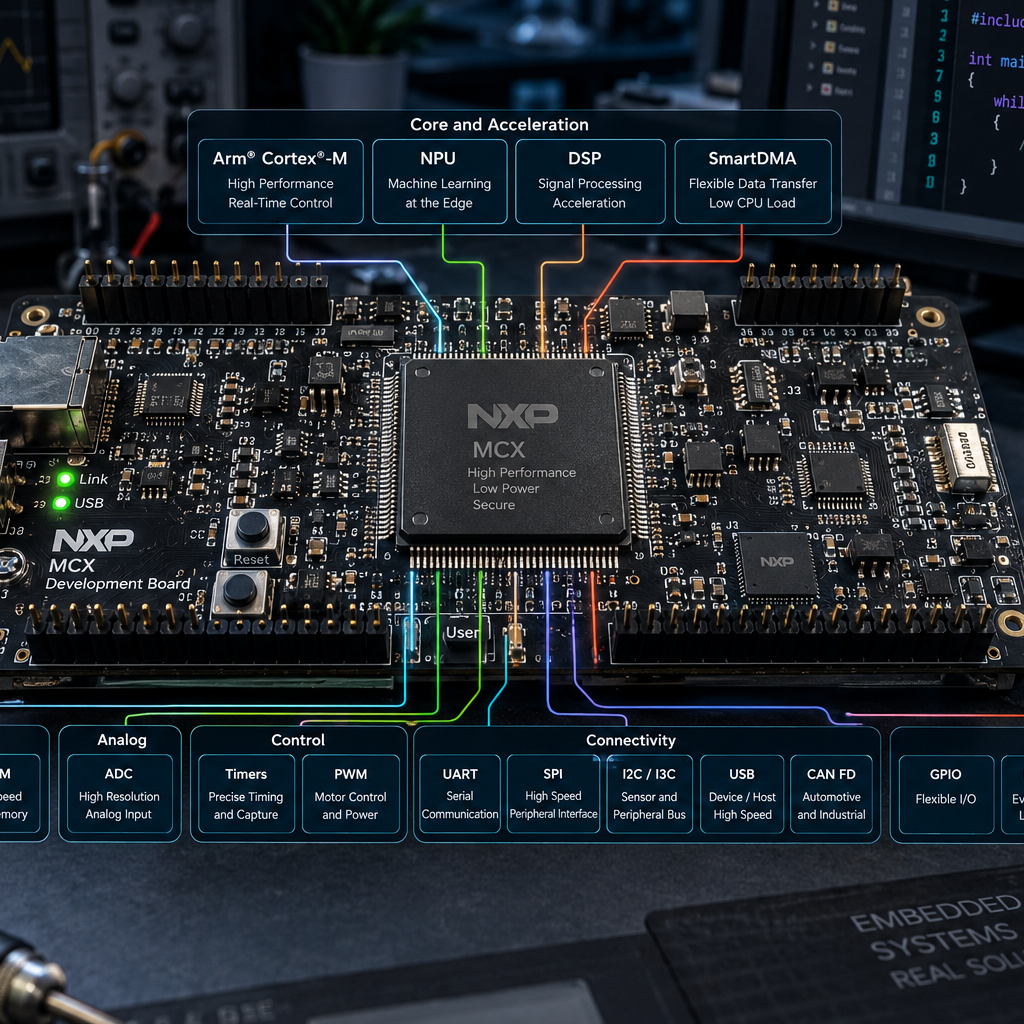
The architecture of an MCX microcontroller combines an Arm processor core with memory, intelligent peripherals, communication interfaces, analog functions, security hardware, and system management features. The exact architecture depends on the MCX family and individual device.
For example, MCX N devices can combine dual Cortex M33 cores with DSP capabilities, an NPU, SmartDMA, Flash, SRAM, communication interfaces, and security hardware. Other MCX families use different cores and peripheral combinations to target lower cost, wireless, low power, or specialized applications.
Arm Cortex M CPU Core
The CPU is responsible for executing application firmware and coordinating the different hardware resources inside the MCU. MCX devices use Arm Cortex M processor technology, but the exact core depends on the series.
MCX N devices use up to two Cortex M33 cores operating at up to 150 MHz in current N94, N54, N53, and N52 devices. The MCX N24 uses a single Cortex M33 core at the same maximum frequency.
Other families use different configurations. For example, MCX C devices use Cortex M0+ cores, while MCX A26 uses a Cortex M33 core operating at up to 240 MHz.
This range allows the MCX portfolio to address both relatively simple embedded controllers and more demanding systems that need higher processing performance.
NPU and DSP Acceleration
Selected MCX devices add hardware acceleration for workloads that would otherwise consume significant CPU resources.
MCX N devices integrate NXP’s eIQ Neutron Neural Processing Unit for edge AI and machine learning workloads. Current MCX N94, N54, N53, N52, and N24 devices also include a DSP coprocessor and provide up to 4.8 GOPS of edge AI and ML acceleration through the NPU.
A dedicated NPU can process supported neural network operations more efficiently than running the entire workload on a general purpose CPU. This is useful when an embedded device needs to analyze sensor data, audio, images, or other inputs locally.
DSP acceleration is useful for signal processing tasks such as filtering, transforms, and other mathematical operations. Together, the CPU, DSP resources, and NPU can divide workloads according to their requirements.
Flash and SRAM
MCX microcontrollers use nonvolatile Flash memory to store application firmware and SRAM for runtime data. The amount of memory varies significantly between MCX families.
Current MCX N devices provide up to 2 MB of Flash and 512 KB of SRAM in several models. The MCX A26 family provides up to 1 MB of Flash and 256 KB of RAM, while entry level MCX C04x devices provide 32 KB of Flash and 2 KB of SRAM.
This scalability allows developers to select a device according to application size, data requirements, performance needs, and cost constraints.
Some MCX devices also include memory protection and ECC capabilities. These features can help detect or correct certain memory errors and can be important in applications where data integrity matters.
GPIO and Peripherals
GPIO provides the basic connection between the MCU and external hardware. Developers can use GPIO pins for LEDs, buttons, sensors, control signals, displays, and other digital devices.
MCX devices also integrate a broad selection of peripherals. Depending on the family, these can include ADCs, timers, PWM modules, UART, SPI, I2C, I3C, USB, CAN FD, LCD interfaces, and other hardware resources.
For example, the MCX A26 provides SmartDMA, FlexIO, dual FlexPWM, up to two 16 bit ADCs, USB, dual CAN FD, I3C, and LCD support.
Key Features of MCX Microcontrollers
The MCX portfolio combines conventional microcontroller functions with features designed for intelligent edge devices. However, not every MCX device includes every feature, so the individual product specification should always be checked before hardware selection.
GPIO and Digital Control
GPIO allows an MCX MCU to monitor and control digital hardware. A firmware program can read a button, detect a digital sensor signal, switch an LED, control a relay, or communicate with external logic through configurable I/O pins.
Many MCX devices also provide flexible peripheral routing and pin configuration. This allows developers to assign available pins to different functions according to the requirements of their circuit.
ADC and Analog Functions
Analog to digital converters allow MCX devices to measure analog signals from sensors and control systems. A sensor can produce a voltage representing temperature, pressure, current, light, or another physical measurement, and the ADC converts that signal into a digital value.
Some MCX families provide advanced analog capabilities. The MCX A26, for example, includes up to two 16 bit ADCs, while MCX N families offer different analog configurations depending on the specific device.
These integrated analog resources can reduce the need for external conversion hardware in measurement and control systems.
Timers and PWM
Timers provide accurate timing, event measurement, periodic interrupts, and signal generation. PWM outputs can control motors, LEDs, power electronics, and servo actuators.
The MCX A26 includes dual FlexPWM modules, making it suitable for applications that require responsive real time control.
When combined with ADC feedback, PWM can form part of a closed loop control system. For example, an MCU can measure motor current or position and adjust the PWM output according to the measured value.
Communication Interfaces
MCX microcontrollers provide different communication options depending on the family. Common interfaces include UART, SPI, I2C, I3C, USB, and CAN FD.
These interfaces allow an MCU to communicate with sensors, displays, memory devices, other controllers, computers, and industrial equipment.
MCX W adds wireless communication to the portfolio. NXP’s MCX W platform supports standards including Matter, Thread, Zigbee, and Bluetooth Low Energy, making it suitable for connected embedded products and IoT systems.
Security Features
Security is another major part of the MCX architecture. Selected devices provide secure boot, hardware accelerated cryptography, TrustZone based isolation, and EdgeLock security technology.
MCX N devices include an EdgeLock Secure Enclave and an immutable root of trust for secure boot and hardware assisted security functions.
These capabilities can help protect firmware, sensitive data, device credentials, and communication keys throughout the product lifecycle.
NXP MCX Microcontroller Families
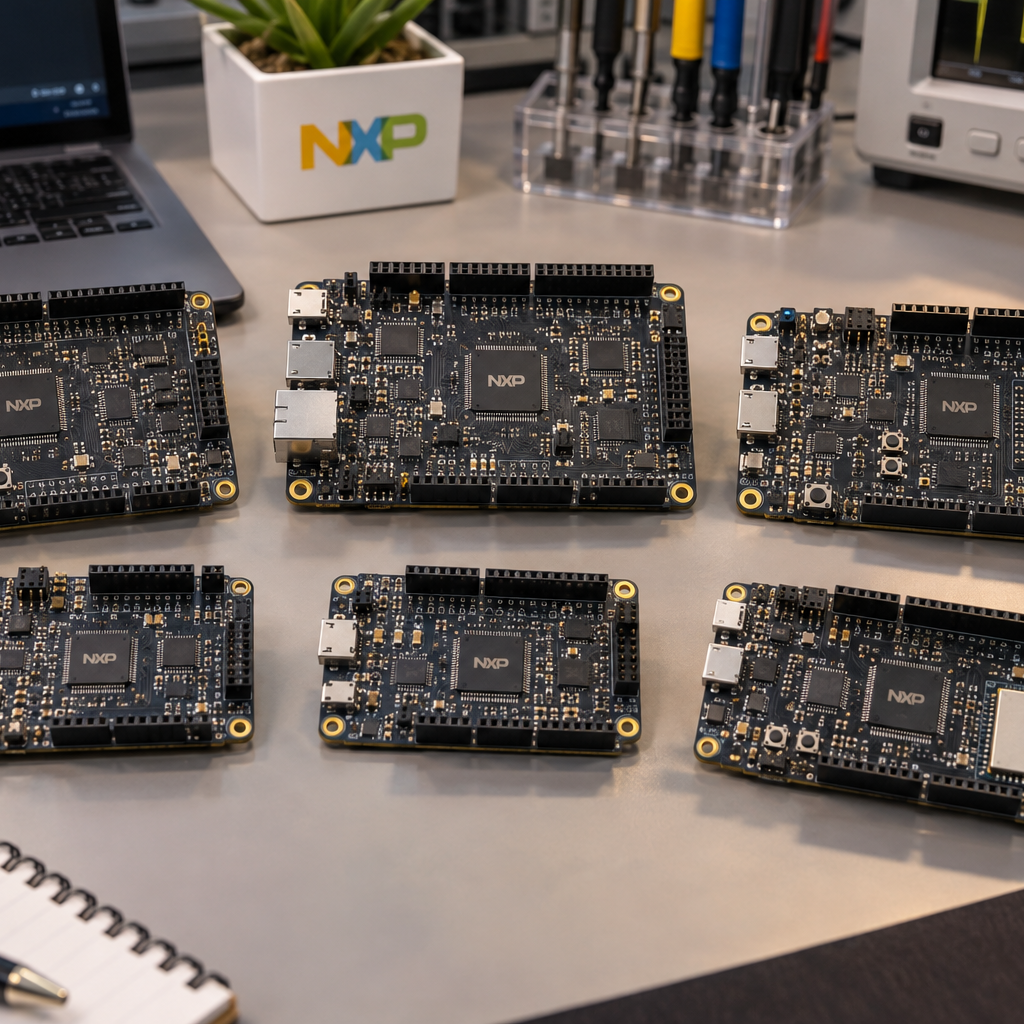
The MCX portfolio includes several families designed for different combinations of performance, power efficiency, connectivity, security, analog capability, and application requirements. NXP currently groups the portfolio into MCX N, A, W, E, L, and C families, supported through the broader MCUXpresso development ecosystem.
MCX N Series
The MCX N series targets advanced embedded applications that require high processing performance, edge AI, security, and efficient data processing. Current MCX N devices can combine dual Arm Cortex M33 cores, an NPU, DSP acceleration, SmartDMA, large Flash and SRAM resources, and advanced security features.
The series is particularly relevant to applications where machine learning needs to run locally rather than sending all data to a cloud service. Examples include smart sensors, industrial monitoring, voice processing, predictive maintenance, and intelligent control systems. NXP’s current MCX N54 evaluation platform includes an NPU, PowerQuad, SmartDMA, Ethernet, USB, multiple serial interfaces, and an onboard MCU Link debugger.
MCX A Series
The MCX A series is designed as a mainstream MCU platform with a strong combination of processing performance, low power operation, and intelligent peripherals.
The MCX A26 family, for example, uses an Arm Cortex M33 core running at up to 240 MHz and provides SmartDMA, up to 1 MB Flash, up to 256 KB RAM, dual 16 bit ADCs, USB, CAN FD, I3C, and other peripherals.
This makes MCX A suitable for applications such as industrial control, smart sensing, motor control, human machine interfaces, and general embedded systems.
MCX C Series
The MCX C series focuses on value oriented embedded applications while maintaining the modern MCX development ecosystem.
MCX C devices use Arm Cortex M0+ based architectures in some families and integrate features such as Flash, SRAM, timers, ADC, UART, SPI, I2C, and USB on selected devices. NXP also provides FRDM development boards such as the FRDM MCXC041 for evaluation and prototyping.
These characteristics make the family suitable for cost sensitive control systems, sensors, appliances, and general purpose embedded applications.
MCX W Series
The MCX W series adds wireless connectivity to the MCX portfolio. These devices use Arm Cortex M33 technology and are designed for connected products requiring protocols such as Bluetooth Low Energy, Matter, Thread, and Zigbee.
For example, the MCX W71 supports Bluetooth LE, Zigbee, Thread, and Matter and can be evaluated using the FRDM MCXW71 development board. The board also includes an onboard MCU Link debugger, accelerometer, light sensor, external SPI Flash, and expansion interfaces.
This makes MCX W particularly relevant to smart home devices, building automation, connected sensors, asset tracking, and other wireless IoT products.
MCX E and L Series
The MCX E series focuses on applications requiring robust operation, functional safety features, industrial interfaces, and extended operating capabilities. The MCX L series instead emphasizes ultra low power operation and always on applications.
NXP’s portfolio overview identifies MCX E as its safe family and MCX L as its ultra low power family, while also highlighting features such as precision analog, energy saving peripherals, functional safety, and robust supply options across relevant MCX families.
How to Program an MCX Microcontroller
MCX development is supported by NXP’s MCUXpresso Developer Experience, which brings together software tools, SDKs, configuration tools, examples, debugging resources, and development hardware.
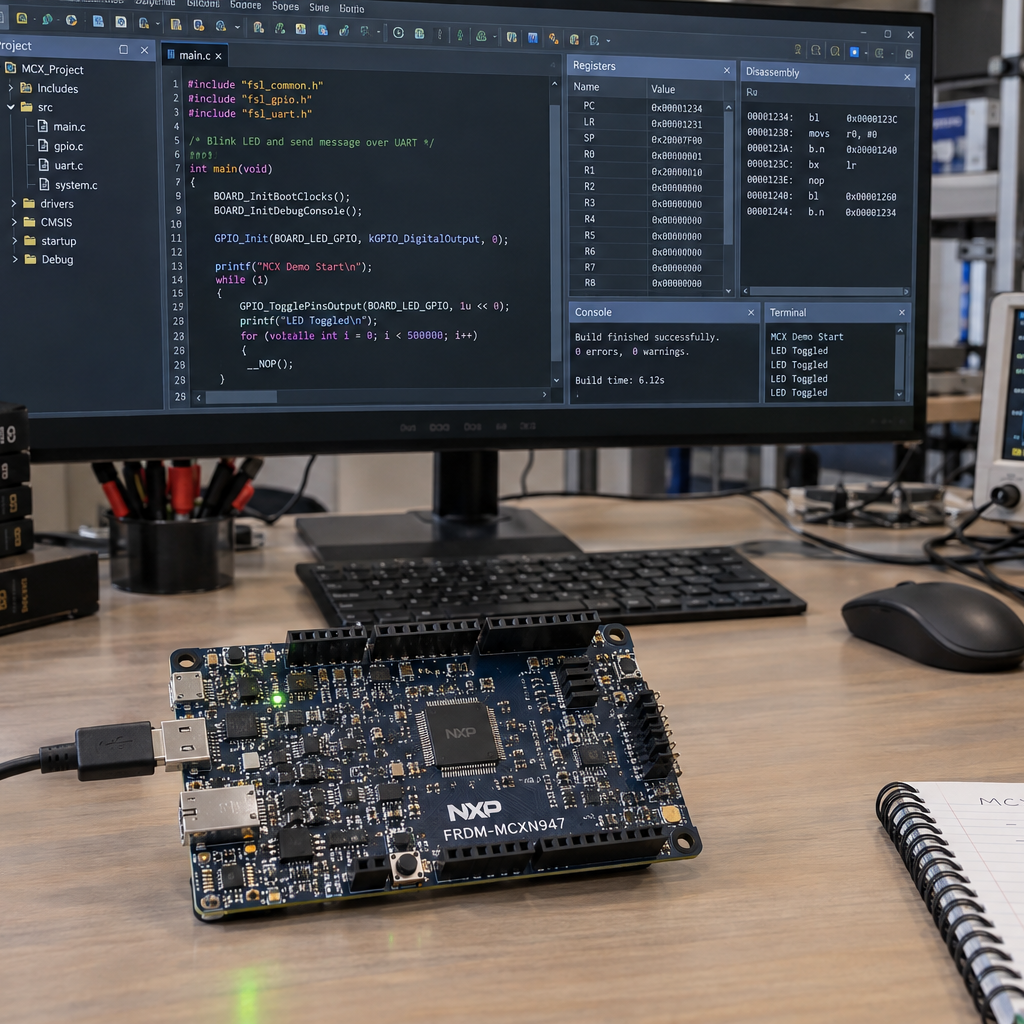
Embedded C Programming
Embedded C is commonly used to develop firmware for MCX microcontrollers. Developers can configure GPIO, timers, ADCs, communication interfaces, interrupts, memory, and other peripherals through application code and software drivers.
For more complex applications, developers can combine the MCU firmware with RTOS components, middleware, communication stacks, and machine learning software where supported by the selected MCX device.
MCUXpresso Development Tools
The MCUXpresso ecosystem includes the MCUXpresso IDE, MCUXpresso SDK, configuration tools, and development resources. NXP’s SDK provides drivers, examples, middleware, and software components for supported MCX devices.
NXP also provides MCUXpresso for Visual Studio Code and additional tools for configuration, secure provisioning, debugging, and application development. Current MCX evaluation platforms link directly to these resources through the MCUXpresso Developer Experience.
Programmer and Debugger
MCX development boards commonly include an onboard MCU Link debugger. This allows developers to program Flash memory and debug firmware without requiring a separate debugging probe.
For example, the MCX N5XX EVK includes an onboard MCU Link debugger with energy monitoring, while the FRDM MCXW71 also provides an onboard MCU Link debugger and standard JTAG/SWD access.
MCX Development Boards
NXP provides FRDM development boards for several MCX families, giving developers a practical way to evaluate hardware, test peripherals, and build prototypes before designing a custom PCB. The current FRDM portfolio includes boards for MCX A, C, E, N, and W devices, with different boards targeting sensing, motor control, industrial automation, wireless connectivity, and AI/ML acceleration.
FRDM Development Boards
The FRDM platform provides compact development boards with accessible MCU I/O, standard expansion headers, USB connectivity, and onboard debugging on many MCX platforms.
For example, the FRDM MCXN947 targets the MCX N series and includes an Arm Cortex M33 MCU, 2 MB Flash, an NPU, Ethernet, high speed USB, CAN FD, and interfaces for display and camera expansion. This makes it useful for evaluating advanced embedded and TinyML applications.
NXP also provides boards such as the FRDM MCXA344 and FRDM MCXA366 for MCX A devices. These platforms provide access to peripherals and features relevant to smart sensing, motor control, and industrial HMI applications.
MCX Evaluation Boards
Beyond the compact FRDM platforms, NXP provides larger evaluation boards for selected MCX devices. These boards can expose more interfaces and hardware resources for detailed testing.
The FRDM MCXE31B, for example, is designed around the MCX E31B and includes a Cortex M7 based MCU, 4 MB Flash, 512 KB SRAM, external Flash, Ethernet, CAN, USB Type C, sensors, and an onboard MCU Link debugger.
For lower cost MCX C development, boards such as the FRDM MCXC041 and FRDM MCXC242 provide accessible I/O, serial interfaces, and onboard MCU Link debugging.
Prototyping With MCX
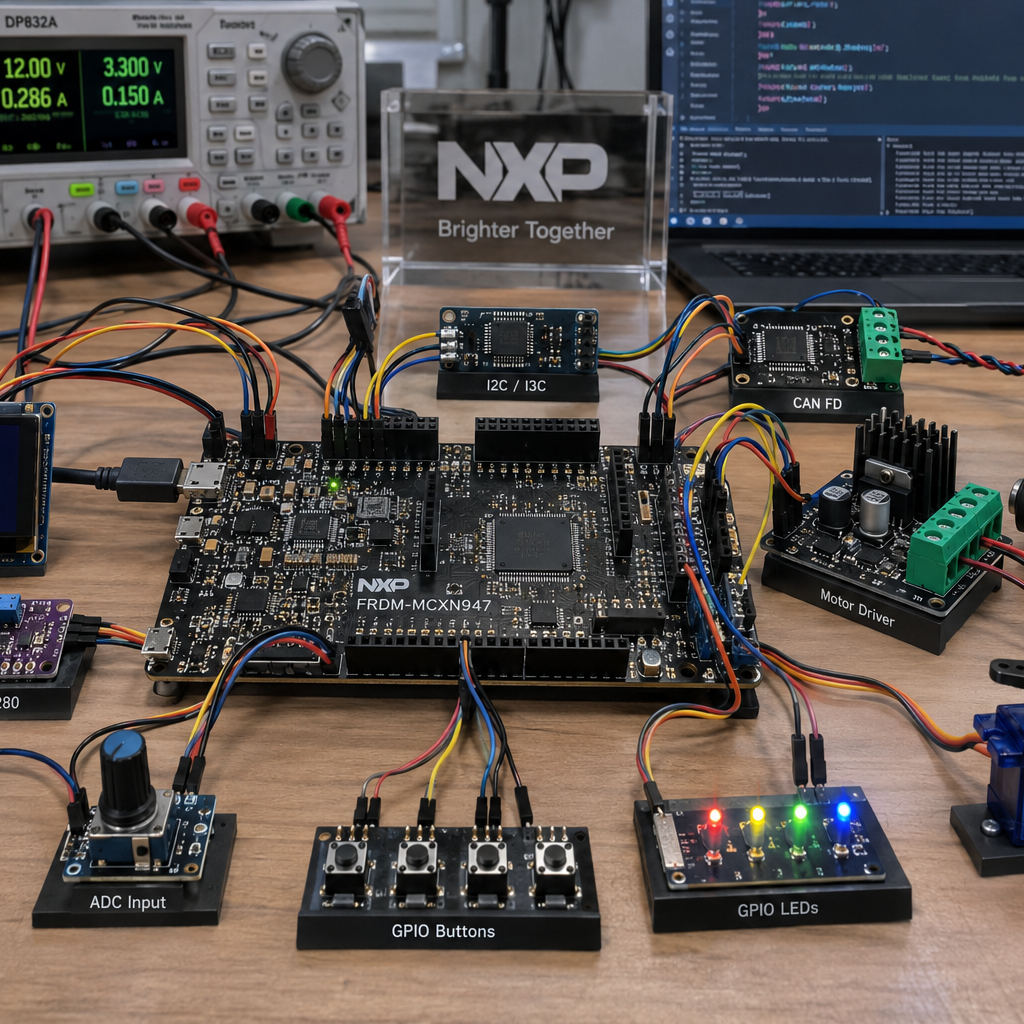
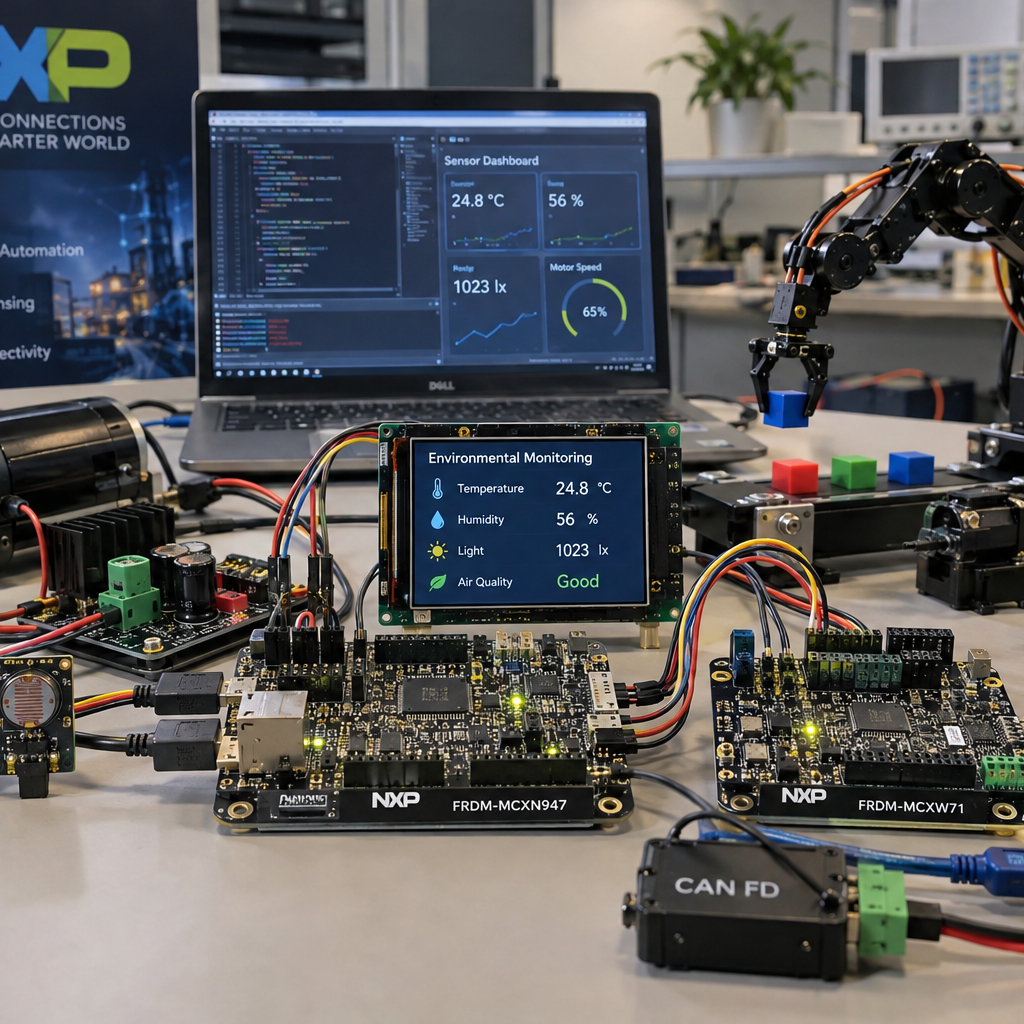
A typical MCX prototype can include a development board, USB connection, computer, sensors, displays, motor drivers, and other external components. Developers can connect these components through the board’s accessible I/O and expansion interfaces.
For example, a smart sensing prototype could connect an analog sensor to an ADC, use I3C or I2C for digital sensors, control an actuator through PWM, and send processed information to another system through USB, CAN FD, Ethernet, or wireless connectivity depending on the MCX device.
The FRDM ecosystem also provides expansion boards and application examples through NXP’s MCUXpresso Developer Experience, helping developers move from initial evaluation toward functional prototypes.
Applications of MCX Microcontrollers
MCX microcontrollers target a broad range of embedded applications, from basic sensing and control to wireless IoT, industrial automation, edge AI, and intelligent motor control.
The appropriate MCX family depends on the required processor performance, memory, connectivity, power consumption, security, and hardware acceleration.
Edge AI and IoT
MCX N devices are particularly suited to edge AI applications because selected devices combine Cortex M33 processing with an NPU and DSP acceleration.
An embedded system can process sensor information locally, run supported machine learning models, and make decisions without continuously sending raw data to a remote server. This approach can be useful for smart sensing, anomaly detection, predictive maintenance, audio processing, and other intelligent edge applications. NXP positions the MCXN947 FRDM platform specifically for TinyML and factory automation use cases.
Industrial Automation
Industrial systems can require real time control, multiple communication interfaces, sensing, security, and reliable processing. MCX devices provide different combinations of these capabilities across the portfolio.
MCX E devices are designed for robust industrial applications, while MCX A platforms target applications including smart sensing, motor control, and industrial HMI. The FRDM MCXE31B, for example, combines Ethernet, CAN FD, external memory, sensors, and an Arm Cortex M7 MCU for industrial development.
Robotics and Smart Sensing
Robotic systems can use MCX devices to read sensors, process measurements, control motors and actuators, and communicate with other controllers.
A typical robotic controller might combine ADC inputs for analog sensors, I2C or I3C for digital sensors, PWM for motors or servos, and CAN FD or Ethernet for communication. More capable MCX devices can additionally process complex data locally using DSP or AI acceleration.
Motor Control
Motor control is another important MCX application. MCX A development platforms include devices designed for motor control, with peripherals such as FlexPWM, ADCs, SmartDMA, and mathematical acceleration resources on selected devices.
These resources can be used in systems such as motor drives, pumps, fans, power tools, and industrial machinery. The MCU can measure feedback signals, calculate control responses, and generate PWM signals for the motor power stage.
Connected Devices
The MCX W series extends the platform into wireless embedded applications. MCX W devices support technologies such as Bluetooth Low Energy, Thread, Zigbee, and Matter, depending on the specific product.
This makes the family relevant to smart lighting, connected sensors, asset tracking, smart home devices, and other products that need local processing together with wireless communication.
Advantages and Limitations of MCX Microcontrollers
MCX microcontrollers cover a wide range of embedded requirements, from entry level control and ultra low power sensing to wireless connectivity and edge AI. Because the portfolio contains several families, the practical advantages and limitations depend on the particular MCX device selected. NXP currently positions MCX as a scalable portfolio covering mainstream, wireless, robust, advanced, value, and ultra low power applications.
Advantages of MCX Microcontrollers
One major advantage is the range of processing options. Developers can select devices using Cortex M0+, Cortex M33, Cortex M4, or Cortex M7 based architectures depending on the MCX family. This provides flexibility for applications with different performance, memory, and power requirements.
MCX also combines traditional microcontroller peripherals with newer processing capabilities. Selected MCX N devices include an integrated NPU, DSP coprocessor, intelligent peripherals, and advanced security hardware. This can allow embedded systems to perform more processing locally while reducing the workload placed on the main CPU.
Another advantage is the security architecture available on selected devices. MCX N products include features such as an EdgeLock Secure Enclave, secure boot, immutable root of trust, and hardware accelerated cryptography. These capabilities are useful when embedded products need to protect firmware, credentials, and sensitive data.
The MCX ecosystem also provides a common development environment through MCUXpresso. NXP provides IDEs, SDKs, configuration tools, development boards, and software resources to support the development process.
Limitations of MCX Microcontrollers
The wide MCX portfolio can make device selection more complicated for beginners. Different families can use different processor cores, memory sizes, peripherals, power characteristics, and communication features. Engineers therefore need to examine the specific device rather than assuming that every MCX MCU has the same capabilities.
Another consideration is that advanced features are not available across the entire portfolio. For example, the integrated NPU and advanced AI acceleration are associated with selected MCX N devices rather than every MCX family. Similarly, wireless protocols are concentrated in the MCX W family.
Software and hardware requirements can also increase when using advanced features such as machine learning accelerators, secure subsystems, or wireless protocols. Developers may need additional software components, configuration, debugging, and optimization compared with a basic MCU application.
For this reason, engineers should check the exact NXP product page, datasheet, reference manual, development tools, and lifecycle information for the selected MCX device before beginning a new hardware design.
Frequently Asked Questions About MCX Microcontrollers
The MCX portfolio includes several families and device configurations, so common questions often focus on processor architecture, AI capabilities, software tools, and development hardware. The exact specifications vary by MCX family and individual device.
Is MCX a 32 Bit Microcontroller?
Yes. MCX is a family of 32 bit microcontrollers from NXP based on Arm Cortex M architectures. Different MCX families use different Cortex M cores depending on their intended applications. For example, the MCX N94 and N54 families use dual Arm Cortex M33 cores running at up to 150 MHz, while the MCX N24 uses a single Cortex M33 core.
What ARM Core Does MCX Use?
MCX devices use different Arm Cortex M cores across the portfolio. Cortex M33 is used in families such as MCX N, MCX A, and MCX W, while other MCX families provide different processor configurations for their target applications.
The MCX N94 and N54, for example, use two Cortex M33 cores, while the MCX A26 uses a Cortex M33 core running at up to 240 MHz.
Does MCX Support AI?
Selected MCX devices support on device AI and machine learning acceleration. MCX N94 and N54 devices integrate an eIQ Neutron NPU along with other processing accelerators. NXP specifies up to 4.8 GOPS of edge AI and ML acceleration for the MCX N family.
The NPU can handle supported machine learning workloads separately from the main CPU, allowing embedded devices to perform inference locally. NXP also provides eIQ related examples and development resources for MCX N devices.
What Is the MCX N Series?
The MCX N Series is the advanced MCX family focused on high performance, low power operation, intelligent peripherals, security, and edge AI. Selected devices combine dual Cortex M33 cores, an NPU, DSP acceleration, SmartDMA, advanced security, and up to 2 MB of Flash.
The MCX N series can therefore be used for applications that require local machine learning, industrial control, connected devices, sensing, and complex embedded processing.
What Software Is Used to Program MCX?
NXP provides the MCUXpresso development ecosystem for MCX microcontrollers. It includes development environments, MCUXpresso SDK, configuration tools, drivers, middleware, examples, and debugging support.
Developers can use Embedded C with the MCUXpresso SDK to configure peripherals, write application firmware, and debug MCX devices. The SDK also provides example projects that can help developers begin working with specific MCX boards and devices.
What Are MCX Development Boards?
MCX development boards are evaluation and prototyping platforms that provide access to the MCU’s peripherals and development interfaces. NXP’s FRDM MCXN947, for example, includes an MCXN947 MCU, onboard MCU Link debugger, Ethernet, USB Type C, CAN FD, sensor hardware, and several expansion interfaces.
These boards allow developers to test hardware features, create firmware prototypes, evaluate peripherals, and experiment with applications before developing a custom PCB.
Conclusion
The NXP MCX family represents a broad generation of 32 bit microcontrollers designed for modern embedded applications. Its portfolio includes devices for general purpose control, wireless connectivity, industrial systems, ultra low power operation, and advanced edge processing.
Features such as Cortex M processing, intelligent peripherals, communication interfaces, security hardware, and selected AI accelerators allow MCX devices to support applications ranging from smart sensors and connected products to robotics, industrial automation, motor control, and edge AI.