
What Is a PIC Microcontroller?
Your Attractive Heading
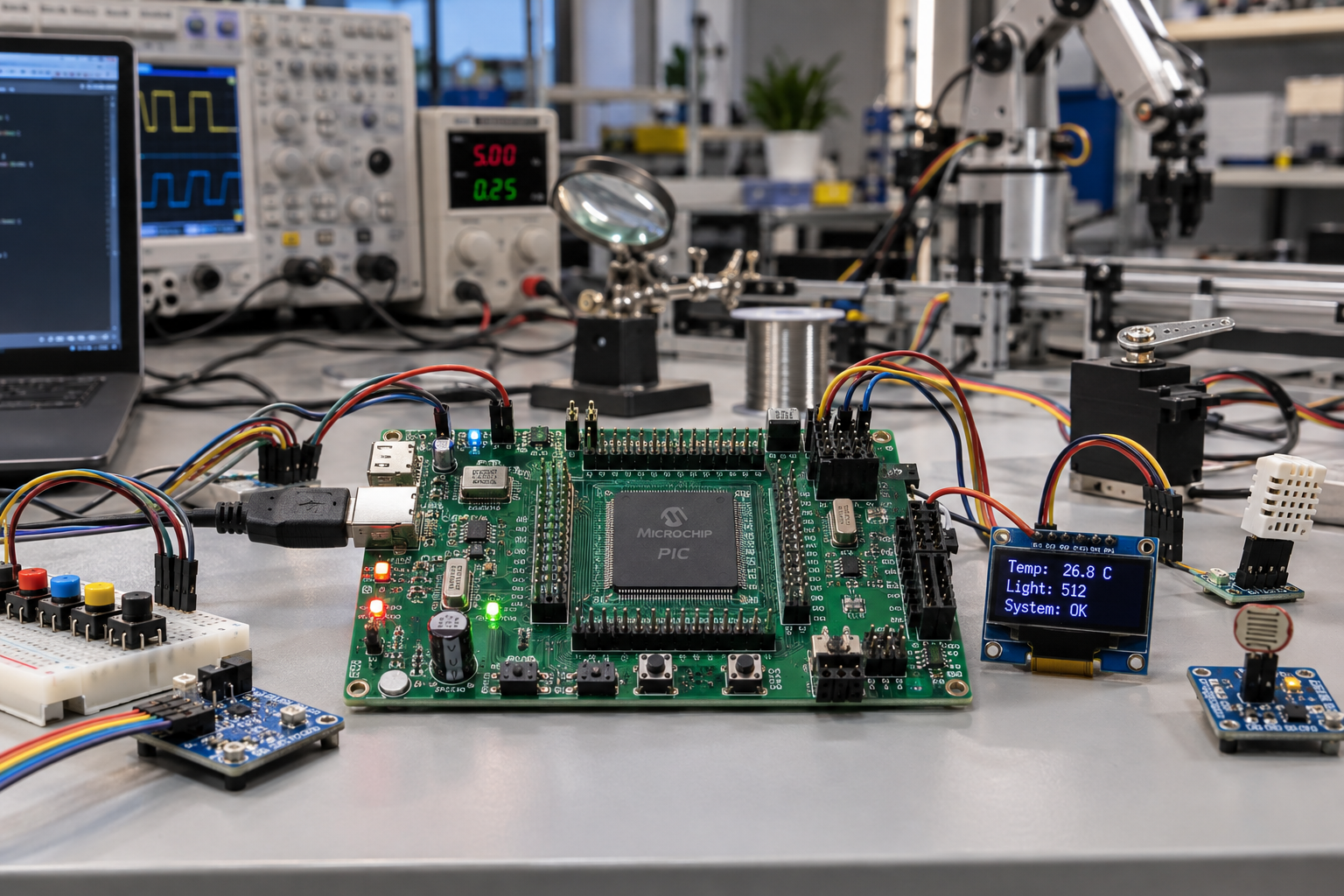
A PIC microcontroller is a programmable integrated circuit developed by Microchip Technology for controlling electronic systems. It combines a processor core, memory input and output pins, timers, communication interfaces, and other peripherals inside a single chip.
PIC microcontrollers are widely used in embedded systems because they can directly interact with sensors, switches, displays motors, communication modules, and other electronic components. The PIC family includes devices designed for simple control tasks as well as more advanced embedded applications.
What Does PIC Mean?
PIC originally referred to a programmable interface controller. The name became associated with Microchip family of programmable microcontrollers and is now widely recognized as the PIC microcontroller platform.
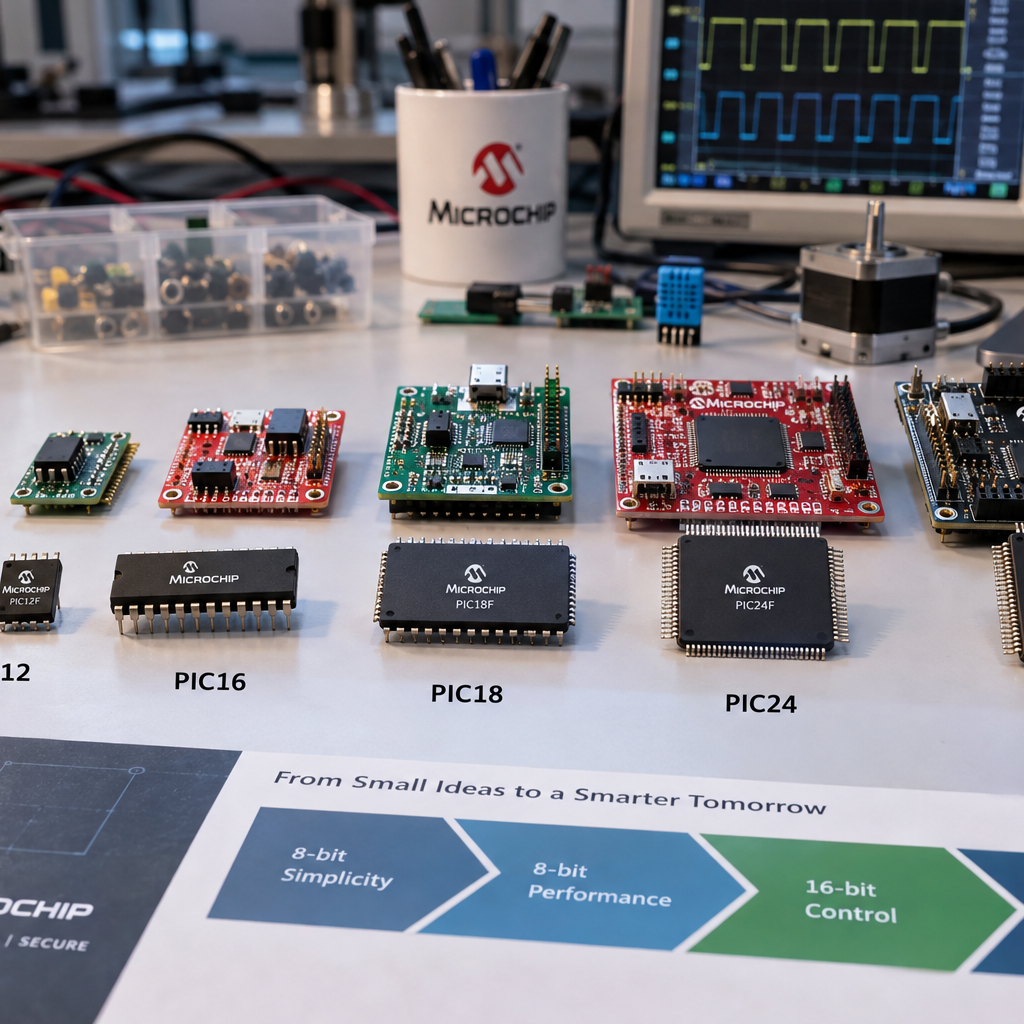
Microchip offers several PIC families with different architectures, memory sizes, peripheral options, package types, and performance levels. Popular 8 bit families include PIC10, PIC12, PIC16, and PIC18. Microchip also offers 16 bit PIC24 and dsPIC devices for applications that require additional processing and control capabilities.
How Does a PIC Microcontroller Work?
A PIC microcontroller works by executing firmware stored in its program memory. The firmware tells the processor how to read inputs process information, and control outputs.
For example, a temperature monitoring system can connect a temperature sensor to an analog input. The PIC microcontroller reads the sensor signal through an analog to digital converter and converts it into a digital value. The program can then compare the measurement with a defined condition and control an LED, display, fan, relay, or other output.
The same basic process can be used in robotics, industrial automation, consumer electronics, measurement equipment, security systems, and sensor based devices.
PIC Microcontroller Families
The PIC platform includes several families designed for different embedded applications.
PIC10 devices are intended for compact applications that require a small number of inputs and outputs and limited processing resources.
PIC12 devices provide additional features while maintaining a compact design suitable for small embedded products.
PIC16 is one of the most widely used PIC families. Many PIC16 devices include timers, ADC, PWM, communication interfaces, and configurable peripherals.
PIC18 devices generally provide more resources and advanced features within the 8 bit PIC family. They are suitable for applications that need greater memory, communication capability, and peripheral functionality.
PIC24 and dsPIC devices extend the PIC ecosystem into 16 bit applications. They are used in applications that require higher processing capability and more advanced digital control functions.
Why Is the PIC Microcontroller Important?
PIC microcontrollers have been widely used in embedded electronics because Microchip provides a large selection of devices for different applications. Engineers can select a PIC device according to the required processing capability, memory, GPIO count, analog features, communication interfaces, power requirements, and package size.
This flexibility makes the PIC platform useful for both simple electronic controllers and more advanced embedded systems.
Wide Range of Microcontroller Options
One of the important characteristics of the PIC ecosystem is the large number of available microcontroller options.
A simple electronic product may only need a few GPIO pins, a timer, an ADC, and a small amount of program memory. A more advanced controller may require multiple communication interfaces, PWM outputs, larger memory, and additional hardware peripherals.
The different PIC families allow engineers to choose a device that matches the requirements of a particular project instead of using the same microcontroller for every design.
Integrated Peripherals
PIC microcontrollers can integrate many hardware functions directly into the chip.
Depending on the specific device, these functions can include analog to digital converters, timers, PWM modules, UART, SPI, I2C, comparators, USB, CAN, and other peripherals.
Having these functions inside the microcontroller can reduce the number of external components required in an electronic design. It can also simplify the connection between the processor and external hardware.
Core Independent Peripherals
Many modern Microchip microcontrollers include Core Independent Peripherals. These hardware peripherals can perform specific tasks with limited involvement from the main processor.
For example, a peripheral can handle a timing, signal generation, or control function while the processor works on another part of the application. This can help reduce processor workload and improve the responsiveness of an embedded system.
The available Core Independent Peripherals depend on the specific PIC device, so the datasheet should always be checked when selecting a microcontroller for a project.
Suitable for Embedded Control
PIC microcontrollers are designed for embedded control applications where a processor needs to continuously monitor inputs and control outputs.
A PIC can read buttons, switches, sensors, and analog signals while controlling LEDs, motors, displays, relays, and other devices.
This makes PIC microcontrollers suitable for robotics, industrial control, home appliances, electronic instruments, security equipment, and many other embedded products.
Development and Programming Ecosystem
Microchip provides a development ecosystem for designing, programming, and debugging PIC based applications.
MPLAB X IDE provides an environment for creating firmware projects, writing source code, building applications, and working with compatible debugging and programming hardware.
Microchip also provides development boards and programming tools that help engineers test PIC microcontrollers before creating a custom PCB.
PIC Microcontroller Architecture Explained
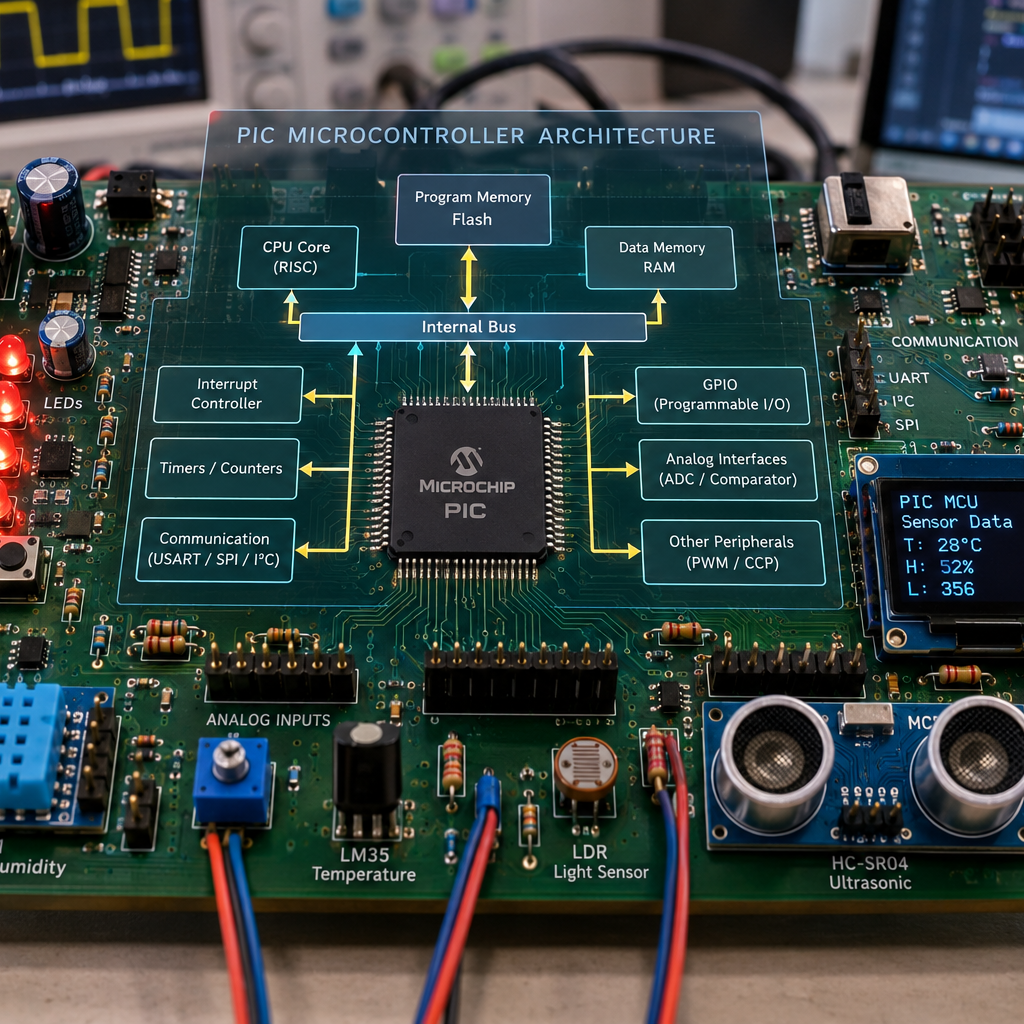
PIC architecture describes how the processor core, program memory, data memory, registers, buses, GPIO, and peripheral modules work together.
The exact architecture is different across PIC families, so the specifications of one PIC device should not automatically be applied to another. However, several architectural concepts are important for understanding the platform.
Many 8 bit PIC microcontrollers use a Harvard architecture in which program memory and data memory are separated.
Harvard Architecture
Harvard architecture separates program instructions from data.
The microcontroller stores program instructions in program memory while variables and temporary data are handled through data memory. Separate memory paths can allow the processor to access instructions and data efficiently.
This architecture is used across many PIC devices, although the exact implementation depends on the specific family.
Understanding the memory architecture is useful when developing firmware because it affects how programs access instructions, variables, registers, and peripherals.
Processor Core
The processor core executes the instructions contained in the firmware.
It performs arithmetic operations, logical operations, data movement, decisions, and control operations. The processor also interacts with peripheral registers to configure and control hardware features.
Different PIC families use different processor implementations. For this reason, clock speed, instruction architecture, memory organization, and processing capabilities can vary significantly between devices.
Program Memory
Program memory stores the firmware that controls the PIC microcontroller.
Modern PIC devices commonly use Flash memory for program storage. Flash memory allows firmware to be programmed electrically and makes it practical to update the program during development.
The amount of program memory depends on the particular PIC family and device. Smaller microcontrollers may provide limited memory for simple control programs, while more advanced devices provide substantially more space for complex firmware.
Data Memory
Data memory provides storage for variables, temporary calculations, registers, and other information required while the program is running.
PIC devices organize their data memory according to the architecture of the specific family. Peripheral control registers are also associated with the device’s memory structure.
Efficient use of data memory becomes increasingly important as an embedded application grows because firmware needs enough working space for variables and peripheral operations.
GPIO and Peripheral Connections
General purpose input and output pins allow a PIC microcontroller to communicate directly with external electronic hardware.
A GPIO pin can be configured as an input to read a button, switch, or digital sensor. It can also be configured as an output to control an LED, relay driver, or other digital circuit.
Many PIC devices provide multifunction pins. A single physical pin may support GPIO as well as functions such as analog input, PWM, timer operation, UART, SPI, or I2C.
This flexibility allows designers to use the available pins efficiently, especially when developing compact electronic products.
Analog and Digital Functions
PIC microcontrollers can combine digital processing with analog hardware functions.
An analog to digital converter allows the microcontroller to read varying electrical signals from sensors. This is useful for measuring temperature, light, pressure, battery voltage, position, and other physical conditions.
Digital peripherals work with defined logic states and can be used to control switches, LEDs, communication signals, and other digital hardware.
The combination of analog and digital capabilities makes PIC microcontrollers useful for systems that interact directly with the physical world.
Timers and Interrupts
Timers provide hardware based timing functions inside the microcontroller.
They can generate timing intervals, measure signals, support PWM operations, and control periodic tasks.
Interrupts allow the processor to respond to important hardware events without continuously checking every peripheral. For example, an interrupt can notify the processor when a timer reaches a specific value or when new communication data arrives.
These features are important for embedded applications that require accurate timing and fast responses.
Key Features of PIC Microcontrollers
PIC microcontrollers offer a wide range of hardware features, but the exact specifications depend on the family and individual device. Common features include GPIO, analog to digital conversion, timers, PWM, serial communication, memory, and power management functions.
These features allow a single microcontroller to handle sensing, processing, communication, and control tasks within an embedded system.
GPIO and Digital I/O
General purpose input and output pins are among the most important features of a PIC microcontroller.
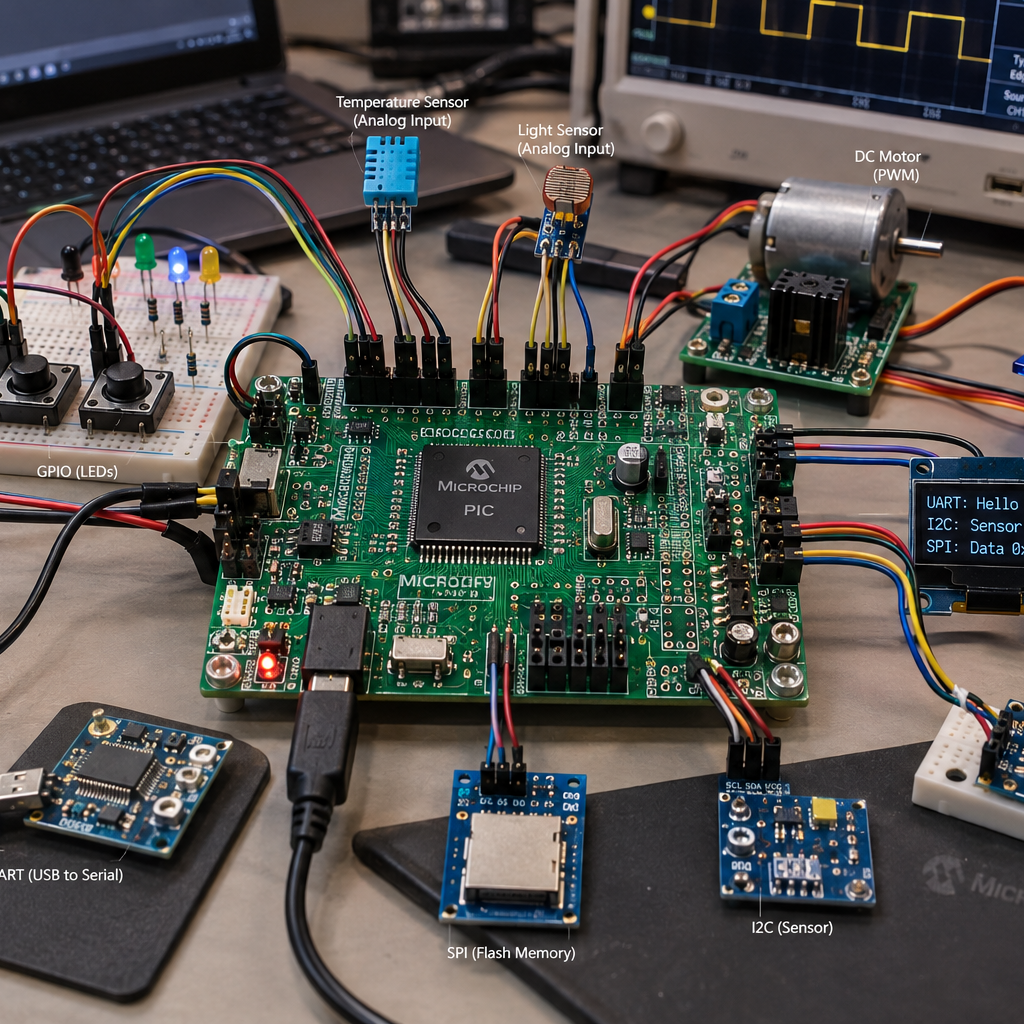
GPIO pins can be configured as inputs for reading switches, buttons, digital sensors, and external signals. They can also operate as outputs for controlling LEDs, relays, displays, motor drivers, and other electronic circuits.
Many PIC devices use multifunction pins, allowing one physical pin to support different hardware functions. The available GPIO count and alternate functions depend on the selected device.
Analog to Digital Converter
Many PIC microcontrollers include an analog to digital converter, commonly called an ADC.
An ADC converts an analog voltage into a digital value that the processor can read. This allows the microcontroller to work with sensors and other analog signals.
For example, an ADC can be used to measure temperature sensor output, battery voltage, light intensity, pressure, or a potentiometer position.
The ADC resolution and number of analog channels vary between PIC devices, so the specific datasheet should be checked before designing a circuit.
PWM and Timers
Pulse width modulation, or PWM, allows a PIC microcontroller to generate controlled digital waveforms.
PWM can be used for applications such as motor speed control, LED brightness adjustment, servo control, and power management.
Timers provide hardware based timing functions and can be used to generate precise intervals, measure events, control periodic operations, and support other peripherals.
Using hardware timers and PWM reduces the need to create timing functions entirely through software.
UART, SPI and I2C
PIC microcontrollers can provide several serial communication interfaces depending on the device.
UART is commonly used for communication between a microcontroller and devices such as computers, displays, GPS modules, and other serial equipment.
SPI provides a high speed synchronous interface that can connect the microcontroller with displays, memory devices, sensors, and other peripherals.
I2C uses a two wire communication system and is useful when multiple compatible sensors or peripheral devices need to share the same communication bus.
The exact communication interfaces available depend on the PIC model.
Memory Options
PIC microcontrollers provide different types and amounts of memory depending on the device.
Flash program memory stores the firmware that the microcontroller executes. RAM provides temporary storage for variables and calculations during operation.
Some PIC devices also provide EEPROM or other nonvolatile data storage for information that needs to remain available when power is removed.
Memory capacity is an important consideration when selecting a PIC because firmware size, data requirements, and application complexity can vary significantly.
Low Power Features
Many PIC microcontrollers include features designed to reduce power consumption.
Low power operating modes can be useful for battery powered products, portable electronics, remote sensors, and other systems that spend long periods waiting for an event.
The available sleep modes, wake up features, clock options, and power consumption levels vary between devices. Engineers should therefore examine the electrical specifications of the exact PIC model when designing a low power system.
PIC Microcontroller Families Explained
Microchip offers multiple PIC families rather than a single universal PIC architecture. Each family is designed around different performance levels, memory requirements, peripheral capabilities, and application needs.
Understanding the major families makes it easier to identify the type of PIC microcontroller that may fit a particular embedded project.
PIC10
PIC10 microcontrollers are compact devices designed for applications with limited hardware and processing requirements.
Their small package options make them useful when PCB space is limited. They can be used for simple control functions, small sensors, switches, indicators, and other compact electronic products.
PIC10 devices are particularly useful when a project does not require the resources of a larger microcontroller.
PIC12
PIC12 microcontrollers provide a step up from the smallest PIC devices while maintaining a compact form factor.
They can provide additional GPIO and peripheral capabilities for small embedded applications. Typical uses can include simple controllers, sensor interfaces, consumer electronics, and compact automation functions.
The exact memory, peripherals, and pin configuration depend on the selected PIC12 device.
PIC16
PIC16 is one of the most recognized PIC microcontroller families.
PIC16 devices are available in many configurations and can include features such as ADC, PWM, timers, communication interfaces, configurable peripherals, and different memory capacities.
They are used across education, prototyping, industrial control, consumer electronics, and embedded products.
The PIC16 family also includes different architectural generations, so specifications should be checked for the exact device rather than assumed across the entire family.
PIC18
PIC18 devices generally provide greater resources within the 8 bit PIC ecosystem.
Depending on the model, PIC18 microcontrollers can provide larger memory capacities, more advanced communication interfaces, enhanced peripherals, and additional hardware features.
They are suitable for embedded applications that require more resources than a small PIC10, PIC12, or basic PIC16 device can provide.
PIC18 devices can be used in industrial equipment, communication systems, consumer products, robotics, and other embedded applications.
PIC24 and dsPIC
PIC24 and dsPIC families extend Microchip’s microcontroller portfolio into 16 bit processing.
PIC24 devices are designed for applications that require additional processing and memory capabilities compared with many 8 bit PIC devices.
dsPIC devices combine microcontroller functionality with specialized digital signal processing capabilities. This makes them suitable for applications involving motor control, power conversion, audio processing, and other computationally intensive embedded tasks.
These families should be considered separately from the 8 bit PIC10, PIC12, PIC16, and PIC18 families because their architectures and intended applications are different.
How to Program a PIC Microcontroller
Programming a PIC microcontroller involves writing firmware that defines how the processor interacts with its hardware. Developers typically create the source code, compile it into machine instructions, program the resulting firmware into the microcontroller, and then test and debug the system.
Microchip provides an integrated development ecosystem for this process, including software tools, compilers, programmers, debuggers, and development boards.
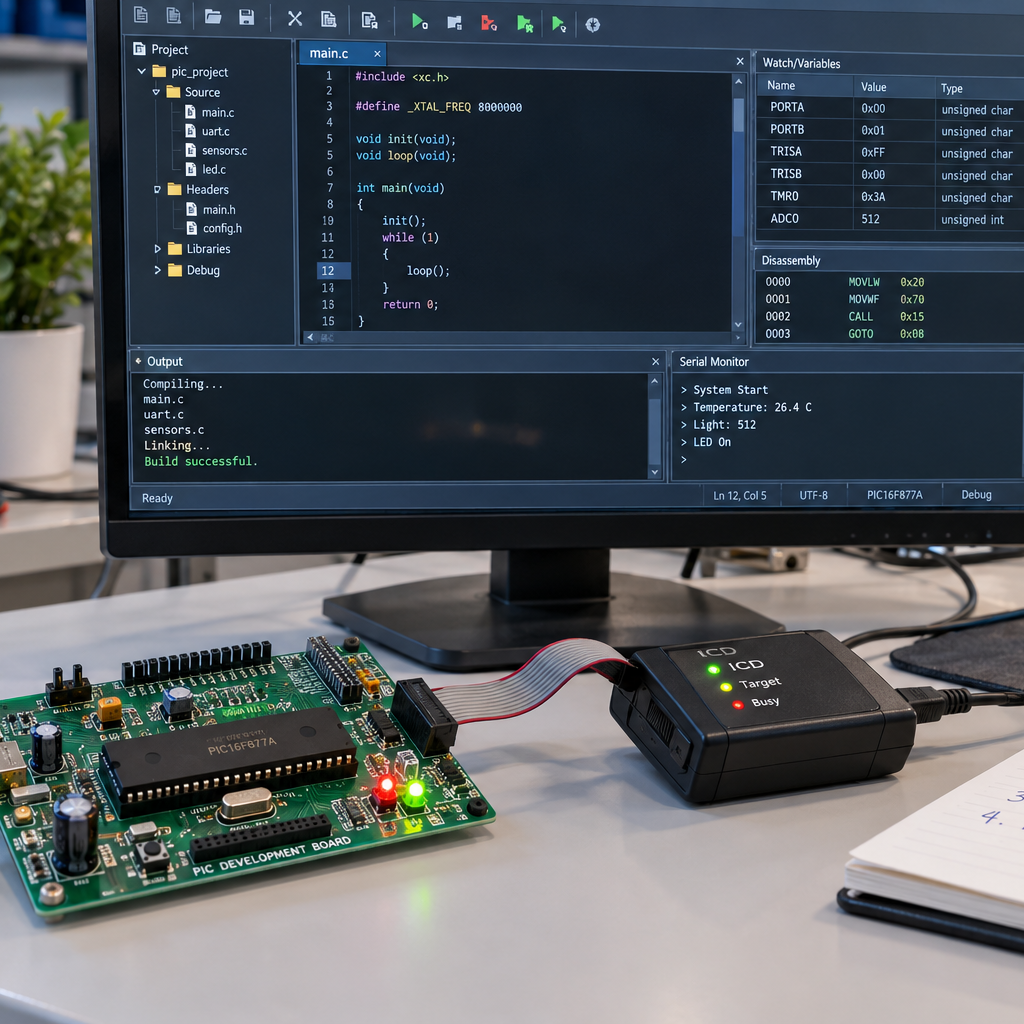
MPLAB X IDE
MPLAB X IDE is Microchip’s integrated development environment for supported microcontrollers.
It provides tools for creating projects, editing source code, compiling firmware, configuring development settings, and working with compatible programming and debugging hardware.
The IDE can be used with different Microchip device families and development tools, although the exact features available depend on the selected device and development environment.
C Programming
C is widely used for PIC microcontroller firmware because it allows developers to work with hardware registers and peripherals while maintaining a practical level of abstraction.
A typical PIC program may configure GPIO pins, initialize timers, set up ADC channels, communicate through UART or I2C, and continuously process sensor or control data.
The structure of the code depends on the PIC family, compiler, libraries, and development approach being used.
MPLAB XC Compilers
Microchip provides the MPLAB XC family of compilers for supported microcontrollers.
These compilers translate C source code into machine code that can run on the selected microcontroller architecture.
Different XC compiler versions and configurations support different Microchip device families. The correct compiler should therefore be selected according to the target PIC device.
Programming and Debugging Hardware
A PIC microcontroller needs compatible hardware for programming and debugging during development.
Microchip provides tools such as PICkit programmers and debuggers for supported devices. These tools can transfer firmware to the microcontroller and provide debugging functions during development.
Development boards can also simplify testing because they provide a ready made platform with the microcontroller, power connections, programming interface, and access to important pins.
Firmware Development Process
A typical PIC development process begins by selecting a suitable microcontroller according to the required memory, GPIO, peripherals, package, and power requirements.
The developer then creates a project in the development environment and writes the firmware. After compilation, the generated program is transferred to the microcontroller through compatible programming hardware.
The system is then tested with the connected sensors, actuators, and other peripherals. Debugging tools can help identify firmware or hardware problems before the final product is manufactured.
PIC Microcontroller Development Boards
PIC development boards provide a practical way to test a microcontroller before designing a custom circuit. They usually provide the microcontroller, power connections, programming interface, and access to important input and output pins on a single platform.
For beginners, development boards make it easier to learn PIC programming and experiment with peripherals. For experienced developers, they can speed up firmware testing and hardware evaluation.
PIC Development Boards
A PIC development board typically provides a PIC microcontroller together with supporting hardware needed for development.
Depending on the board, it may include LEDs, push buttons, communication connectors, sensors, expansion headers, or other peripheral circuits. These features allow developers to test different functions without building every supporting circuit from scratch.
Development boards can be especially useful when evaluating GPIO, ADC, PWM, timers, and communication interfaces before moving to a custom PCB.
Microchip Curiosity Development Boards
Microchip Curiosity development boards are designed to provide a convenient platform for working with supported Microchip microcontrollers.
Different Curiosity boards target different device families, so the available hardware and features depend on the specific board. Some provide integrated programming and debugging capabilities, reducing the amount of external hardware needed during development.
PICkit Programmers and Debuggers
PICkit tools are used with compatible Microchip devices for programming and debugging.
A programmer can transfer compiled firmware into the microcontroller’s program memory. Debugging capabilities can also allow developers to inspect program execution and identify problems during firmware development.
Prototyping With PIC Microcontrollers
A development board can shorten the early stages of an embedded project.
Instead of immediately designing a complete custom PCB, developers can first connect sensors, displays, motors, switches, and communication modules to a development platform. This makes it easier to test firmware and verify that the selected PIC provides the required hardware resources.
What Are PIC Microcontrollers Used For?
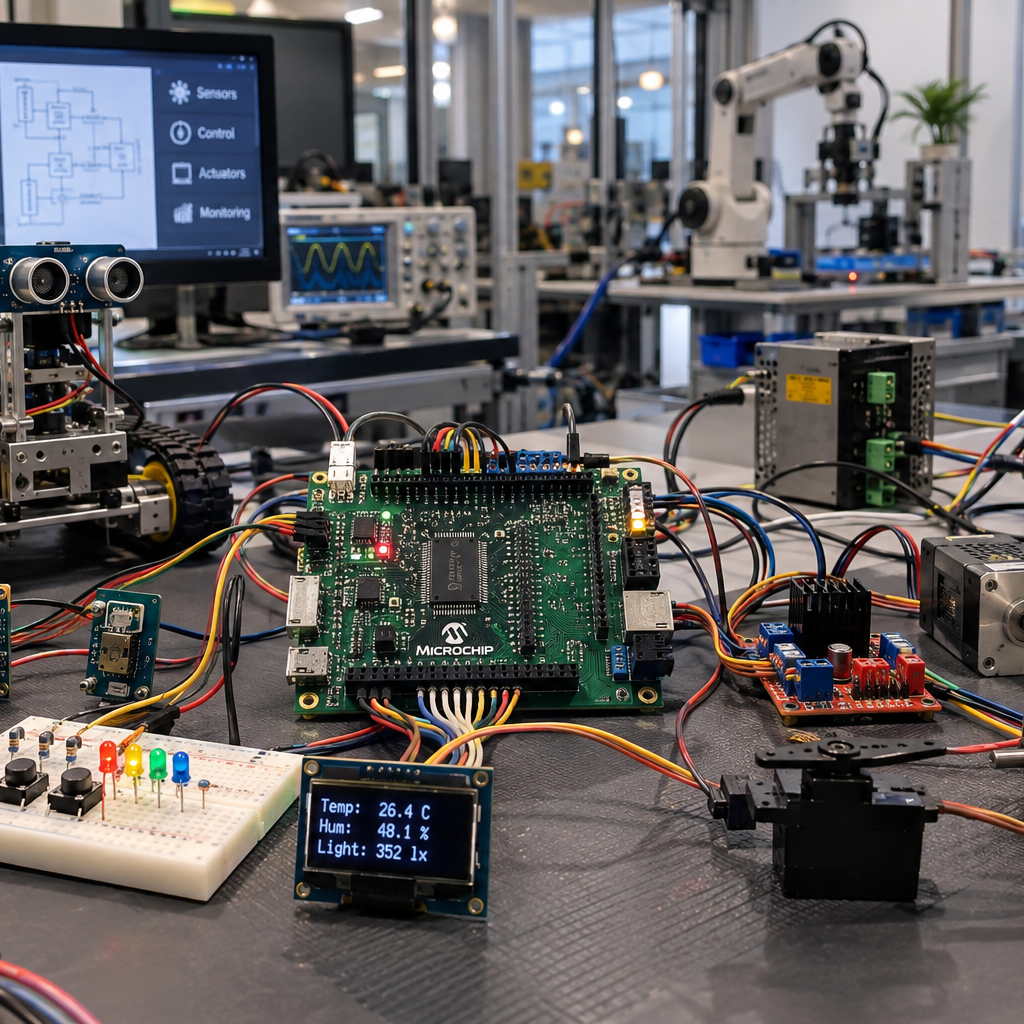
PIC microcontrollers are used in a wide range of embedded applications where electronic hardware needs programmable control.
Their combination of processing, GPIO, analog functions, timers, communication interfaces, and configurable peripherals allows them to interact with both simple electronic circuits and more complex embedded systems.
Robotics
PIC microcontrollers can be used in robotic systems for reading sensors and controlling motors, servos, indicators, and other hardware.
A PIC can process signals from position sensors, switches, distance sensors, or other inputs and then generate control signals for motor drivers or actuators.
Industrial Automation
PIC devices can be used in industrial control systems where a microcontroller needs to monitor inputs and control outputs.
Applications can include control panels, monitoring equipment, small automation controllers, sensor interfaces, and machine control subsystems.
IoT and Sensor Systems
PIC microcontrollers can serve as controllers in sensor based devices.
A sensor system can use the ADC to measure analog signals while GPIO handles digital sensors and external control signals.
Motor Control
Motor control systems often require precise timing and controlled output signals.
PIC microcontrollers with PWM and timer peripherals can generate signals used by external motor driver circuits. The processor can also monitor feedback signals and adjust control parameters according to the application.
Consumer Electronics
PIC microcontrollers can be found in embedded consumer products where dedicated control is required.
They can handle functions such as button input, display control, sensor monitoring, power management, timing, and communication with other electronic components.
Because the required hardware resources vary greatly between products, different PIC devices can be selected according to the design requirements.
Measurement and Control Systems
PIC microcontrollers are useful for electronic measurement systems because many devices combine analog and digital peripherals.
An ADC can measure signals from sensors, while timers and communication interfaces can process and transmit the resulting data.
This approach can be used in instruments, monitoring systems, environmental devices, laboratory equipment, and other applications that need programmable measurement and control.
Advantages and Limitations of PIC Microcontrollers
PIC microcontrollers offer a broad range of features and device options, but they also have limitations that should be considered before selecting a particular model.
The suitability of a PIC depends on the application rather than on the family name alone. Engineers should compare the exact device specifications with the project’s hardware and software requirements.
Advantages of PIC Microcontrollers
One major advantage is the wide selection of devices available across different PIC families. Designers can choose from compact microcontrollers for simple applications to more capable devices with larger memory and advanced peripherals.
Another advantage is the integration of hardware peripherals. Depending on the device, features such as ADC, PWM, timers, communication interfaces, and configurable peripherals can reduce the need for external components.
Microchip also provides a development ecosystem that includes development boards, programming tools, debugging hardware, software tools, and documentation.
Limitations of PIC Microcontrollers
The large number of PIC families and device variants can make the platform confusing for beginners. Two PIC microcontrollers with similar names may have significantly different memory sizes, peripherals, pin configurations, and programming requirements.
Another consideration is that firmware written for one PIC family may require changes when moved to another architecture or device.
The development process can also require learning Microchip specific tools, device configuration, compiler settings, programming hardware, and peripheral registers.
For this reason, selecting the exact PIC device before starting hardware and firmware development is important.
Frequently Asked Questions About PIC Microcontrollers
PIC microcontrollers are available in many families and configurations, which can lead to common questions about their architecture, programming, applications, and capabilities.
What Is a PIC Microcontroller?
A PIC microcontroller is a programmable embedded controller developed by Microchip Technology. It combines processing, memory, GPIO, and hardware peripherals in a single integrated circuit.
Is PIC a Microcontroller?
PIC is a family of microcontrollers rather than one specific microcontroller model.
Microchip produces multiple PIC families, including PIC10, PIC12, PIC16, PIC18, PIC24, and dsPIC devices. Each family targets different levels of performance and application requirements.
What Is PIC Used For?
PIC microcontrollers are used in embedded control applications such as robotics, industrial automation, sensor systems, consumer electronics, motor control, measurement equipment, and custom electronic products.
Which PIC Microcontroller Is Best for Beginners?
There is no single PIC device that is suitable for every beginner.
A beginner can start with a PIC development board that provides easy access to the microcontroller and its programming interface. PIC16 and PIC18 devices are commonly encountered in educational and embedded development projects, but the appropriate device depends on the features being learned.
Can PIC Microcontrollers Be Programmed in C?
Yes. C is widely used for PIC firmware development.
Developers can write C programs that configure GPIO, timers, ADC, PWM, communication interfaces, and other peripherals.
What Software Is Used to Program PIC Microcontrollers?
MPLAB X IDE is a major development environment used for supported Microchip microcontrollers.
Developers can use it to create projects, write firmware, compile programs, and work with compatible programming and debugging tools.
What Is the Difference Between PIC16 and PIC18?
PIC16 and PIC18 are different families within Microchip’s 8 bit PIC ecosystem.
PIC16 includes a broad range of devices with different memory sizes and peripherals. PIC18 generally provides additional resources and features in devices intended for applications requiring more capability.
Does PIC Support ADC and PWM?
Yes, many PIC microcontrollers support both ADC and PWM.
ADC allows the microcontroller to read analog signals from sensors and other circuits. PWM can generate controlled output waveforms for applications such as motor control, LED brightness adjustment, and other embedded control tasks.
Conclusion
PIC microcontrollers have remained an important part of embedded electronics because the Microchip portfolio provides devices for a wide range of control and sensing applications. From compact PIC10 and PIC12 devices to widely used PIC16 and PIC18 families, the platform includes options for different memory, GPIO, processing, and peripheral requirements.
The PIC architecture combines a processor core with program memory, data memory, GPIO, timers, analog functions, PWM, and communication interfaces. Depending on the device, additional capabilities such as Core Independent Peripherals can provide hardware based functions with less processor involvement.
Sources
- Microchip Technology — 8 bit PIC Microcontrollers
- Microchip Technology — Microcontrollers
- Microchip Technology — MPLAB XC Compilers
- Microchip Technology — Development Tools
- Microchip Technology — Curiosity Development Boards
- Microchip Technology — Development Boards and Hardware
- Microchip Developer Help — Microcontroller Development Boards