
What Is an AVR Microcontroller?
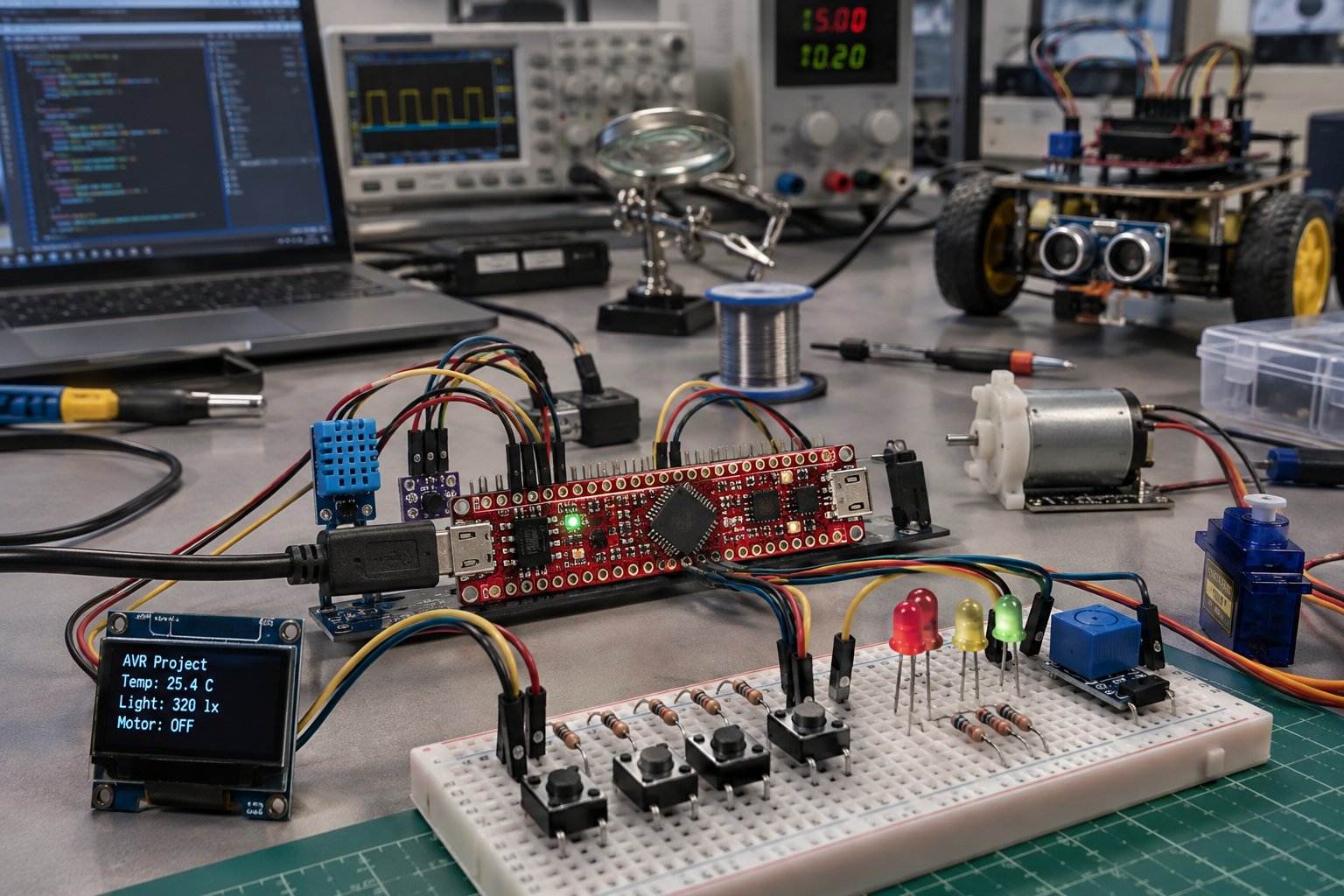
An AVR microcontroller is an 8 bit microcontroller family developed by Microchip for embedded systems that need efficient processing, low power operation, and flexible hardware control. An AVR MCU combines a processor core, memory, GPIO, timers, communication interfaces, and other peripherals inside a single chip.
This integrated design allows one microcontroller to handle many tasks without requiring separate control circuits for every function. An AVR can read sensors, process input data, control LEDs and motors, communicate with other devices, and respond to external events through programmed firmware. Microchip describes its 8 bit AVR portfolio as providing performance, power efficiency, flexibility, and customizable peripherals for embedded applications.
What Does AVR Mean?
AVR refers to a family of microcontrollers built around the AVR architecture. Microchip offers AVR devices in different families and configurations, so the term does not identify one particular chip.
Different AVR models can provide different amounts of Flash memory, SRAM, GPIO pins, analog peripherals, timers, communication interfaces, and package options. This range allows engineers to select a device based on the requirements of a specific embedded project.
Classic AVR devices became widely known for their efficient architecture and strong support for C programming. Modern AVR families continue that foundation while adding more configurable peripherals and hardware functions.
How Does an AVR Microcontroller Work?
An AVR microcontroller executes firmware stored in its program memory. The CPU fetches instructions, processes data through its registers and arithmetic logic unit, and controls peripherals according to the program.
For example, a temperature monitoring system can use an AVR to read an analog sensor through an ADC. The firmware can process that measurement and activate a fan through a digital output or PWM signal when the temperature reaches a defined level.
The same MCU can communicate with another device through interfaces such as USART, SPI, or TWI. This combination of processing and hardware control makes AVR microcontrollers useful in many embedded systems.
Why Are AVR Microcontrollers Important?
AVR microcontrollers remain important in embedded electronics because they combine processing, memory, and peripheral control in a compact device. Microchip’s current AVR portfolio focuses on performance, power efficiency, flexibility, and customizable peripherals for embedded applications.
Efficient Embedded Control
An AVR can monitor inputs and control outputs directly from its firmware. GPIO pins can read switches and sensors or control LEDs, relays, and other digital devices. Timers can generate precise timing signals, while interrupts allow the CPU to respond quickly to important events.
The AVR CPU also uses a modified Harvard architecture with separate program and data memories and buses. Its register file contains 32 general purpose 8 bit working registers, which gives the processor fast access to frequently used data.
This architecture supports efficient instruction execution while keeping the hardware suitable for compact embedded designs.
Flexible Peripheral Integration
Modern AVR devices include much more than a basic processor and GPIO. Depending on the family, an AVR can include ADCs, DACs, analog comparators, timers, serial communication interfaces, Event System channels, and Configurable Custom Logic.
For example, the AVR DA family includes a 12 bit differential ADC, DAC, Event System, Configurable Custom Logic, and Peripheral Touch Controller. These hardware features can reduce the need for external components and allow the MCU to handle more functions directly.
The AVR EA family also combines advanced analog features with hardware based Core Independent Peripherals. Its feature set includes a 12 bit ADC, programmable gain amplifier, DAC, timers, USART, SPI, TWI, Event System, and Configurable Custom Logic.
Power Efficient Operation
Power consumption matters in battery powered sensors, portable electronics, and devices that remain active for long periods. AVR families include low power features that help developers balance processing requirements with energy consumption.
Actual power usage depends on the specific AVR device, clock configuration, supply voltage, active peripherals, and operating mode. Engineers should therefore use the relevant device datasheet when calculating power requirements for a finished product.
Architecture of an AVR Microcontroller
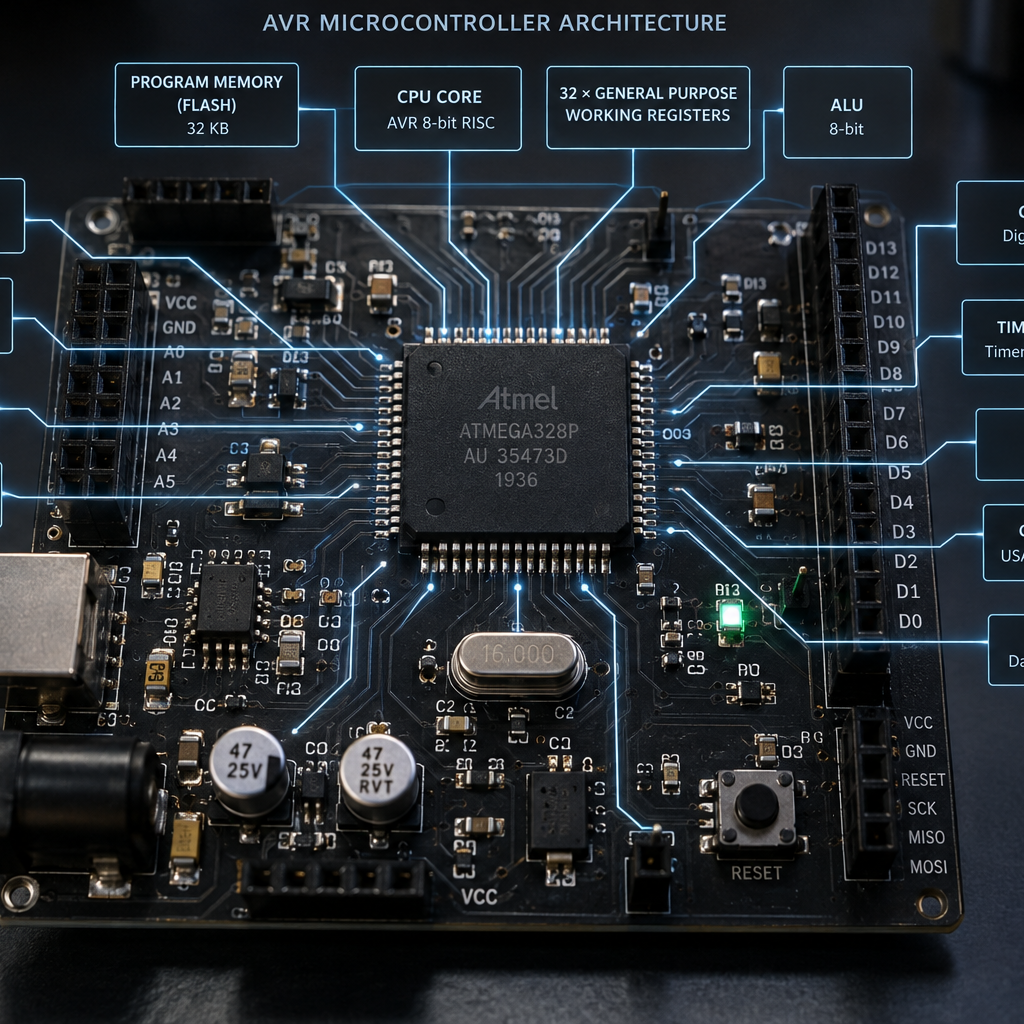
The 8 bit AVR architecture uses a modified Harvard design with separate program and data memories and buses. This arrangement allows the CPU to fetch instructions from program memory while working with data through the data memory system.
AVR CPU Core
The CPU core controls program execution, calculations, memory access, peripheral operation, and interrupt handling.
A classic AVR CPU includes 32 general purpose 8 bit working registers. The ALU performs arithmetic and logical operations using these registers, while the processor uses pointer registers for efficient data addressing. Microchip states that the AVR core uses single level instruction pipelining, allowing the CPU to prefetch the next instruction while it executes the current one.
This register based design helps AVR devices execute common embedded control operations efficiently.
Program and Data Memory
AVR microcontrollers use Flash memory to store firmware. SRAM provides temporary working memory for variables, calculations, and runtime data. Many AVR devices also include EEPROM for storing nonvolatile information that must remain available after power is removed.
Memory capacity varies between AVR families and individual devices. For example, the current AVR EA family includes devices with 16 KB, 32 KB, or 64 KB of Flash memory, while newer AVR DA devices extend to configurations with up to 128 KB of Flash.
GPIO and Peripherals
GPIO provides the connection between the AVR and external electronics. Firmware can configure pins as digital inputs or outputs, while alternate pin functions can connect them to internal peripherals.
An AVR can therefore interact with switches, LEDs, sensors, displays, motor control circuits, and communication devices. The exact number and type of available peripherals depend on the specific device.
Key Features of AVR Microcontrollers
AVR microcontrollers combine processing, memory, digital I/O, analog functions, timers, communication interfaces, and control peripherals in a single device. The exact feature set depends on the AVR family and individual model, so engineers should always check the selected device’s datasheet before designing a circuit. Modern AVR families such as AVR DA and AVR EA also add hardware features that can handle some tasks without continuous CPU involvement.
GPIO
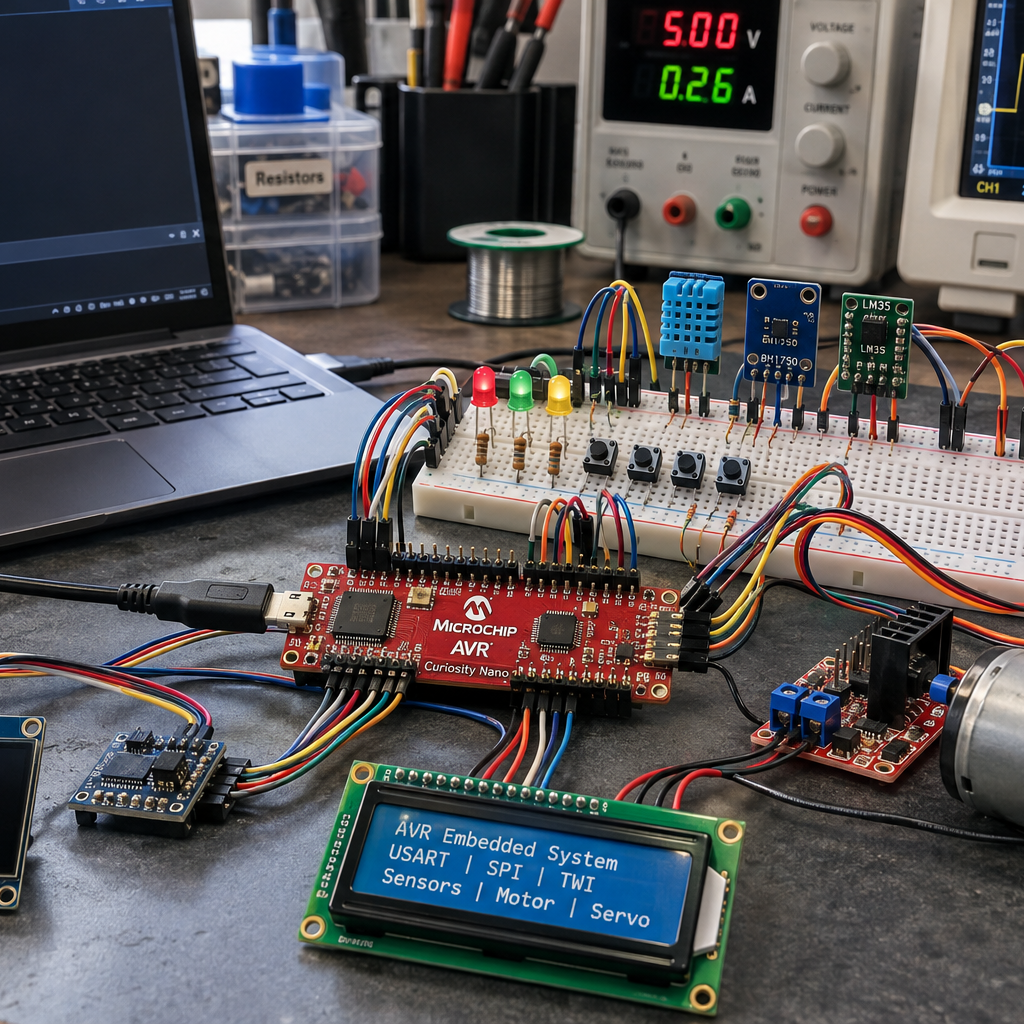
General purpose input/output (GPIO) pins provide the main connection between an AVR microcontroller and external hardware. Firmware can configure these pins as inputs for switches, buttons, and digital sensors or as outputs for LEDs, relays, displays, and control circuits.
Many AVR devices also assign alternate functions to their GPIO pins. A single physical pin can therefore connect to a timer, serial communication interface, analog peripheral, or another internal function depending on the device configuration.
This flexibility helps engineers build compact control systems without adding separate interface chips for every basic function.
ADC and Analog Functions
Analog to digital converters allow an AVR to measure changing voltage levels from sensors and other analog circuits. A firmware program can then process the converted value and use it for monitoring or control.
Modern AVR families provide increasingly capable analog hardware. For example, AVR DA devices include a 12 bit differential ADC and a 10 bit DAC, while AVR EA devices combine a 12 bit differential ADC with a programmable gain amplifier and a 10 bit DAC.
These features make newer AVR devices useful for sensor interfaces, measurement systems, closed loop control, and other applications that require direct interaction with analog signals.
Timers and PWM
Timers and counters provide accurate timing functions inside the microcontroller. Firmware can use them to create delays, measure signal timing, generate periodic events, or track external pulses.
Pulse width modulation (PWM) uses timer hardware to produce controlled digital waveforms. Engineers commonly use PWM for LED brightness control, motor control, actuator control, and other applications that require adjustable output levels.
Because timer hardware handles the timing independently, the CPU does not need to generate every PWM transition through software.
Communication Interfaces
AVR microcontrollers support several communication interfaces depending on the device. Common options include USART, SPI, and TWI, which is Microchip’s implementation of the two wire interface commonly associated with I2C systems.
These interfaces allow an AVR to communicate with sensors, displays, memory devices, motor controllers, computers, and other microcontrollers. Newer AVR families can also provide additional connectivity features. For example, AVR DU devices include full speed USB 2.0 functionality alongside USART, SPI, and TWI interfaces.
Interrupts
Interrupts allow the microcontroller to respond to important events without continuously checking every input through software. An external signal, timer event, communication event, or peripheral condition can trigger an interrupt.
The CPU temporarily handles the required interrupt routine and then returns to the main program. This approach helps embedded systems respond quickly while keeping the processor available for other tasks.
Flash, SRAM and EEPROM
AVR devices use different types of memory for different purposes. Flash memory stores firmware, SRAM holds temporary runtime data, and many AVR models provide EEPROM for nonvolatile user data.
Memory capacity varies across the product range. Current AVR DA devices, for example, can provide up to 128 KB of Flash and up to 16 KB of SRAM, while AVR EA devices offer configurations from 16 KB to 64 KB of Flash.
Low Power Features
Low power modes help AVR based systems reduce energy consumption when full processing power is unnecessary. Depending on the device, sleep modes can stop the CPU while selected peripherals continue operating.
AVR DA and AVR EA devices include Idle, Standby, and Power Down modes, allowing developers to select an operating state based on the application’s processing and power requirements.
Microchip AVR Microcontroller Families
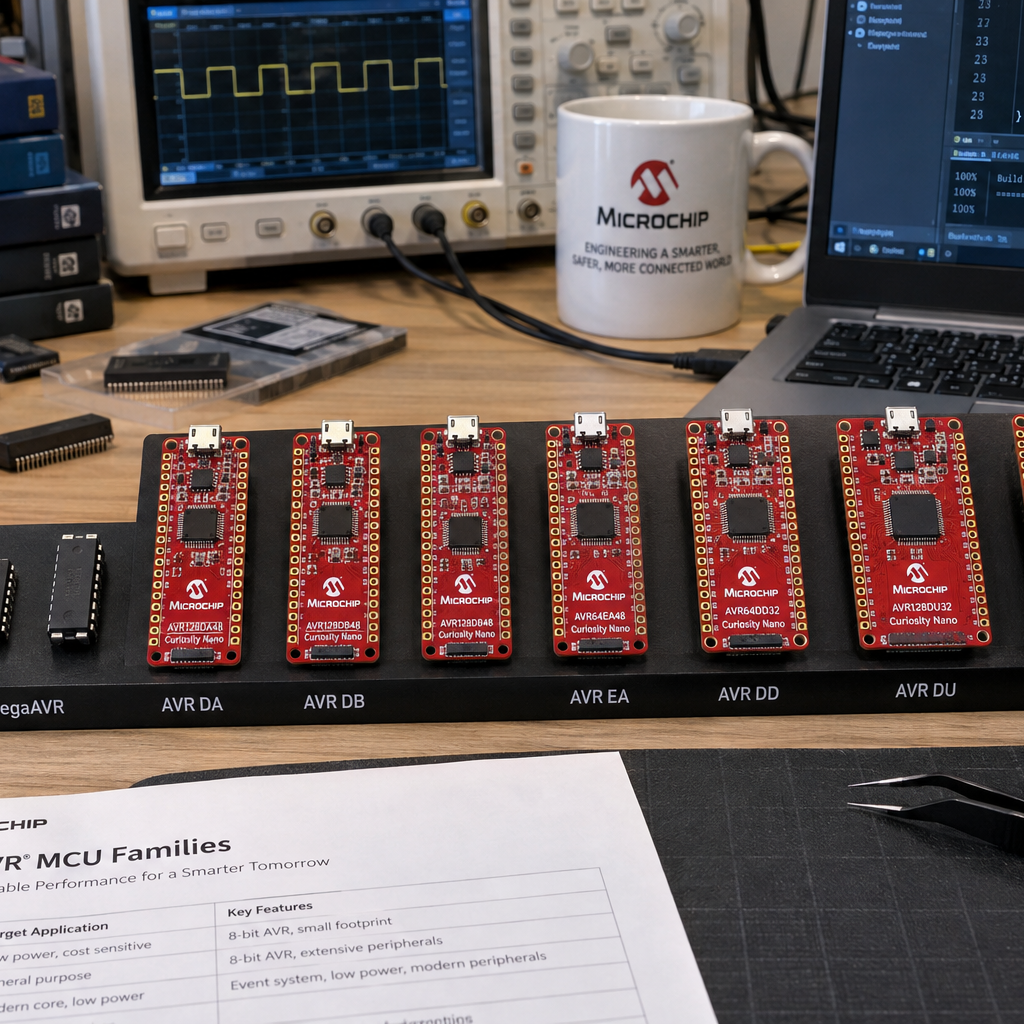
Microchip offers AVR microcontrollers in several families, with each family targeting different combinations of memory, analog capability, connectivity, control functions, and package options.
tinyAVR
tinyAVR devices target compact embedded applications where designers need a small MCU with essential processing and peripheral functions. Their compact packages make them suitable for space constrained electronics, simple control systems, sensors, and consumer products.
The exact memory, pin count, timers, communication interfaces, and analog capabilities depend on the selected tinyAVR model.
megaAVR
megaAVR devices have played an important role in the AVR ecosystem and provide a broader range of memory and peripheral capabilities than many compact AVR devices.
These MCUs suit applications that need more program memory, GPIO, timers, communication interfaces, or other peripherals while still using the familiar AVR architecture and development approach.
AVR DA
The AVR DA family targets real time control, connectivity, human machine interfaces, and analog intensive applications. It combines Core Independent Peripherals with features such as a 12 bit differential ADC, 10 bit DAC, Event System, Configurable Custom Logic, and Peripheral Touch Controller.
AVR DA devices can provide up to 128 KB of Flash and operate at up to 24 MHz. Microchip also offers the AVR128DA48 Curiosity Nano as a development platform for this family.
AVR EA
AVR EA devices focus on analog sensing, real time control, and monitoring applications. The family provides up to 64 KB of Flash and includes features such as a 12 bit differential ADC, programmable gain amplifier, DAC, analog comparators, timers, CCL, and Event System.
The integrated PGA can provide up to 16x gain, which helps the MCU work with smaller analog signals in applications where sensor signals may have low amplitude.
AVR DU
The AVR DU family adds USB functionality to the AVR platform. These devices provide USB 2.0 full speed device support along with Core Independent Peripherals, Event System, Configurable Custom Logic, ADC, timers, USART, SPI, and TWI.
This makes the family relevant to embedded products that need USB communication, firmware updates, USB bridges, or direct connection to USB hosts.
How to Program an AVR Microcontroller
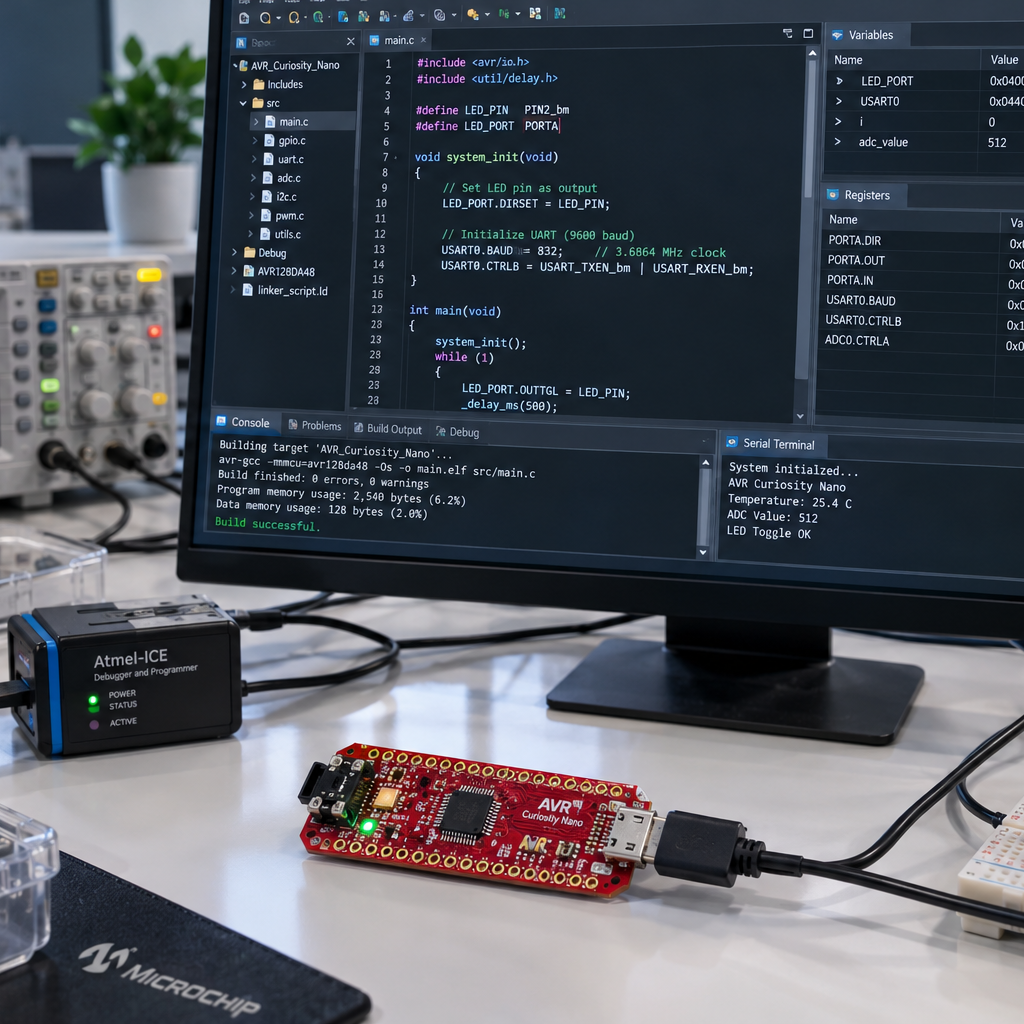
Programming an AVR involves writing firmware, compiling it into machine code, transferring that code to the MCU’s Flash memory, and debugging the application on the target hardware.
C Programming
C remains an important language for AVR firmware development because it provides direct control over registers, GPIO, timers, interrupts, and peripheral hardware while keeping code easier to maintain than pure assembly.
A typical AVR project starts by configuring the clock and GPIO, initializing required peripherals, and then implementing the main control logic. More advanced applications can combine interrupts, timers, communication interfaces, and analog peripherals within the same firmware.
MPLAB X IDE and Microchip Studio
Microchip supports AVR development through its software ecosystem, including MPLAB X IDE and Microchip Studio. Modern AVR development boards such as Curiosity Nano can integrate an onboard programmer and debugger, simplifying the connection between the development computer and target MCU.
The development environment can handle source code, compilation, programming, debugging, and project configuration. The exact software workflow depends on the AVR device and the development tools selected.
Programmer and Debugger
A programmer transfers compiled firmware into the AVR’s program memory, while a debugger allows developers to inspect and control firmware execution during development.
Curiosity Nano boards provide an onboard programmer/debugger, while Microchip also supports dedicated programming and debugging hardware within its AVR development ecosystem.
A typical development cycle therefore looks like this:
- Write the AVR firmware.
- Configure the required peripherals.
- Compile the project.
- Connect the AVR development hardware.
- Program the MCU.
- Test the circuit.
- Debug and modify the firmware.
- Program the updated version.
AVR Development Boards
AVR development boards make it easier to learn, test, program, and prototype AVR based embedded systems before moving to a custom PCB. Microchip provides several development platforms for AVR devices, including Curiosity Nano and Xplained boards. These platforms can provide onboard programming and debugging, USB connectivity, and access to the MCU’s peripherals.
Curiosity Nano
Curiosity Nano boards provide a compact development platform for selected AVR microcontrollers. The boards include programming and debugging capabilities, making it possible to connect the MCU to a computer without requiring a separate programmer for basic development work.
Microchip offers Curiosity Nano boards for several AVR families. Examples include the ATtiny1627, AVR128DA48, AVR64EA48, and AVR64DD32. The exact features vary by board, but typical boards provide the target MCU, user LED, user switch, headers, USB connectivity, and onboard debugging hardware.
The AVR128DA48 Curiosity Nano, for example, includes an onboard debugger, USB connectivity, a user LED, a mechanical switch, and adjustable target voltage. It also provides access to programming, debugging, and virtual serial communication.
Xplained Boards
Microchip’s Xplained boards provide another development option for AVR engineers. These boards are designed to help developers explore MCU features and build prototypes with less hardware preparation.
Microchip states that Xplained boards support AVR and Arm based MCUs and can work with Microchip Studio and third party development environments. Many boards include an embedded debugger and USB connectivity.
Xplained platforms can be useful when a project needs more accessible peripherals and expansion options than a compact development board provides.
Prototyping With AVR Boards
A development board can shorten the early stages of an embedded project. Engineers can connect sensors, LEDs, switches, displays, communication modules, and other circuits to the board and test the firmware before designing a custom PCB.
Microchip’s Curiosity Nano ecosystem can also connect to the Curiosity Nano Base for Click boards, which provides expansion options for sensors, connectivity modules, and other peripherals.
Applications of AVR Microcontrollers
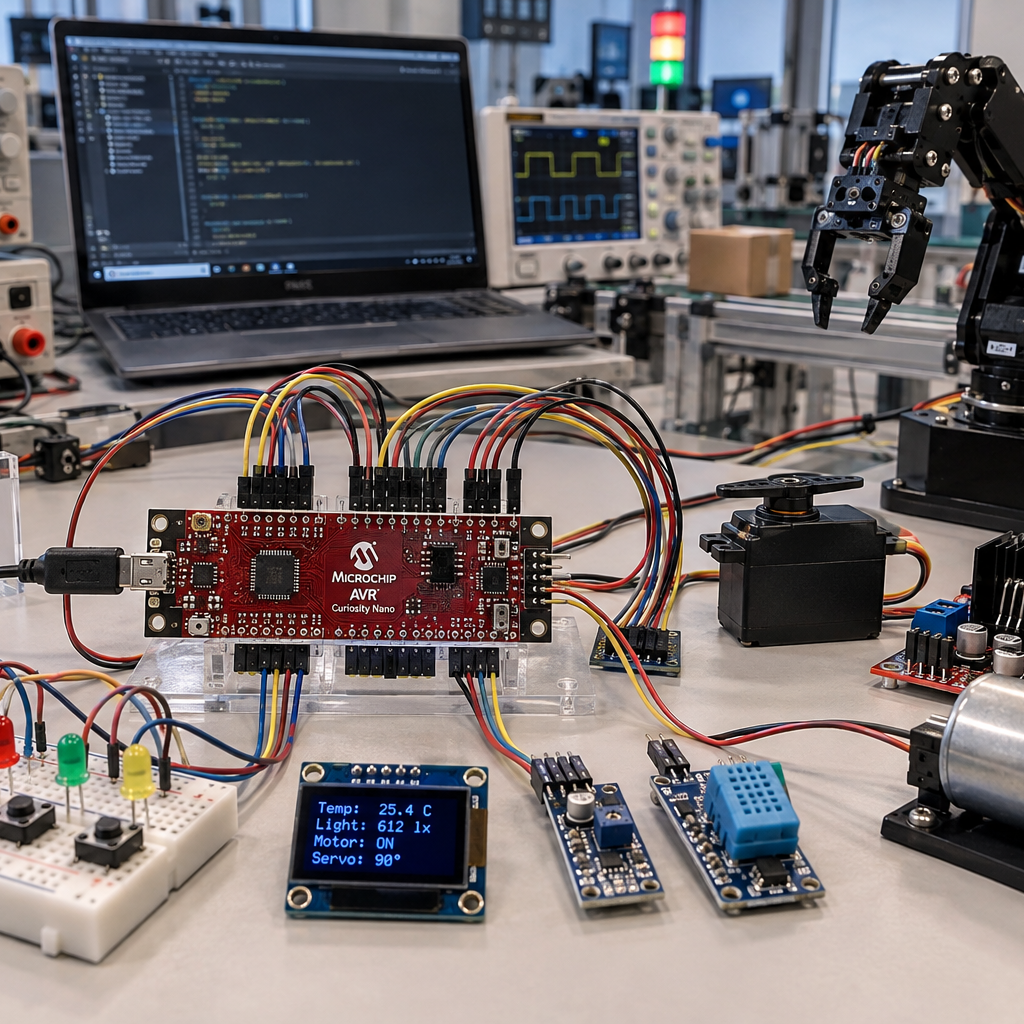
AVR microcontrollers can handle many embedded control tasks because they combine a CPU, memory, GPIO, timers, analog peripherals, and communication interfaces in one device. The exact application range depends on the selected AVR family and its available peripherals.
Robotics
AVR microcontrollers can control small robotic systems by reading sensors and generating signals for motors, servos, LEDs, and other actuators.
A robot can use ADC inputs to read analog sensors, GPIO pins for digital sensors and switches, and PWM outputs for motor or servo control. Timers and interrupts can coordinate these functions while the CPU processes the control logic.
For small robots and educational platforms, an AVR can provide enough processing and peripheral capability without requiring a larger microcontroller.
Industrial Automation
AVR devices can support control and monitoring functions in industrial equipment. They can monitor switches and sensors, control indicators and actuators, and exchange information with other electronic systems through serial communication interfaces.
Modern AVR families add hardware features that can simplify real time control. Core Independent Peripherals, Event System, and Configurable Custom Logic can allow certain operations to run through hardware rather than requiring constant CPU intervention.
Sensor Systems
Sensor based products often require an MCU to measure physical conditions, process readings, and communicate the results. AVR devices provide ADC and other analog functions that can connect directly with many sensor circuits.
For applications that require signal conditioning, newer AVR families provide more advanced analog features. The AVR DB family, for example, includes three integrated operational amplifiers and Multi Voltage I/O, which can help with signal conditioning and systems that use multiple voltage domains.
Motor Control
AVR microcontrollers can generate PWM signals and use timers to control motor drivers. Firmware can adjust the PWM duty cycle according to sensor readings or commands from another system.
Small DC motors, fans, pumps, and servos can use this type of control. More advanced motor systems may require a specialized MCU or digital signal controller with additional processing and control features.
Consumer Electronics
AVR devices can appear in compact consumer products that need buttons, indicators, displays, sensors, or simple control logic.
The MCU can monitor user inputs, process sensor data, control outputs, and communicate with other components. Its integrated peripherals can reduce the number of external components required for many designs.
IoT and Embedded Devices
AVR microcontrollers can also serve as control processors in connected embedded products. An AVR can collect sensor information, process local data, and communicate with a separate connectivity device through interfaces such as USART, SPI, or TWI.
For many IoT products, the AVR can handle local sensing and control while another device manages Wi Fi, Bluetooth, Ethernet, or cloud communication.
Advantages and Limitations of AVR
AVR microcontrollers offer a combination of simple programming, integrated peripherals, compact packages, and a broad development ecosystem. However, the right choice depends on the application’s processing, memory, connectivity, and power requirements.
Advantages of AVR Microcontrollers
AVR devices provide several useful characteristics for embedded development:
- Efficient 8 bit architecture
- Multiple memory configurations
- Integrated GPIO and peripherals
- ADC and other analog functions on many devices
- Timers and PWM hardware
- Common serial communication interfaces
- Low power operating modes
- Compact development boards
- Onboard programming and debugging on many development platforms
- Modern Core Independent Peripherals on newer families
The availability of Curiosity Nano and Xplained platforms also makes it easier to evaluate specific AVR devices before designing custom hardware.
Limitations of AVR Microcontrollers
AVR devices also have limitations. An 8 bit MCU may not provide enough processing performance for applications that require advanced graphics, large operating systems, intensive signal processing, or complex networking.
Memory capacity also varies considerably between models. Developers therefore need to select the device according to Flash, SRAM, GPIO, analog, communication, timing, and processing requirements.
For demanding applications, a 16 bit, 32 bit, or specialized controller may provide a more suitable hardware platform. The choice should depend on the actual system requirements rather than the MCU family name alone.
Frequently Asked Questions About AVR Microcontrollers
Is AVR an 8 bit microcontroller?
Most of the AVR devices discussed in this article are 8 bit microcontrollers. Microchip’s current portfolio also includes 32 bit AVR and RISC based MCUs, so the term AVR does not refer exclusively to one 8 bit device or architecture.
What programming language is commonly used for AVR?
C is commonly used for AVR firmware because it provides direct access to MCU peripherals while remaining easier to maintain and reuse than assembly for many projects. Microchip’s AVR training resources use C code for examples involving GPIO, ADC, PWM, timers, and USART.
Can AVR microcontrollers be programmed with MPLAB X IDE?
Yes. Microchip provides AVR development resources for MPLAB X IDE, including hands on examples using the ATmega328PB Xplained Mini. The development workflow can include project creation, C code development, compilation, programming, and debugging.
What memory does an AVR microcontroller use?
AVR devices commonly use Flash for program storage, SRAM for runtime data, and EEPROM for nonvolatile data storage. The available memory capacity depends on the specific AVR model. Microchip’s AVR documentation describes separate program Flash and data memory spaces within the AVR architecture.
Are AVR microcontrollers suitable for beginners?
AVR devices can provide a practical way to learn embedded programming because development boards, C examples, documentation, and programming tools are available through the Microchip ecosystem. Curiosity Nano and Xplained platforms also provide accessible hardware for experimenting with AVR peripherals.
Conclusion
The AVR microcontroller family provides a flexible platform for embedded systems that need efficient processing, integrated peripherals, and low power operation. Its modified Harvard architecture, register based CPU design, Flash memory, GPIO, timers, analog peripherals, and communication interfaces give developers a broad set of hardware functions within a compact MCU.
Microchip’s modern AVR portfolio extends the traditional AVR approach with features such as Core Independent Peripherals, Event System, Configurable Custom Logic, advanced analog functions, and USB on selected families. Development boards such as Curiosity Nano also simplify programming, debugging, and prototyping.
For an embedded project, the most suitable AVR device depends on the required Flash and SRAM capacity, GPIO count, analog features, communication interfaces, timing requirements, power constraints, package, and development needs. Reviewing the specific device datasheet before selecting the MCU helps ensure that the hardware matches the project requirements.