
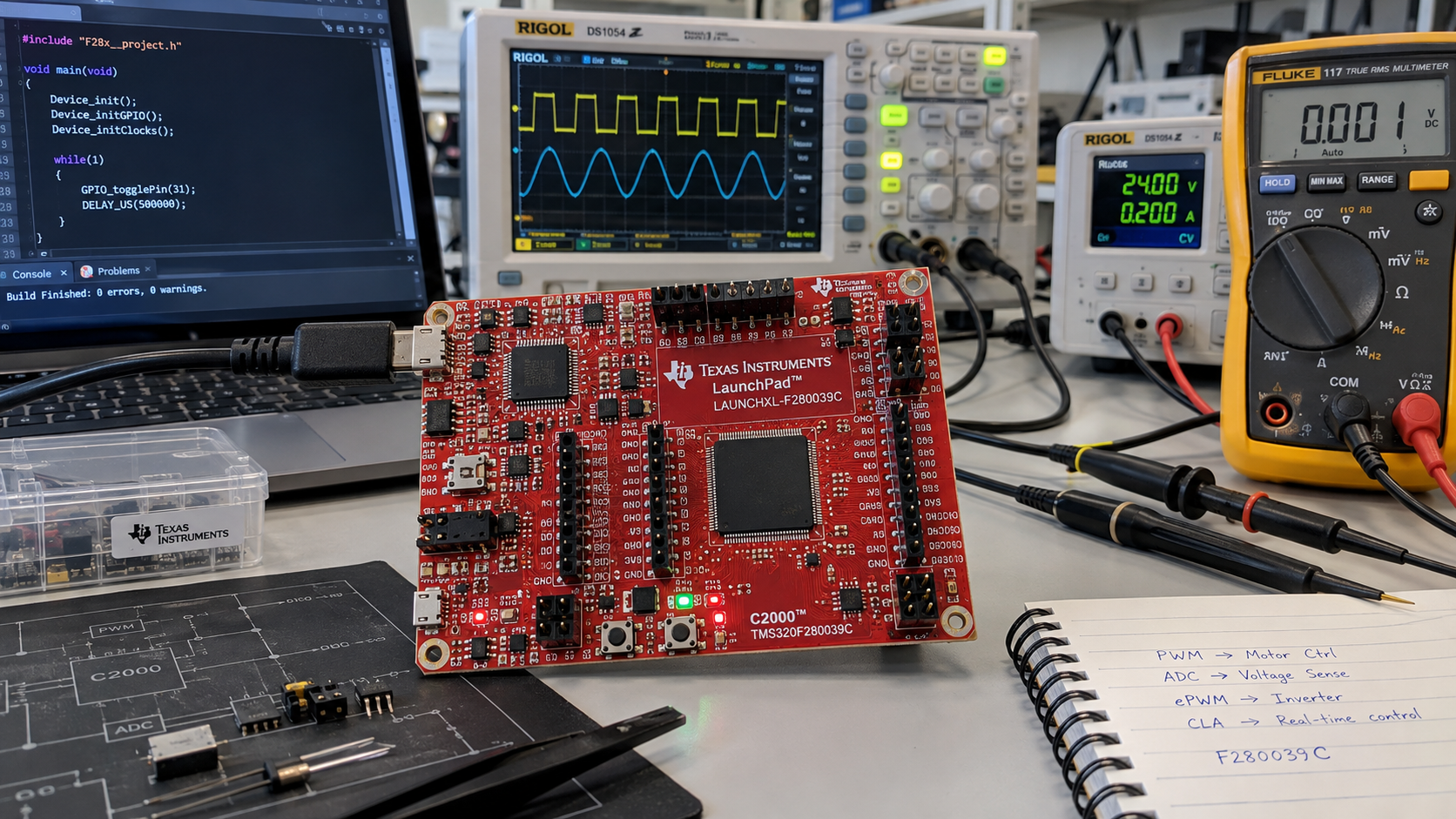
What Is a TI C2000 Microcontroller?
A TI C2000 microcontroller is a 32 bit real time MCU family from Texas Instruments designed for applications that need fast processing, sensing, and precise control. Unlike general purpose microcontrollers that are used across many types of embedded projects C2000 device are especially focused on closed loop control systems such as motor drives, digital power systems, solar inverters, electric vehicles industrial equipment, and signal processing
the C2000 platform combines a C28x processor with specialized control peripherals, analog functions, memory and hardware accelerators. This combination allows the microcontroller to measure a system process the data, and generate a control response with very low latency.
What Does C2000 Mean?
C2000 refers to Texas Instruments’ family of real time control microcontrollers. The platform includes different device families designed for different performance, memory, connectivity, analog and control requirements.
For exampl the F28003x family uses a 32 bit C28x DSP core running at up to 120 MHz and includes a Control Law Accelerator, floating point support, Trigonometric Math Uni, ADCs PWM channels, communication interfaces, and other control focused peripherals.
This architecture make C2000 particularly useful when software must respond quickly to changing sensor measurement. A motor controller, for example can continuously measure current and position, calculate the required correction, and update PWM signals to control the motor.
How Does a C2000 Microcontroller Work?
A C2000 system normally starts by collecting information from sensors through its analog and digital peripherals ADCs can convert voltage or current measurements into digital values, while position and communication interfaces provide additional system information.
The C28x CPU then executes the control algorithm. Depending on the device, specialized hardware such as the Control Law Accelerator, Floating Point Unit, Trigonometric Math Unit, or other accelerators can handle specific calculations efficiently.
After processing the measurements, the MCU generates outputs through PWM, GPIO, communication interfaces, or other control peripherals. This creates a fast feedback loop between the physical system and the firmware.
Why Are C2000 Microcontrollers Important?
C2000 microcontrollers are important because many modern electronic systems require more than basic input and output control. Motor drives, power converters, charging systems, and industrial equipment often need precise timing and rapid responses.
TI describes C2000 MCU as optimized for processing, sensing, and actuation to improve closed loop performance in real time control applications.
Real Time Control Performance
Real time control mean the microcontroller must process incoming measurements and produce an output within a predictable time. Delays can affect system stability, efficiency, and response.
C2000 devices are designed around this requirement. Their processor and dedicated control peripheral allow calculations and hardware operations to work together without depending entirely on slow software based processing.
This is useful in applications where PWM signal, sensor measurements and control calculations must remain synchronized.
32 Bit C28x Processing
The C28x processor is one of the defining parts of the C2000 architecture. It is designed for digital signal processing and real time control workload.
Different C2000 families provide different levels of processing performance. For example, the F28004x family provides a 100 MHz C28x CPU while the F28003x family provides up to 120 MH.
Floating point support is also available on several modern C2000 devices. This can simplify mathematical calculations used control algorithms.
Fast Sensing and Actuation
A control system needs to measure physical conditions and react quickly. C2000 devices integrate ADCs, PWM modules comparators, timer, and other peripheral to reduce the need for external control hardware.
For example, a motor controller can measure phase current through an ADC and use PWM outputs to control the power stage. The processor can repeatedly perform this process as part of a closed loop control system.
Hardware Accelerator
Some C2000 devices include hardware designed to reduce the processing workload of the main CPU. The Control Law Accelerator, or CL, can execut control related code independently from the main C28x CPU on supported devices.
Modern C2000 families can also include features such as the Floating Point Unit and Trigonometric Math Unit. The F28003x, for example, combines C28x processing with FPU, TMU, CLA, DMA, and other control focused resource.
Architecture of a C2000 Microcontroller
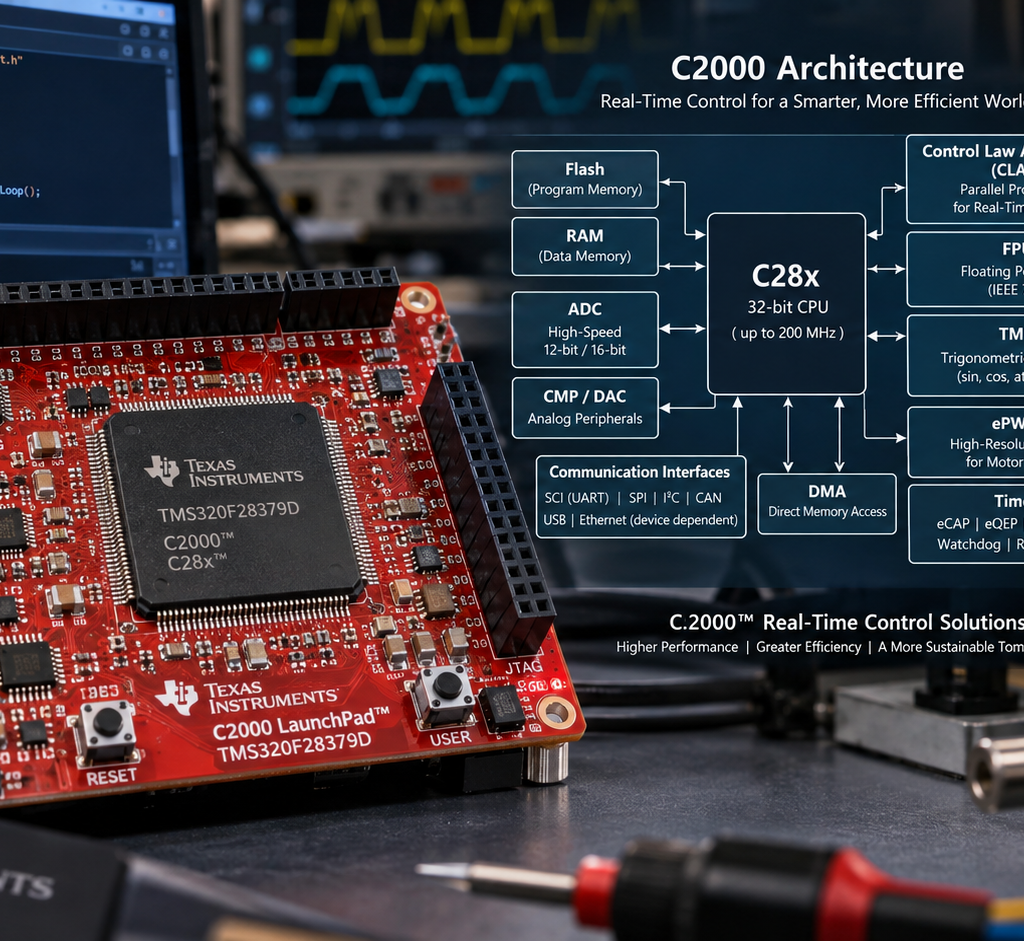
The architecture of a C2000 microcontroller combines a real time processing core with memory, analog peripherals PWM modules communication interfaces and control accelerators.
The exact architecture varies between C2000 families so not every device includes the same memory size, peripherals, or accelerators. For example, the F28004x provides a C28x CPU, CLA, FPU, TMU, ADCs, PWM channels DMA, and communication peripherals in a single MCU.
C28x CPU Core
The C28x CPU is the main processing engine in C2000 microcontrollers. It executes the control firmware and handles mathematical operations, system logic, communication, and peripheral management.
Modern C2000 devices can combine the C28x core with floating point and specialized instruction extensions. The F28003x family, for example, uses a 120 MHz C28x DSP core with FPU, TMU, and VCRC capabilities.
This processing structure is particularly useful for algorithms involving motor control, power conversion, filtering, and signal processing.
Control Law Accelerator
The Control Law Accelerator, commonly called CLA, is a specialized processing unit available on many C2000 devices. It can execute selected control algorithms independently of the main CPU.
This separation can help keep time critical control operations running while the C28x processor handles communication, system management, diagnostics, or other tasks.
The F28003x and F28004x families both provide CLA based control acceleration.
Flash and RAM
C2000 devices include on chip nonvolatile Flash for storing firmware and RAM for variables, buffers, and runtime operations. Memory capacity depends on the specific device.
For example, TI lists the F280037 with 256 KB of Flash and 69 KB of RAM, while the F28004x family can provide up to 256 KB of Flash and about 100 KB of RAM depending on the device.
This memory structure allows control firmware, mathematical routines, communication code, and application data to operate directly on the MCU.
ADC and Analog Peripherals
Analog peripherals are essential in real time control because systems frequently need to measure current, voltage, temperature, position, or other physical signals.
C2000 devices provide integrated ADCs and other analog functions. The F280037, for example, includes 12 bit SAR ADCs with multiple input channels.
These peripherals allow the MCU to collect measurements directly and use them in control algorithms without requiring a separate external processor.
PWM and Control Peripherals
PWM is one of the most important peripherals in C2000 systems. PWM outputs can control motor power stages, DC DC converters, inverters, and other switching circuits.
C2000 devices combine PWM with ADC triggering, timers, comparators, and other peripherals so that measurements and control actions can be synchronized. This hardware based coordination is a major part of the platform’s real time control approach.
Key Features of C2000 Microcontrollers
C2000 microcontrollers combine high speed real time processing with specialized peripherals for control applications. Their features are designed to help a single MCU handle sensing, calculations, timing, and actuation with minimal delay. The exact feature set varies by C2000 device and family.
GPIO and Digital Control
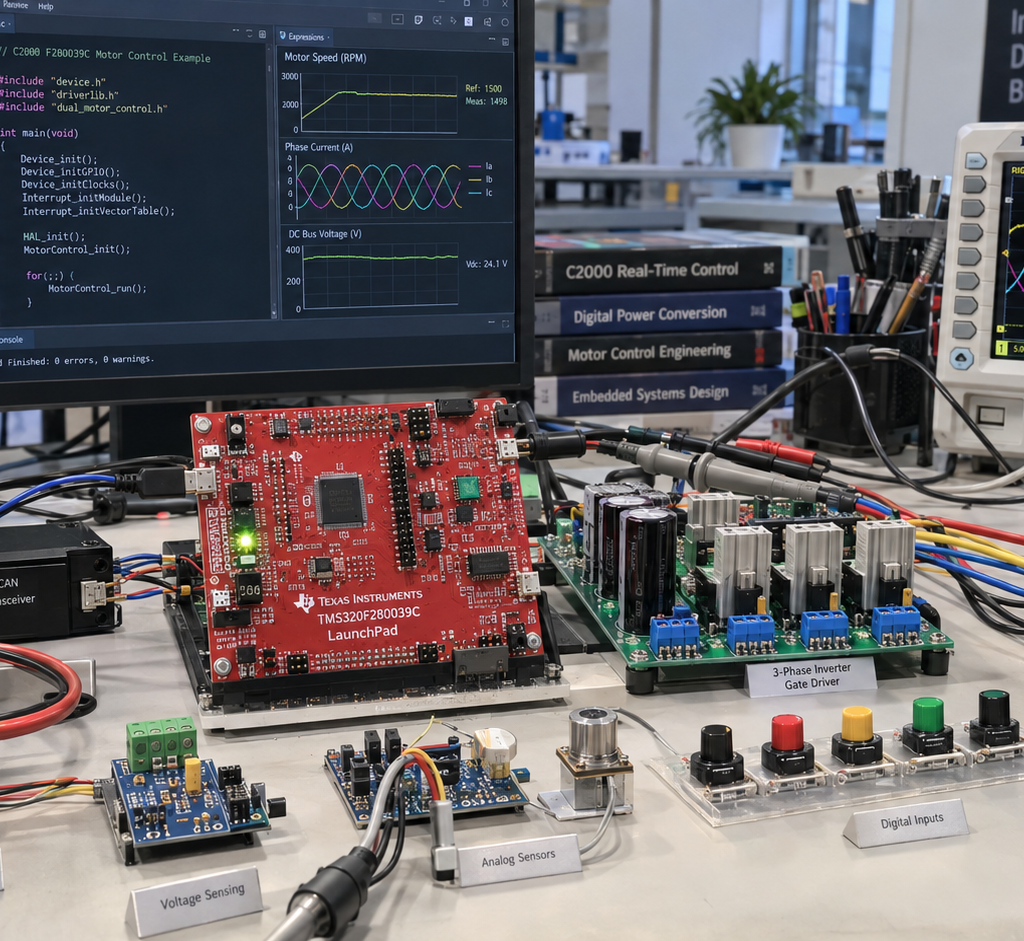
GPIO pins allow a C2000 microcontroller to interact with external digital circuits. They can be used for switches, status LEDs, digital sensors, control signals, and other hardware.
In a motor controller, for example, GPIO can monitor digital feedback signals while PWM outputs control the power stage. The combination of GPIO, timers, interrupts, and PWM allows firmware to coordinate different parts of a control system.
C2000 devices also provide flexible peripheral connections so designers can connect the MCU to different external circuits without requiring a large number of additional components.
ADC and Analog Functions
Analog to digital conversion is essential in real time control because many important system measurements are analog. Motor current, bus voltage, temperature, and sensor outputs can all be converted into digital values for processing.
C2000 devices integrate ADCs with control focused peripherals. Some devices provide multiple ADC modules and multiple input channels, allowing several signals to be sampled during a control cycle. The F280049C, for example, includes three 12 bit ADCs.
Fast and synchronized measurements allow the C28x processor or CLA to use fresh sensor data when calculating the next control response.
PWM and Timers
PWM is a core feature of the C2000 platform. It can be used to control motor phases, power converters, inverters, and other switching circuits.
C2000 ePWM modules provide precise timing and can work with ADC triggering, synchronization, dead band control, and other functions required by power electronics. This allows the MCU to coordinate measurement and actuation directly through hardware.
Timers are also used for periodic tasks, event generation, scheduling, and system timing. Together, PWM and timers give developers precise control over when important operations occur.
Communication Interfaces
C2000 devices include communication interfaces that allow the controller to exchange information with other components and systems. Depending on the device, available interfaces can include UART, SPI, I2C, CAN, and specialized interfaces such as Fast Serial Interface.
These interfaces can connect the MCU to sensors, displays, gate drivers, other controllers, industrial networks, or monitoring equipment.
The F280049C, for example, includes CAN, UART, and FSI along with its control focused peripherals.
Motor Control Features
Motor control is one of the major applications of C2000 microcontrollers. The platform combines high speed processing, ADCs, PWM modules, timers, and specialized control functions for applications such as brushless DC, permanent magnet synchronous, and other motor systems.
Some devices and development platforms also support TI technologies such as InstaSPIN FOC. The F280049C LaunchPad, for example, supports InstaSPIN FOC and provides interfaces useful for motor control development.
These capabilities allow a C2000 controller to continuously measure motor conditions and adjust the drive signals according to the control algorithm.
Security and Safety Features
Modern C2000 devices can include security and system protection features alongside their control peripherals. Depending on the family, these may include secure memory functions, code security, error detection, watchdog functionality, and diagnostic mechanisms.
The exact security and safety features depend on the individual C2000 device, so designers should check the specific device documentation before selecting an MCU for a safety or security sensitive application.
TI C2000 Microcontroller Families
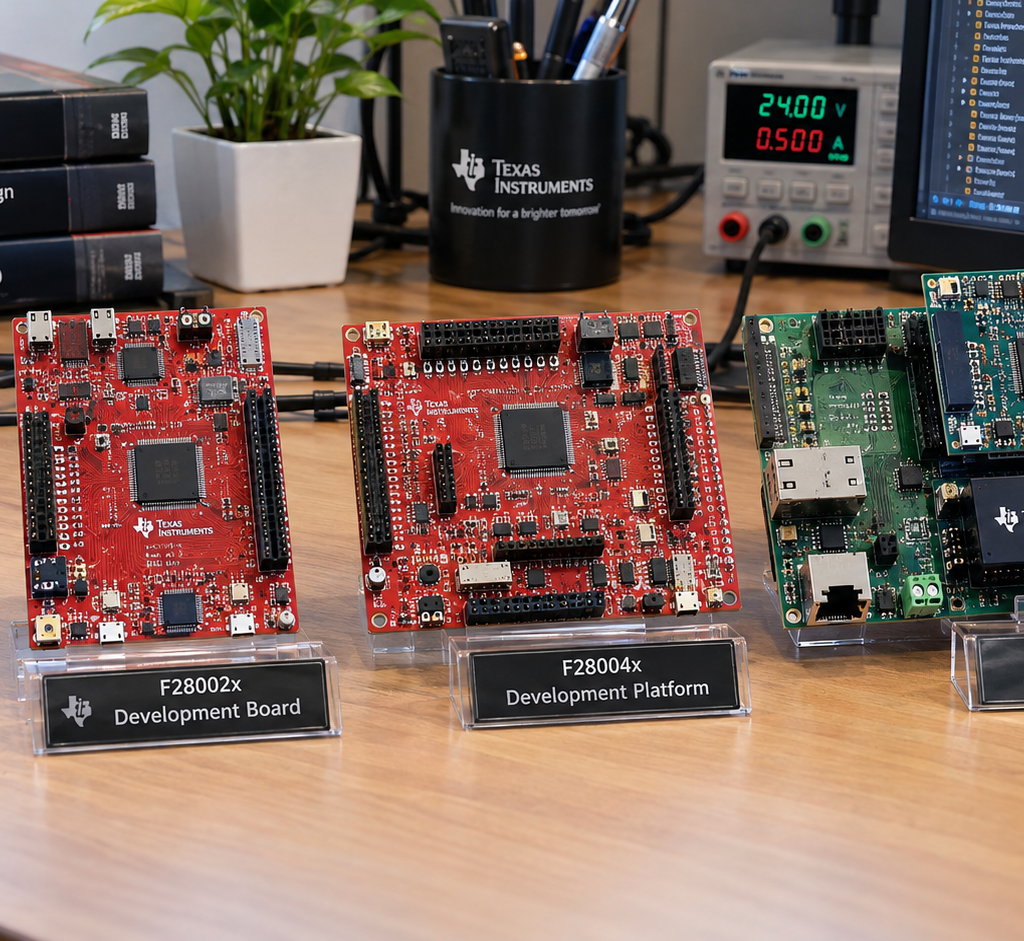
The C2000 portfolio includes several families designed for different levels of real time control performance, memory, analog capability, connectivity, and application requirements. The F28002x, F28003x, F28004x, and F2837x/F2838x families are examples of C2000 devices used across control applications.
C2000 F28002x Series
The F28002x family is part of the Piccolo C2000 platform and targets cost sensitive real time control applications. These devices combine the C28x processing architecture with control peripherals such as PWM and ADCs.
They can be useful where designers need dedicated real time control capabilities without moving to a larger and more complex MCU.
The family is also supported by TI’s C2000 software ecosystem, including development tools and example software.
C2000 F28003x Series
The F28003x family provides higher processing capability for more demanding control applications. Devices in this family can include a 120 MHz C28x CPU, floating point support, Trigonometric Math Unit, Control Law Accelerator, ADCs, PWM modules, DMA, and communication peripherals.
The F280039C is also supported by a dedicated LaunchPad and controlCARD development hardware, making the family suitable for evaluation and prototyping.
C2000 F28004x Series
The F28004x family provides a 32 bit C28x CPU with 100 MHz signal processing performance along with control focused peripherals, analog functions, and nonvolatile memory. TI also provides F280049C LaunchPad and controlCARD development platforms for this family.
The family is particularly relevant to applications that require precise motor control, digital power conversion, sensing, and fast mathematical processing.
C2000 F2837x and F2838x Series
The F2837x and F2838x families target higher performance control applications that require more processing resources and connectivity.
These devices are used in applications where advanced control algorithms, multiple communication interfaces, larger memory resources, and extensive peripheral integration are important.
The F2838x family also expands the C2000 architecture with additional connectivity and processing resources for more complex real time systems.
How to Program a C2000 Microcontroller
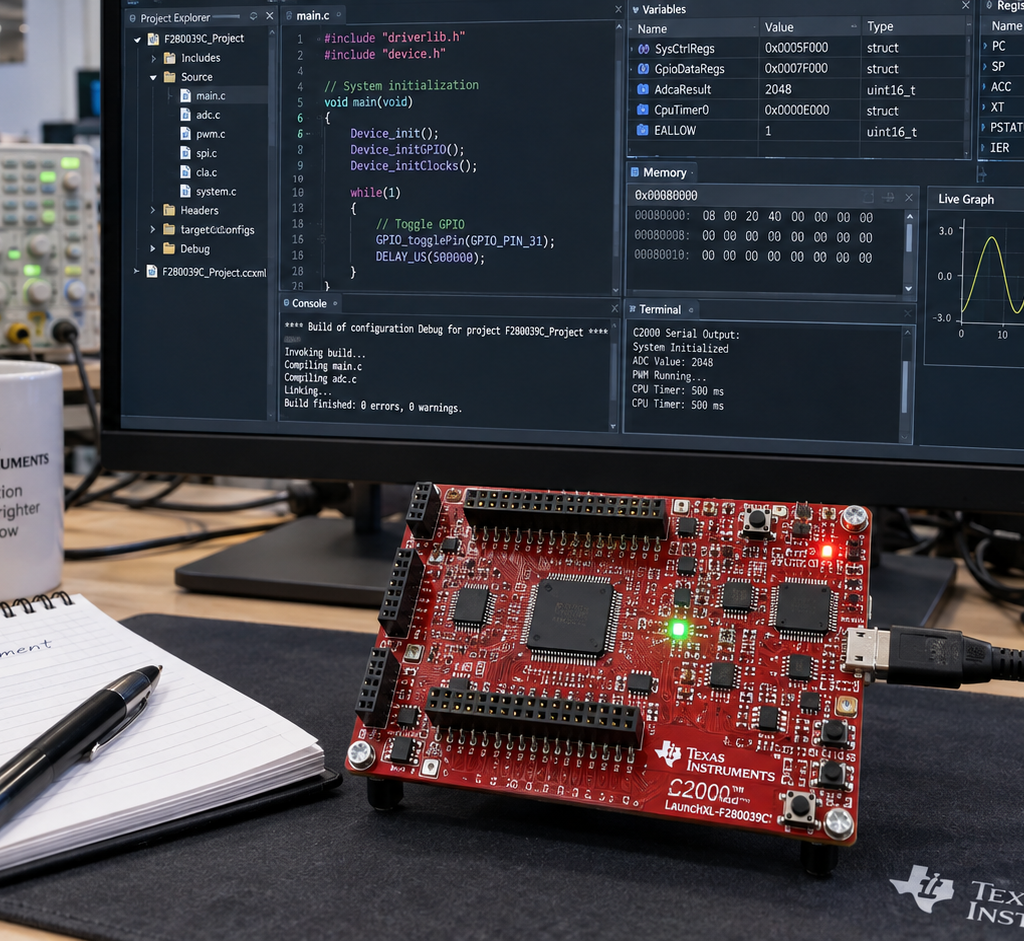
C2000 development normally involves embedded C programming, TI development software, device specific libraries, and a hardware debugger. TI provides a dedicated software ecosystem that helps developers move from initial experiments to complete control applications.
Embedded C Programming
Embedded C is commonly used to develop C2000 firmware. Developers can write code for ADC sampling, PWM generation, motor control algorithms, communication, interrupts, diagnostics, and system management.
Because C2000 applications often require precise timing, developers also need to understand interrupts, peripheral configuration, memory, PWM synchronization, ADC triggering, and real time execution.
Code Composer Studio
Code Composer Studio is TI’s integrated development environment for programming and debugging supported TI microcontrollers and processors. Developers can use it to create projects, compile C code, program the target device, set breakpoints, inspect variables, and debug firmware.
For C2000 development, CCS works together with device support packages and C2000Ware to provide examples and development resources.
C2000Ware
C2000Ware is TI’s software and documentation package for C2000 microcontrollers. It includes device specific drivers, libraries, peripheral examples, documentation, and development resources. TI’s current C2000Ware release also includes support for newer devices and additional software resources.
C2000Ware can significantly simplify development because engineers do not need to create every peripheral driver and example from scratch.
Programmer and Debugger
C2000 development boards commonly include onboard debugging hardware. For example, the F28003x controlCARD provides an isolated XDS110 USB to JTAG debug probe for programming and real time debugging.
The LaunchPad ecosystem provides another convenient way to connect a C2000 device to a computer and begin development. TI’s F28003x LaunchPad uses an onboard XDS110 interface and is supported by C2000Ware examples.
C2000 Development Boards
C2000 development boards provide a practical way to evaluate the microcontroller, test peripherals, develop control algorithms, and build prototypes. TI offers LaunchPad kits, controlCARD boards, evaluation modules, and other hardware for different C2000 families. Current TI resources list boards such as the F28003x LaunchPad, F2800137 LaunchPad, F280049C controlCARD, and newer C2000 platforms.
LaunchPad Development Kits
C2000 LaunchPad development kits are designed to make initial evaluation and prototyping easier. They provide access to the MCU pins and commonly include onboard debugging hardware, allowing developers to connect the board to a computer and begin programming without purchasing a separate debugger.
For example, the LAUNCHXL F280039C uses the TMS320F280039C and includes a 120 MHz C28x CPU, FPU, TMU, CLA, 384 KB Flash, three 12 bit ADCs, 16 PWM channels, CAN, CAN FD, encoder interfaces, FSI, and UART. It also includes an onboard XDS110 debug probe.
The F28003x LaunchPad also supports BoosterPack expansion modules. This allows developers to add additional hardware for sensing, communication, control, and other experiments.
controlCARD Development Boards
C2000 controlCARDs are compact evaluation boards designed for more flexible development and integration. A controlCARD can be connected to a compatible docking station or application specific baseboard, giving engineers access to the MCU’s analog, digital, and communication signals.
The TMDSCNCD280039C, for example, is an F28003x controlCARD with a 180 pin high speed connector and an isolated onboard XDS110 USB to JTAG debug probe. TI describes it as a development and evaluation platform for initial prototyping.
C2000 Evaluation Boards
Evaluation boards provide additional hardware around the C2000 MCU so engineers can test complete system concepts. Depending on the application, these platforms can include power electronics interfaces, motor control hardware, sensing circuits, communication interfaces, or expansion connectors.
TI’s current C2000 ecosystem includes LaunchPads and controlCARD based platforms for motor control, digital power, and other real time control applications.
Prototyping With C2000
A typical C2000 prototype can begin with a LaunchPad or controlCARD connected to a computer. Developers can then test ADC measurements, configure PWM outputs, communicate with sensors, and develop the control algorithm before moving toward a custom PCB.
C2000Ware provides device specific drivers, libraries, peripheral examples, documentation, and hardware design resources for C2000 development boards.
Applications of C2000 Microcontrollers
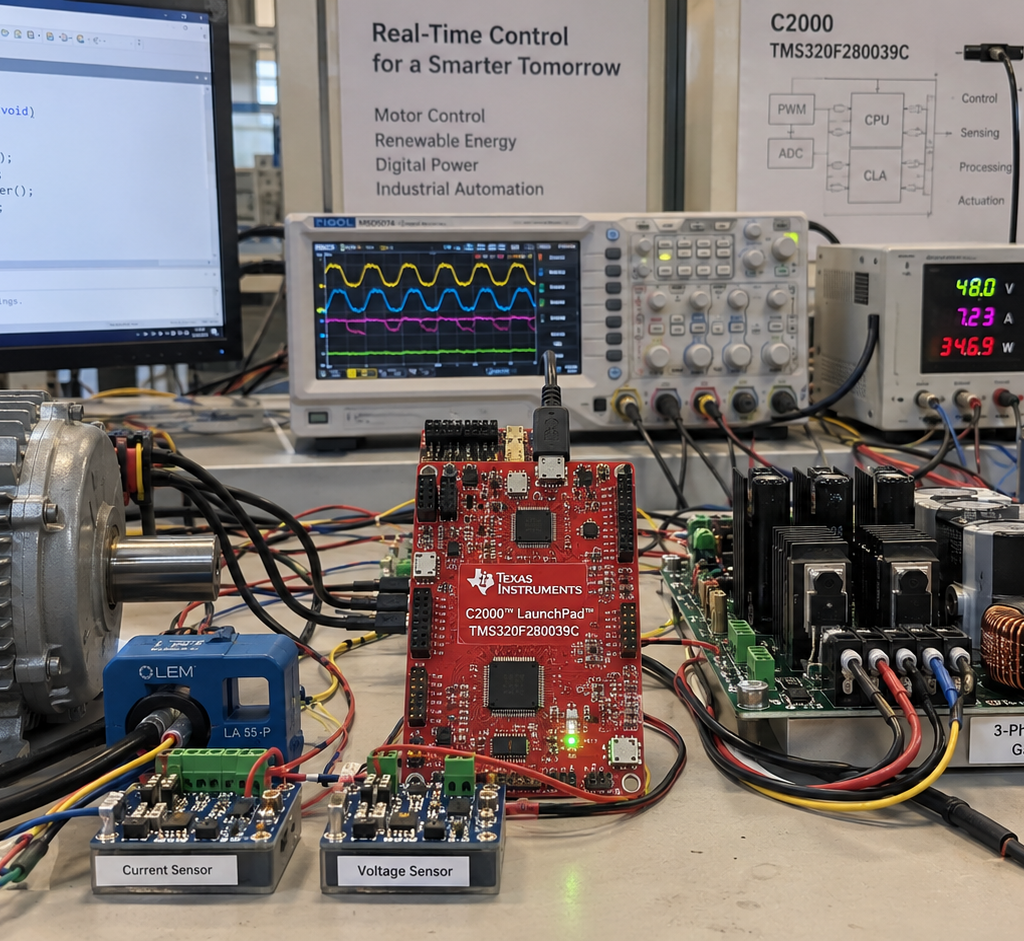
C2000 microcontrollers are mainly used in systems where accurate sensing, fast calculations, and precise control are important. Their combination of C28x processing, ADCs, PWM, timers, control accelerators, and communication peripherals makes them suitable for motor control, digital power, industrial systems, and other real time applications.
Motor Control
Motor control is one of the most important C2000 applications. The MCU can measure motor current, voltage, speed, and position and then adjust PWM signals according to the control algorithm.
C2000 devices are used in applications involving industrial motor drives, servo systems, pumps, fans, compressors, and other electronically controlled motors. TI also provides a dedicated MotorControl SDK for C2000 based motor control development.
Digital Power and Solar Inverters
C2000 microcontrollers are also used in digital power systems. They can monitor voltage and current while controlling switching devices through precisely timed PWM signals.
Applications include AC to DC power supplies, DC to DC converters, DC to AC inverters, battery power systems, and solar energy equipment. TI provides a Digital Power SDK specifically for C2000 based digital power development.
Electric Vehicles
Electric vehicle systems require fast control of motors and power conversion. C2000 microcontrollers can be used in areas such as traction motor control, onboard charging, DC DC conversion, and other power management functions.
Their fast ADC sampling and PWM control make them suitable for feedback based power electronics where measurements and switching decisions must occur repeatedly within precise timing windows.
Industrial Automation
Industrial automation systems often combine motors, sensors, power electronics, communication, and real time control. C2000 devices can provide the processing and peripheral integration needed for these systems.
They can be used for industrial drives, actuators, power supplies, factory equipment, and other control systems where deterministic response is important.
Sensing and Signal Processing
C2000 devices can process sensor information directly through their integrated ADCs and processing resources. This is useful when an application needs to continuously monitor analog signals and make control decisions based on those measurements.
Examples include current sensing, voltage monitoring, position feedback, power measurement, and condition monitoring. Hardware accelerators and mathematical processing features can also help with demanding control and signal processing algorithms.
Advantages and Limitations of C2000 Microcontrollers
C2000 microcontrollers provide a specialized combination of processing and control hardware. However, their application focused architecture also means that selecting a device requires understanding the system’s control, analog, memory, and peripheral requirements.
Advantages of C2000 Microcontrollers
A major advantage is the integration of real time control peripherals into the MCU. ADCs, PWM modules, timers, comparators, communication interfaces, and control accelerators can reduce the need for external control hardware.
The C28x architecture is also designed for mathematical and digital signal processing workloads. Depending on the device, features such as FPU, TMU, CLA, and other accelerators can improve the execution of control algorithms.
Another advantage is the software ecosystem. C2000Ware includes drivers, libraries, examples, documentation, and hardware resources, while TI also provides specialized software such as MotorControl SDK and Digital Power SDK.
Limitations of C2000 Microcontrollers
C2000 devices are highly specialized, so they can require more learning than a simple general purpose microcontroller. Developers need to understand concepts such as PWM synchronization, ADC triggering, interrupts, control loops, and real time scheduling.
The C2000 portfolio also contains many device families with different peripherals, memory sizes, processing capabilities, and package options. Therefore, engineers need to select the specific device according to the application’s requirements rather than treating every C2000 MCU as identical.
For applications that only require simple GPIO control, basic sensing, or straightforward connectivity, many general purpose microcontrollers may provide a simpler development path.
Frequently Asked Questions About C2000 Microcontrollers
Is C2000 a 32 Bit Microcontroller?
Yes. C2000 is a family of 32 bit real time microcontrollers based on the C28x processor architecture. Different C2000 devices provide different processing speeds, memory sizes, peripherals, and hardware accelerators. For example, the F280037 uses a 120 MHz C28x CPU with a CLA, while other C2000 families provide different performance levels.
What CPU Does C2000 Use?
C2000 microcontrollers use the TI C28x CPU architecture. Depending on the device, the C28x processor can be combined with features such as a Floating Point Unit, Trigonometric Math Unit, and Control Law Accelerator.
For example, the F28003x family combines a 120 MHz C28x CPU with a 120 MHz CLA, FPU, and TMU.
What Is C2000 Mainly Used For?
C2000 is mainly designed for real time control applications. Common areas include motor drives, power conversion, industrial control, renewable energy systems, appliances, and other applications that require precise sensing and fast control responses.
The F28003x family, for example, is specifically described by TI as a real time MCU platform for applications including motor drives and power electronics.
Does C2000 Support Motor Control?
Yes. Motor control is a major C2000 application area. Its combination of high speed processing, ADCs, PWM modules, timers, and control accelerators allows the MCU to continuously measure motor conditions and update control signals.
Depending on the device and software package, developers can build control systems for different motor types and control methods.
What Is C2000Ware?
C2000Ware is TI’s software development package for C2000 microcontrollers. It provides device support, peripheral drivers, examples, documentation, and other resources that help developers create C2000 applications.
It can be used alongside Code Composer Studio during firmware development and debugging.
What Software Is Used to Program C2000?
Code Composer Studio is commonly used for C2000 firmware development. Developers can write embedded C code, compile projects, program the MCU, debug firmware, and inspect variables and registers.
C2000Ware provides additional device drivers, examples, libraries, and documentation that can be used within the development workflow.
Conclusion
The TI C2000 microcontroller family is designed around the requirements of real time control. Its C28x processing architecture works together with ADCs, PWM modules, timers, communication peripherals, and specialized accelerators to handle fast sensing, mathematical processing, and precise actuation.
C2000 devices cover different performance and integration levels. For example, the F28002x, F28003x, and F28004x families provide different combinations of CPU performance, memory, ADC resources, PWM channels, communication interfaces, and control accelerators.