
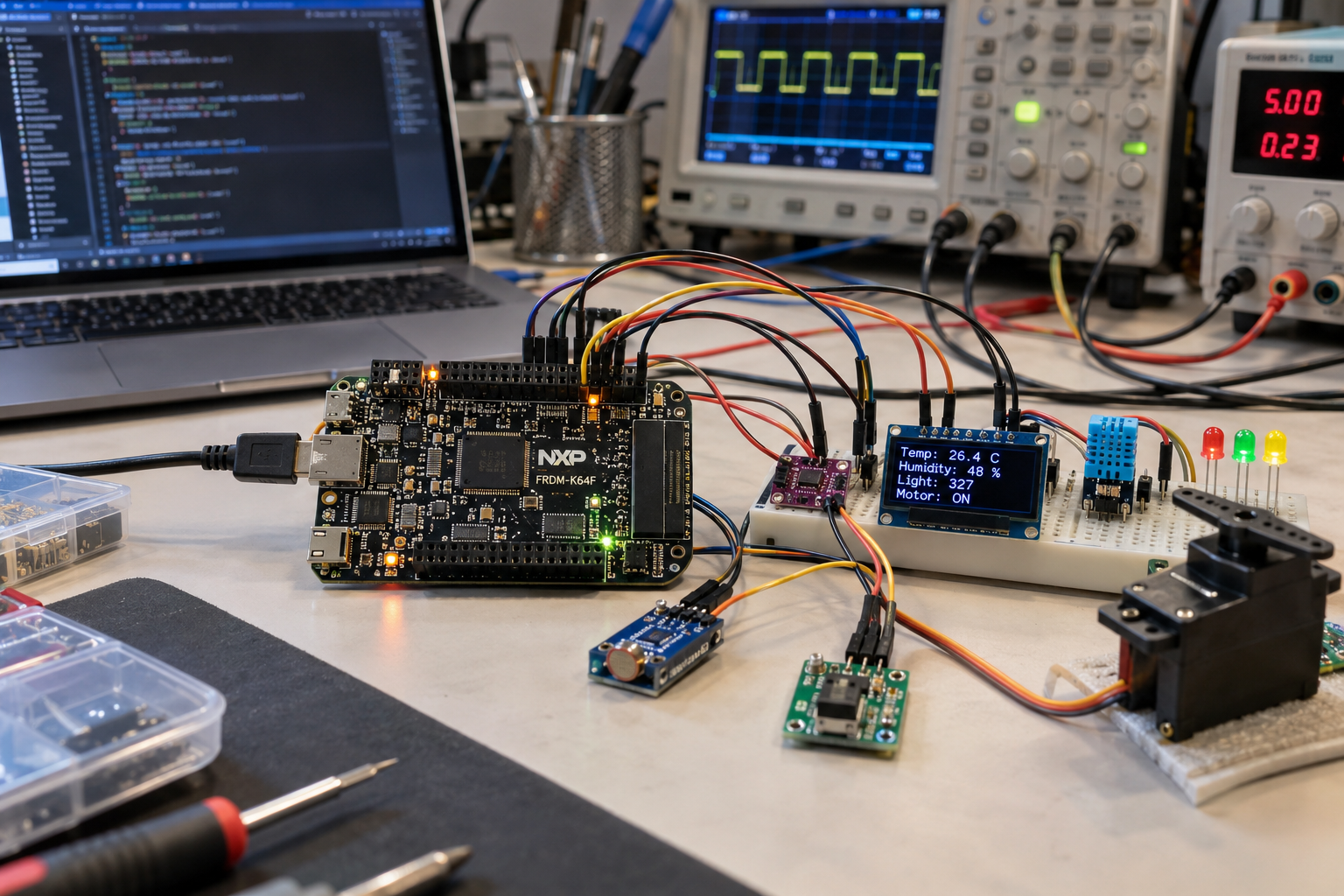
What Is an NXP Kinetis Microcontroller?
An NXP Kinetis microcontroller is a family of 32 bit Arm based MCUs designed for embedded systems, industrial equipment, consumer electronics, measurement devices, motor control, and low power applications. The Kinetis portfolio includes several families with different processor cores, memory sizes, peripherals, power characteristics, and application targets.
The Kinetis K series, for example, uses Arm Cortex M4 cores and focuses on scalable performance and peripheral integration. The Kinetis L series uses Arm Cortex M0+ cores and emphasizes ultra low power operation. The Kinetis E series provides robust 5 V microcontrollers based on Cortex M0+ and Cortex M4 cores for applications that may operate in electrically noisy environments.
What Does Kinetis Mean?
Kinetis is the name NXP uses for a broad family of Arm based microcontrollers. Instead of representing one specific chip, Kinetis refers to a scalable portfolio containing devices for different performance, power, connectivity, analog, security, and control requirements.
This family based approach allows developers to select an MCU that matches the requirements of a particular embedded system. A small battery powered device may use a low power Kinetis L device, while an industrial controller may require the higher processing capability and peripheral integration available in a Kinetis K or E device.
How Does a Kinetis Microcontroller Work?
A Kinetis microcontroller combines a processor core, memory, digital I/O, analog peripherals, timers, communication interfaces, and system control features on a single chip. The processor executes firmware stored in Flash memory, while SRAM provides temporary storage for variables and runtime data.
When an embedded application starts, the MCU initializes its clock system and peripherals before executing the main program. The firmware can then read sensors, control GPIO pins, generate PWM signals, communicate with other devices, process data, and respond to interrupts.
The exact capabilities depend on the Kinetis model. For example, some Kinetis devices include USB, CAN, ADC, DAC, LCD support, security features, or specialized analog hardware. NXP’s Kinetis portfolio is therefore better understood as a range of related MCU families rather than a single hardware configuration.
Why Are Kinetis Microcontrollers Important?
Kinetis microcontrollers became important in embedded development because the portfolio offered developers a scalable range of 32 bit Arm MCUs with different combinations of processing performance, memory, peripherals, and power consumption.
Rather than designing every system around the same type of microcontroller, engineers could select different Kinetis devices while working within a broader ecosystem of development tools and software.
32 Bit Arm Cortex M Performance
Many Kinetis devices use Arm Cortex M processor cores, including Cortex M0+ and Cortex M4 implementations. This provides a modern 32 bit architecture suitable for applications that need more processing capability than traditional 8 bit or 16 bit controllers.
The Kinetis K series is based on Cortex M4 and includes devices designed for scalable performance and integration. Some K series families also combine the processor with analog functions, communication interfaces, timers, security features, and other peripherals.
Kinetis L takes a different approach. Its Cortex M0+ based devices emphasize low power operation while retaining a 32 bit architecture. NXP describes the L series as an ultra low power portfolio with devices ranging from entry level controllers to models with USB, segment LCD, security, and larger memory configurations.
Scalable Microcontroller Platform
One major characteristic of Kinetis is scalability. Different devices can provide different combinations of Flash, SRAM, processor performance, packages, peripherals, and communication interfaces.
For example, NXP lists Kinetis K subfamilies for applications involving USB, Ethernet, LCD, security, measurement, and general purpose control. This variety allows engineers to select hardware according to the actual requirements of their design rather than using a single MCU for every project.
This scalability can also help when an embedded product evolves. A developer may start with a simpler MCU for a prototype and later select a device with additional memory or peripherals when the product requirements increase.
Low Power Operation
Power efficiency is another important part of the Kinetis portfolio. Low power modes allow an MCU to reduce energy consumption when the processor or selected peripherals are not actively performing tasks.
The Kinetis L series is specifically designed around ultra low power operation. Its devices include multiple low power modes, and some peripherals can continue operating during low power states without requiring the main CPU to remain fully active.
This makes low power Kinetis devices useful for battery powered products, portable instruments, smart meters, sensors, and other embedded systems where energy consumption directly affects operating time.
Architecture of a Kinetis Microcontroller
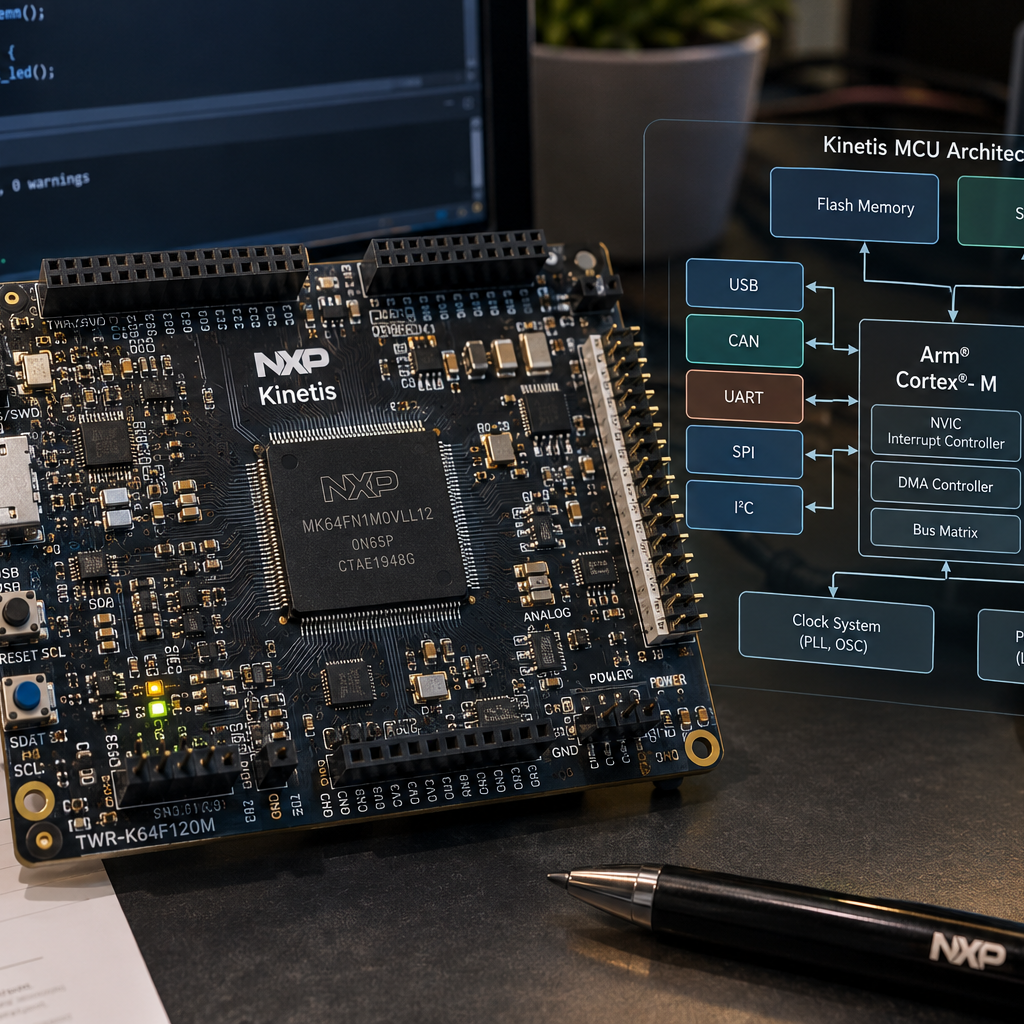
The architecture of a Kinetis MCU varies between families, but the basic structure combines an Arm Cortex M processor with memory, GPIO, timers, analog peripherals, communication interfaces, clock circuitry, and system control hardware.
The exact architecture depends on the individual device. A Kinetis L MCU, for example, may prioritize low power operation and a compact peripheral set, while a Kinetis K device can provide greater processing performance and more advanced connectivity or memory options.
Arm Cortex M CPU Core
The processor is the central computational element of a Kinetis microcontroller. Different Kinetis families use different Arm Cortex M cores according to their intended applications.
Kinetis L devices are based on Cortex M0+, while many Kinetis K devices use Cortex M4. Kinetis E also includes both Cortex M0+ and Cortex M4 based products.
The CPU executes the application firmware and coordinates operations between the MCU’s peripherals. Depending on the model, features such as floating point processing, higher clock speeds, and additional memory can support more demanding embedded workloads.
Flash and SRAM
Kinetis microcontrollers use Flash memory to store firmware and SRAM for temporary data during program execution. The amount of available memory varies considerably between devices.
For example, NXP’s Kinetis K documentation lists devices with different Flash and SRAM configurations, allowing engineers to select a controller based on the size of the application and its data requirements.
Flash retains the program when power is removed, while SRAM is used during operation for variables, buffers, stack data, and other temporary information.
GPIO and Peripherals
GPIO pins allow the Kinetis MCU to interact directly with external hardware. Developers can configure these pins as digital inputs or outputs for switches, LEDs, sensors, relays, and control signals.
Beyond GPIO, Kinetis devices can integrate peripherals such as ADCs, DACs, timers, PWM modules, UART, SPI, I2C, USB, CAN, and other interfaces. The exact combination depends on the device family. For example, NXP lists ADC, DAC, timers, UART, I2C, SPI, and GPIO among standard capabilities in the Kinetis K series.
This high level of integration allows many embedded systems to be built with fewer external components, reducing board complexity and making the MCU the central control element of the design.
Key Features of Kinetis Microcontrollers
Kinetis microcontrollers combine a 32 bit Arm processing core with integrated memory, digital interfaces, analog functions, timers, communication peripherals, and system control features. The exact feature set varies by family and device, so engineers can choose a Kinetis MCU according to the requirements of the application.
GPIO and Digital Control
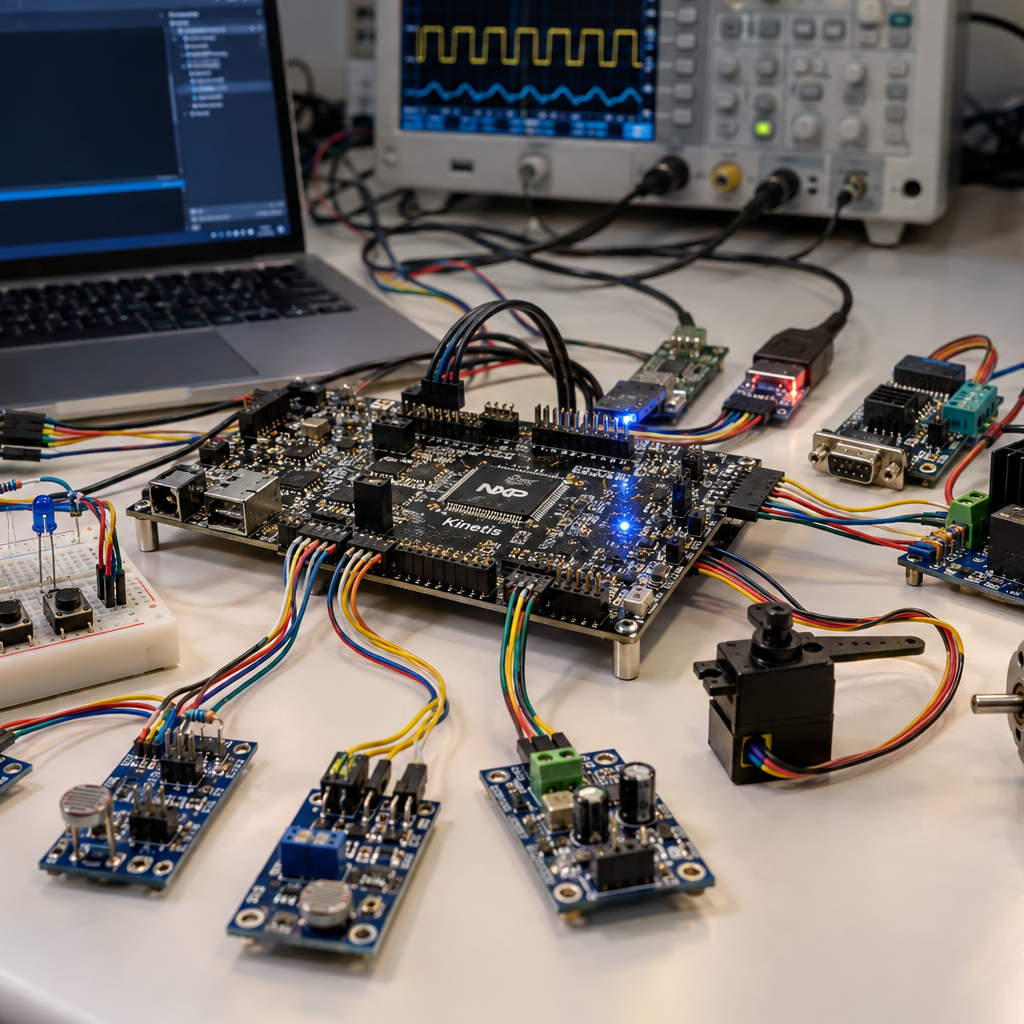
General purpose input/output, or GPIO, pins allow a Kinetis MCU to communicate with external digital hardware. Firmware can configure these pins as inputs or outputs for devices such as switches, LEDs, relays, displays, sensors, and control circuits.
Many Kinetis devices also provide flexible pin multiplexing. This allows a physical pin to perform different functions depending on the selected peripheral configuration. For example, a pin may serve as ordinary GPIO in one application and as a serial communication or timer signal in another.
This flexibility is useful when designing compact PCBs because developers can assign available pins according to the actual hardware requirements.
ADC and Analog Functions
Kinetis devices can include analog to digital converters for measuring signals from sensors and other analog circuits. An ADC converts an analog voltage into a digital value that the processor can analyze.
Depending on the device, Kinetis MCUs can also include other analog functions such as DACs, comparators, voltage references, and specialized analog peripherals. These features can reduce the number of external components required in measurement and control systems.
For example, a Kinetis based controller can read temperature, pressure, light, or current sensors and then use the measured values to make control decisions.
Timers and PWM
Timers provide accurate timing functions for embedded applications. Developers can use them to generate periodic interrupts, measure signal timing, create delays, capture external events, and schedule software tasks.
PWM, or pulse width modulation, is particularly useful for control applications. A Kinetis MCU can generate PWM signals to control motor speed, LED brightness, power electronics, or servo actuators.
Some Kinetis families are specifically targeted at motor control and power conversion, making their timer and PWM capabilities important for these applications. NXP identifies the Kinetis V series as a family for motor control and power conversion based on Cortex M0+ and Cortex M4 cores.
Communication Interfaces
Communication peripherals allow Kinetis microcontrollers to exchange data with other electronic components and systems. Depending on the model, interfaces can include UART, SPI, I2C, USB, CAN, and other connectivity options.
UART can be used for serial communication and debugging, while SPI and I2C are common for connecting sensors, displays, memory chips, and other peripherals. CAN is useful in distributed control systems, including automotive and industrial applications.
Because the available interfaces vary between Kinetis devices, developers should check the specific MCU datasheet before selecting a part for a particular communication requirement.
Security and System Features
Some Kinetis devices include hardware and system features designed to improve reliability and security. Available capabilities depend on the individual family and device.
Kinetis products can also work with NXP software tools for configuration, programming, debugging, and secure development. The current MCUXpresso ecosystem provides configuration tools for pins, clocks, security, memory, and drivers.
NXP Kinetis Microcontroller Families
Kinetis is a large MCU portfolio rather than a single microcontroller. Different families were designed around different combinations of processing performance, power consumption, analog capability, connectivity, and control requirements.
Understanding the family structure makes it easier to select an appropriate Kinetis device.
Kinetis K Series
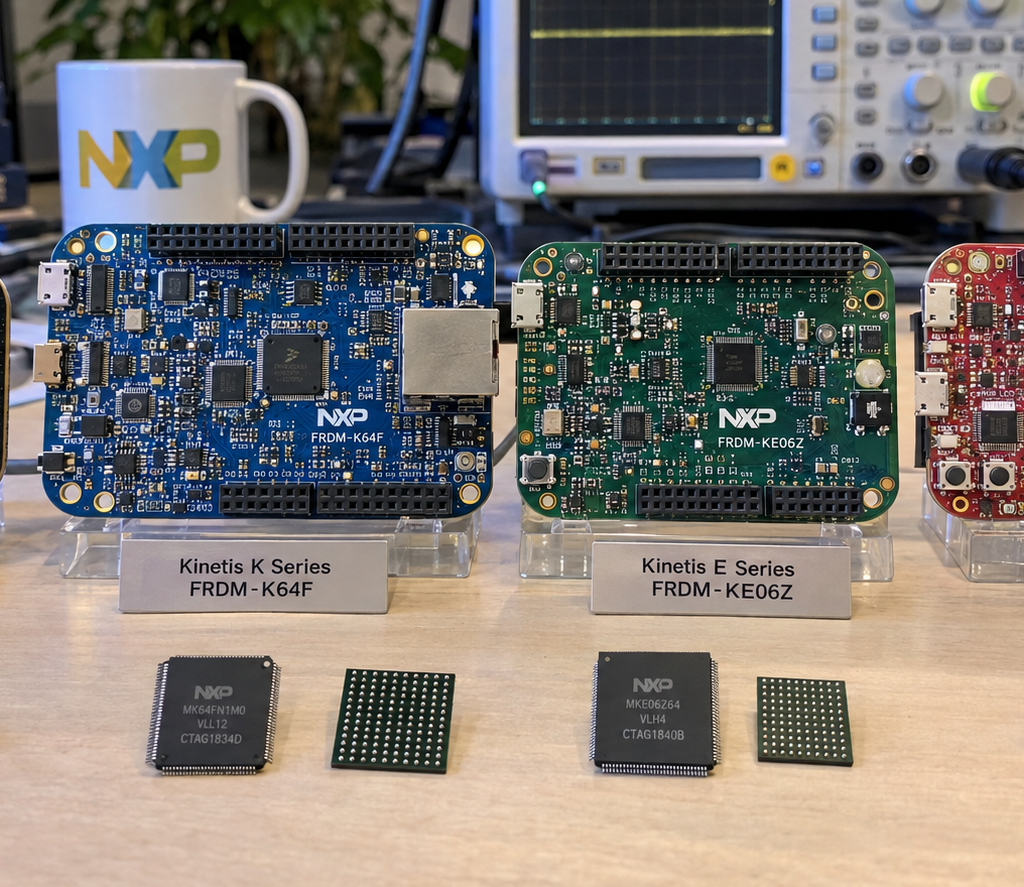
The Kinetis K series is a group of higher performance general purpose microcontrollers based primarily on Arm Cortex M4 technology. NXP designed these devices for applications requiring stronger processing capability together with integrated peripherals.
K series devices can provide combinations of Flash and SRAM memory, ADC and DAC functions, timers, communication interfaces, USB, Ethernet, security features, and other peripherals depending on the specific model.
These characteristics make Kinetis K devices suitable for embedded controllers, industrial equipment, measurement systems, human machine interfaces, and connected embedded products.
NXP’s documentation describes Kinetis K devices as high performance Cortex M4 based microcontrollers.
Kinetis L Series
The Kinetis L series focuses on low power embedded applications. These microcontrollers use Arm Cortex M0+ cores and were designed for applications where energy consumption is an important consideration.
Kinetis L devices can provide features such as ADCs, timers, communication interfaces, USB on selected models, LCD support on some devices, and multiple low power operating modes.
NXP also provides FRDM development platforms for several Kinetis L devices, including the FRDM KL02Z.
This family can therefore be useful in battery powered sensors, portable electronics, smart meters, and other products that need to operate efficiently for extended periods.
Kinetis E Series
The Kinetis E series focuses on robust 5 V microcontroller applications. NXP lists Kinetis E devices based on Arm Cortex M0+ and Cortex M4 cores within its current software ecosystem.
Some E series devices are designed for applications that benefit from 5 V operation and robust analog and digital control capabilities. Development boards such as the FRDM KE02Z40M, FRDM KE04Z, and FRDM KE06Z provide platforms for evaluating different Kinetis E devices.
These characteristics make the E family relevant to industrial control, appliances, motor control, touch interfaces, and other embedded applications where electrical robustness is important.
Other Kinetis Families
The Kinetis portfolio also includes families designed for more specialized requirements. For example, NXP identifies the Kinetis V series for motor control and power conversion, while other Kinetis devices target USB, security, connectivity, measurement, and specialized embedded applications.
This broad portfolio is one reason Kinetis should be evaluated at the individual device level. Two Kinetis MCUs can have significantly different processor capabilities, memory sizes, peripherals, packages, and power characteristics.
How to Program a Kinetis Microcontroller
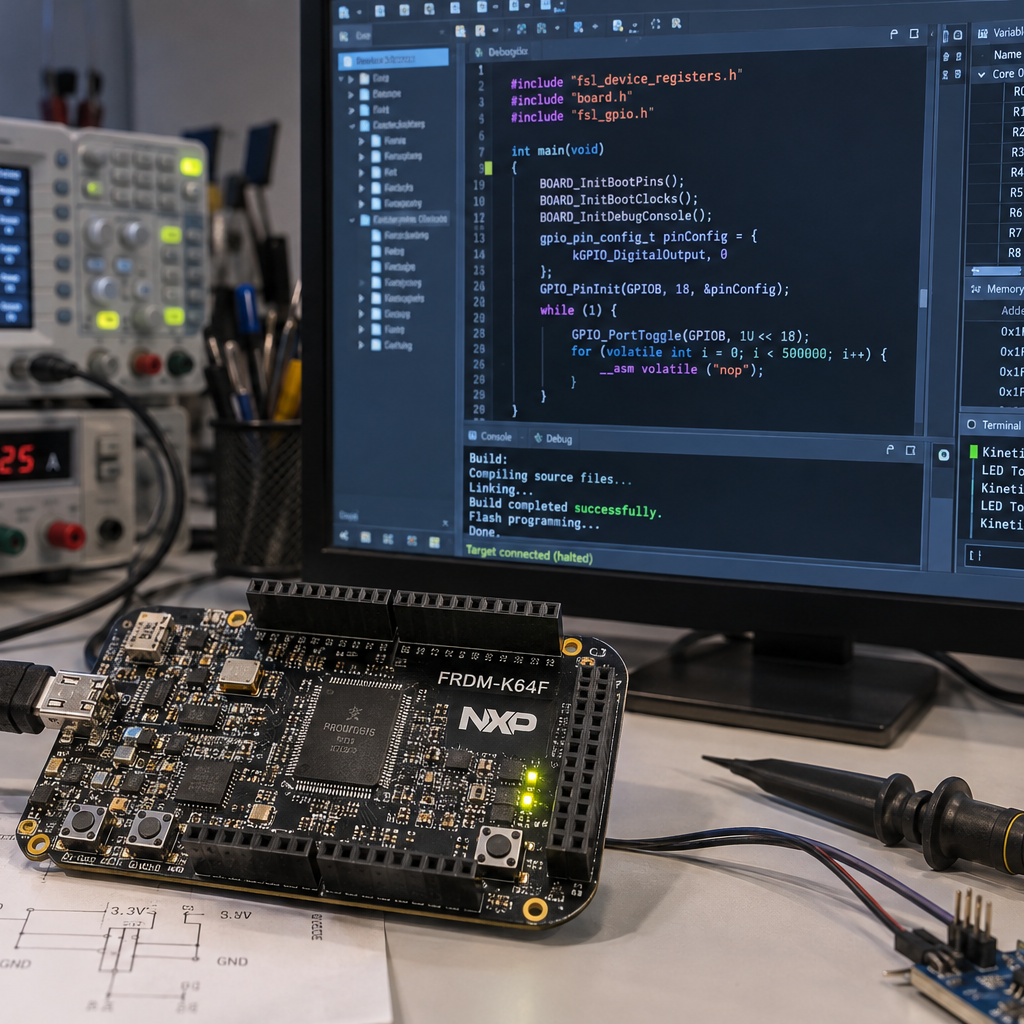
Kinetis development generally uses embedded C or C++ together with NXP’s development ecosystem. NXP’s current MCUXpresso platform provides an IDE, SDK, configuration tools, debugging support, and software examples for its Arm Cortex M based MCUs.
Embedded C Programming
Embedded C is commonly used to write firmware for Kinetis devices. Developers can configure GPIO, timers, ADCs, communication peripherals, interrupts, and other hardware through application code and device drivers.
The firmware is compiled into a binary image and programmed into the MCU’s Flash memory. During development, a debugger can then be used to set breakpoints, inspect variables, monitor registers, and step through program execution.
MCUXpresso Development Tools
NXP’s MCUXpresso ecosystem includes the MCUXpresso IDE, MCUXpresso SDK, and MCUXpresso Config Tools. The IDE provides editing, compiling, and debugging capabilities, while the SDK supplies drivers, middleware, examples, and other software components. Configuration tools help developers configure pins, clocks, peripherals, and related device settings.
NXP also maintains Kinetis specific SDK resources containing peripheral drivers, connectivity stacks, middleware, RTOS components, documentation, examples, and demonstration applications.
Programmer and Debugger
A programmer and debugger provides the connection between the development computer and the Kinetis MCU. It allows developers to transfer firmware to Flash memory and debug the running application.
NXP’s ecosystem supports debugging through tools such as MCU Link, while several Kinetis development boards provide convenient development and programming interfaces.
Kinetis Development Boards
Development boards make it easier to learn, prototype, program, and test Kinetis microcontrollers before designing a custom PCB. NXP has produced several Kinetis based Freedom development platforms, commonly identified by the FRDM prefix.
These boards typically provide access to MCU pins, USB connectivity, power options, user interface components, and an onboard programming or debugging interface. The exact hardware depends on the Kinetis family being evaluated.
FRDM Development Boards
NXP’s Freedom platform includes development boards for different Kinetis families. For example, the FRDM KL26Z supports Kinetis KL16 and KL26 devices and provides access to MCU I/O, expansion options, low power operation, and an integrated debug interface.
Other boards target higher performance Kinetis devices. The FRDM K28F, for example, uses a Kinetis K28 Cortex M4 MCU and provides USB interfaces, OpenSDA based programming and debugging, and support for MCUXpresso development tools.
These boards allow developers to experiment with peripherals and firmware without immediately creating a custom circuit board.
Kinetis Evaluation Boards
Kinetis evaluation platforms are available for different requirements, including general purpose control, low power systems, motor control, and wireless connectivity.
For example, the FRDM KV31F platform targets Kinetis KV30 and KV31 devices, while the FRDM KW36 supports Kinetis wireless MCUs with Bluetooth Low Energy, CAN, LIN, and a 2.4 GHz radio.
This range of boards gives developers a practical way to test the specific peripherals and capabilities required by their projects.
Prototyping With Kinetis
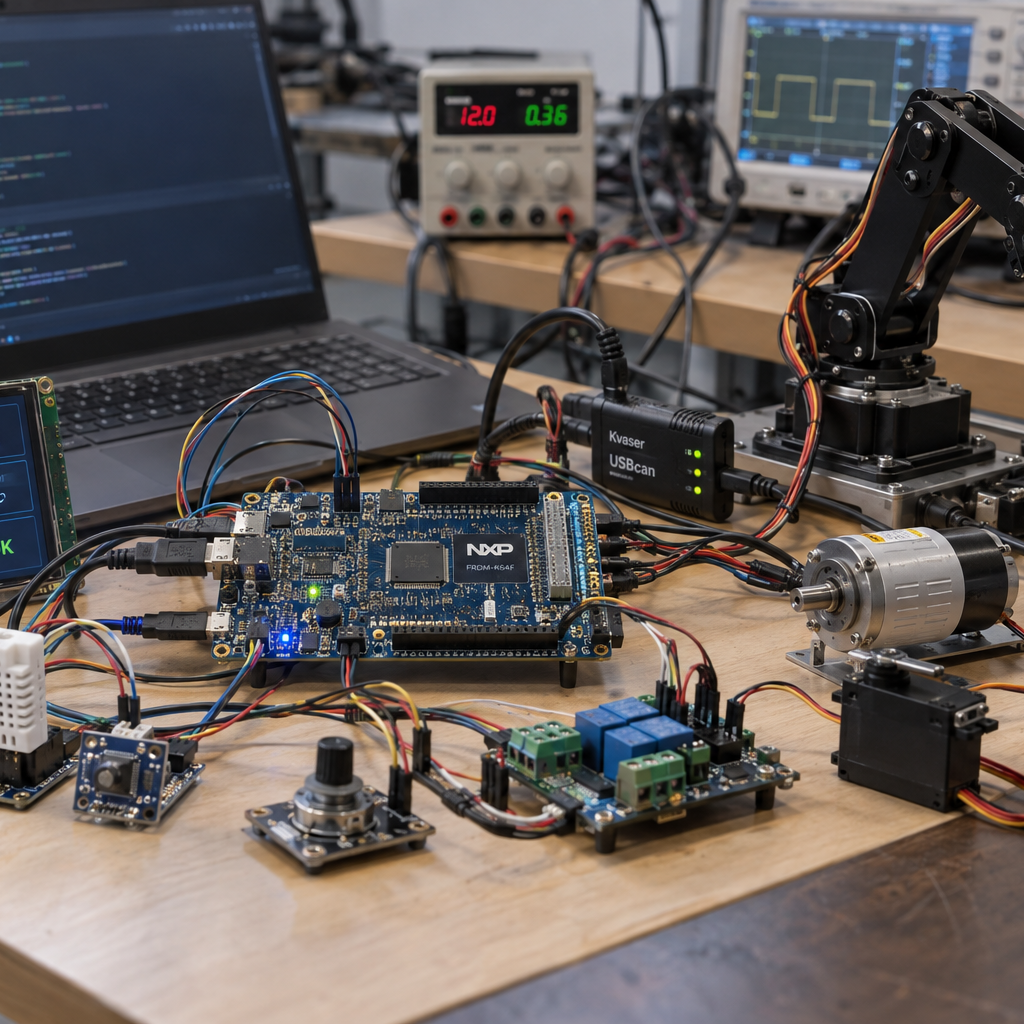
A typical Kinetis development setup includes a development board, USB connection, computer, sensors or actuators, and software tools. Developers can connect external components through the board’s accessible I/O pins and then create firmware to control or measure them.
For example, a prototype could connect a temperature sensor to an ADC input, an LED to GPIO, and a motor driver to a PWM output. The developer can then test the complete control sequence before moving the design to a custom PCB.
Applications of Kinetis Microcontrollers
Kinetis microcontrollers have been used across many embedded applications because the portfolio includes devices optimized for different combinations of processing performance, power consumption, connectivity, analog functions, and control features.
The appropriate Kinetis family depends on the application’s technical requirements rather than simply the Kinetis name.
IoT Devices
Kinetis MCUs can be used in connected embedded devices that collect sensor information, process data, and communicate with other systems.
Wireless Kinetis families extend these capabilities further. For example, the Kinetis KW36 family integrates a 2.4 GHz transceiver with Bluetooth Low Energy support, along with CAN and LIN connectivity.
This type of hardware can support connected sensors, monitoring equipment, smart devices, and other embedded products.
Industrial Automation
Industrial equipment often requires reliable GPIO, analog measurement, timers, communication interfaces, and real time control. Kinetis devices can combine many of these functions inside a single MCU.
A Kinetis based controller can monitor sensors, communicate with other controllers, operate relays or actuators, and execute control logic. Higher performance families can also provide additional processing capability for more demanding applications.
Motor Control
Motor control is another important application area for Kinetis. PWM timers can generate control signals, while ADC channels can measure current, voltage, position, or other feedback signals.
NXP’s Kinetis KV series is specifically associated with real time motor control applications and includes Cortex M4 based devices.
A typical system can combine the Kinetis MCU with a gate driver or power stage, sensors, and a motor to create a closed loop control system.
Consumer Electronics
Kinetis microcontrollers can also be used in consumer products that require user interfaces, sensing, communication, and low power operation.
Depending on the device, developers can connect buttons, touch interfaces, displays, sensors, USB devices, and other peripherals directly to the MCU. Low power Kinetis families can be particularly useful in portable products where battery life matters.
Sensor and Measurement Systems
Kinetis devices with ADCs, timers, communication interfaces, and processing capabilities can form the central controller of measurement equipment.
The MCU can acquire sensor signals, process the measurements, apply filtering or calculations, and send the resulting data to another device through a communication interface.
This approach is useful for environmental monitoring, instrumentation, portable measurement equipment, and industrial sensing systems.
Advantages and Limitations of Kinetis Microcontrollers
Kinetis provides a broad range of Arm based microcontrollers, so its advantages and limitations depend heavily on the specific family and device selected.
Advantages of Kinetis Microcontrollers
One major advantage is the range of available devices. Developers can choose between different Cortex M architectures, memory configurations, power characteristics, peripheral combinations, and package options.
The ecosystem is another important advantage. NXP provides MCUXpresso IDE, SDK, and Config Tools for supported devices. The SDK provides drivers, middleware, examples, and other software components, while the Config Tools help configure pins, clocks, and peripherals.
Kinetis also has a large collection of development hardware, including FRDM boards and specialized evaluation platforms.
Limitations of Kinetis Microcontrollers
The large number of Kinetis families can make device selection difficult for beginners. Two MCUs carrying the Kinetis name may have substantially different processor cores, memory capacities, peripherals, and electrical characteristics.
Another consideration is that some Kinetis development boards are older or have reached the end of their manufacturing lifecycle. NXP’s current product pages, for example, identify some FRDM Kinetis boards as no longer manufactured while other Kinetis platforms remain available.
Therefore, engineers should check the current NXP product page, datasheet, reference manual, software support, and lifecycle status before selecting a specific Kinetis device for a new design.
Frequently Asked Questions About Kinetis Microcontrollers
Is Kinetis a 32 Bit Microcontroller?
Yes. Kinetis refers to a family of 32 bit microcontrollers based on Arm Cortex M processor architectures. However, the exact processor core and capabilities depend on the specific Kinetis family. For example, Kinetis K devices use Cortex M4, while Kinetis L devices use Cortex M0+.
What ARM Core Does Kinetis Use?
Kinetis devices use different Arm Cortex M cores depending on the series. Cortex M0+ is common in low power Kinetis L devices, while Cortex M4 is used extensively in Kinetis K devices. Kinetis E also includes both Cortex M0+ and Cortex M4 based products.
This allows the Kinetis portfolio to cover applications ranging from simple low power controllers to more demanding embedded systems.
What Programming Language Is Used for Kinetis?
Embedded C is commonly used for Kinetis firmware. Developers can also use C++ where appropriate. NXP’s MCUXpresso ecosystem provides development and configuration tools, software libraries, drivers, middleware, and examples for supported Kinetis devices.
What Is the Kinetis K Series?
The Kinetis K series is a group of higher performance microcontrollers based on Arm Cortex M4. NXP describes the series as offering optimized performance, scalable integration, and low power capabilities. Depending on the device, features can include ADC, DAC, timers, GPIO, UART, I2C, SPI, USB, Ethernet, CAN, and security functions.
What Is the Difference Between Kinetis K and L Series?
The main difference is their processor architecture and design emphasis. Kinetis K is primarily based on Cortex M4 and targets higher performance and broader integration, while Kinetis L is based on Cortex M0+ and emphasizes low power operation and energy efficiency.
The choice between them therefore depends on requirements such as processing performance, power consumption, memory, peripherals, package, and application needs.
Conclusion
NXP Kinetis is a broad family of 32 bit Arm based microcontrollers covering different performance, power, connectivity, analog, and control requirements. Its portfolio includes general purpose and application specific devices, including Kinetis K for Cortex M4 based performance, Kinetis L for ultra low power applications, and Kinetis E for robust 5 V applications.
Kinetis devices combine processor cores with Flash, SRAM, GPIO, timers, analog peripherals, communication interfaces, and other integrated functions. Development can be supported through NXP’s MCUXpresso ecosystem, which provides tools and software resources for supported Kinetis devices.
1 thought on “NXP Kinetis Microcontroller: Complete Guide to Features, Architecture and Applications”