
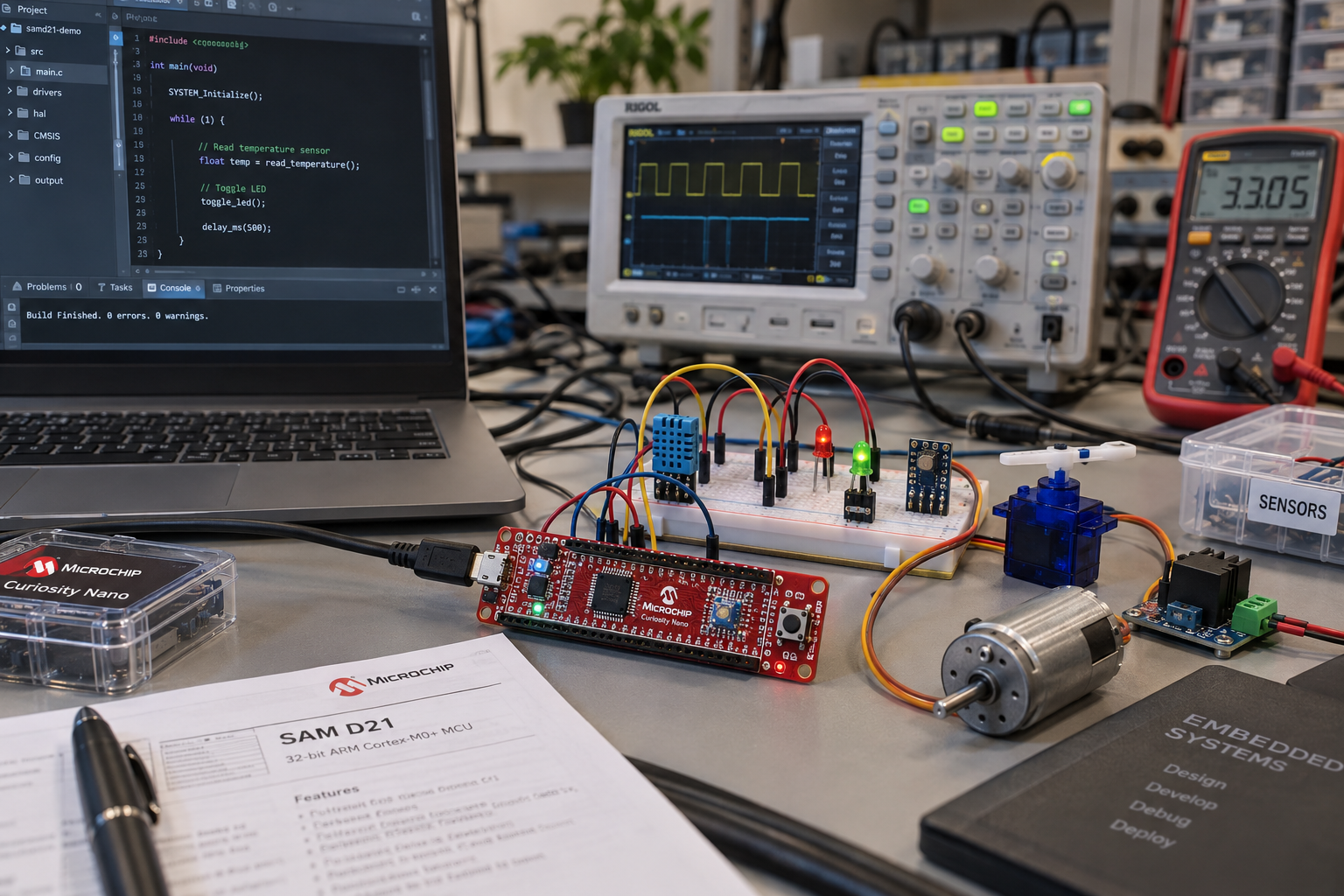
What Is a SAM Microcontroller?
A SAM microcontroller is a family of 32 bit microcontrollers from Microchip Technology that uses Arm Cortex processor cores for embedded applications. The SAM portfolio covers devices designed for low power products, general purpose control, industrial systems, connectivity, and higher performance embedded applications. Different SAM families use different Cortex M cores, so their processing capability, memory, peripherals, and power features can vary significantly.
SAM microcontrollers combine a processor core with Flash memory, SRAM, GPIO, timers, analog peripherals, communication interfaces, and other hardware in a single device. This integration allows engineers to build embedded systems without requiring a separate processor and many external control components.
What Does SAM Mean?
SAM is the product family name used by Microchip for a range of 32 bit Arm based microcontrollers. Unlike a single MCU model, SAM represents multiple families with different performance levels and target applications.
For example, SAM D devices are designed for general purpose and low power applications. SAM L devices focus on ultra low power operation, while SAM C devices provide 5 V operation for applications such as industrial control and appliances. Higher performance families such as SAM E and SAM S use more powerful Arm Cortex M processors and provide larger memory and advanced connectivity options.
How Does a SAM Microcontroller Work?
A SAM microcontroller executes firmware stored in its internal Flash memory. When the device starts, the processor reads instructions from memory and executes them to control connected hardware.
The CPU communicates with peripherals through the device’s internal architecture. GPIO pins can control LEDs, switches, sensors, and actuators, while timers can generate precise timing signals and PWM outputs. Communication peripherals can connect the MCU to other controllers, sensors, displays, storage devices, and communication modules.
Different SAM devices use different Cortex M cores. For example, SAM D1x/2x devices use Arm Cortex M0+ cores, SAM E5x devices use Cortex M4F processors, and SAM S70 devices use Cortex M7 processors.
Why Are SAM Microcontrollers Important?
SAM microcontrollers are important because they give engineers access to a broad range of 32 bit processing capabilities and integrated peripherals within the same product family. Instead of selecting a completely different MCU platform for every embedded project, developers can choose a SAM device that matches the required performance, memory, connectivity, and power requirements.
The portfolio ranges from low power Cortex M0+ devices to high performance Cortex M7 products. This makes the SAM family suitable for applications ranging from simple control systems to connected industrial equipment and more demanding embedded designs.
32 Bit ARM Cortex M Performance
One of the main characteristics of SAM microcontrollers is their use of 32 bit Arm Cortex processor cores. The exact core depends on the family and device.
For example, SAM D1x/2x devices can use Cortex M0+ cores operating up to 48 MHz, while SAM E5x devices use Cortex M4F processors running up to 120 MHz. Higher performance SAM S70 devices use Cortex M7 processors running up to 300 MHz.
This range gives designers flexibility when choosing processing performance for a particular embedded system.
Flexible Peripheral Integration
SAM devices integrate many peripherals directly into the microcontroller. Depending on the family, these can include ADCs, DACs, timers, PWM controllers, DMA, USB, CAN, Ethernet, SPI, I2C, UART, and configurable serial communication modules.
For example, SAM D devices can provide multiple SERCOM modules that can be configured for different communication functions. Higher performance SAM E5x devices add features such as Ethernet, CAN FD, USB, QSPI, and SD host controllers.
This level of integration can reduce the number of external components required in an embedded design.
Low Power Operation
Power efficiency is another important part of the SAM portfolio. Several SAM families provide dedicated low power modes for battery powered and energy sensitive applications.
The SAM L family, for example, is designed specifically for ultra low power operation. Some SAM L devices combine low power operation with analog peripherals, touch sensing, security features, and other embedded functions.
Architecture of a SAM Microcontroller
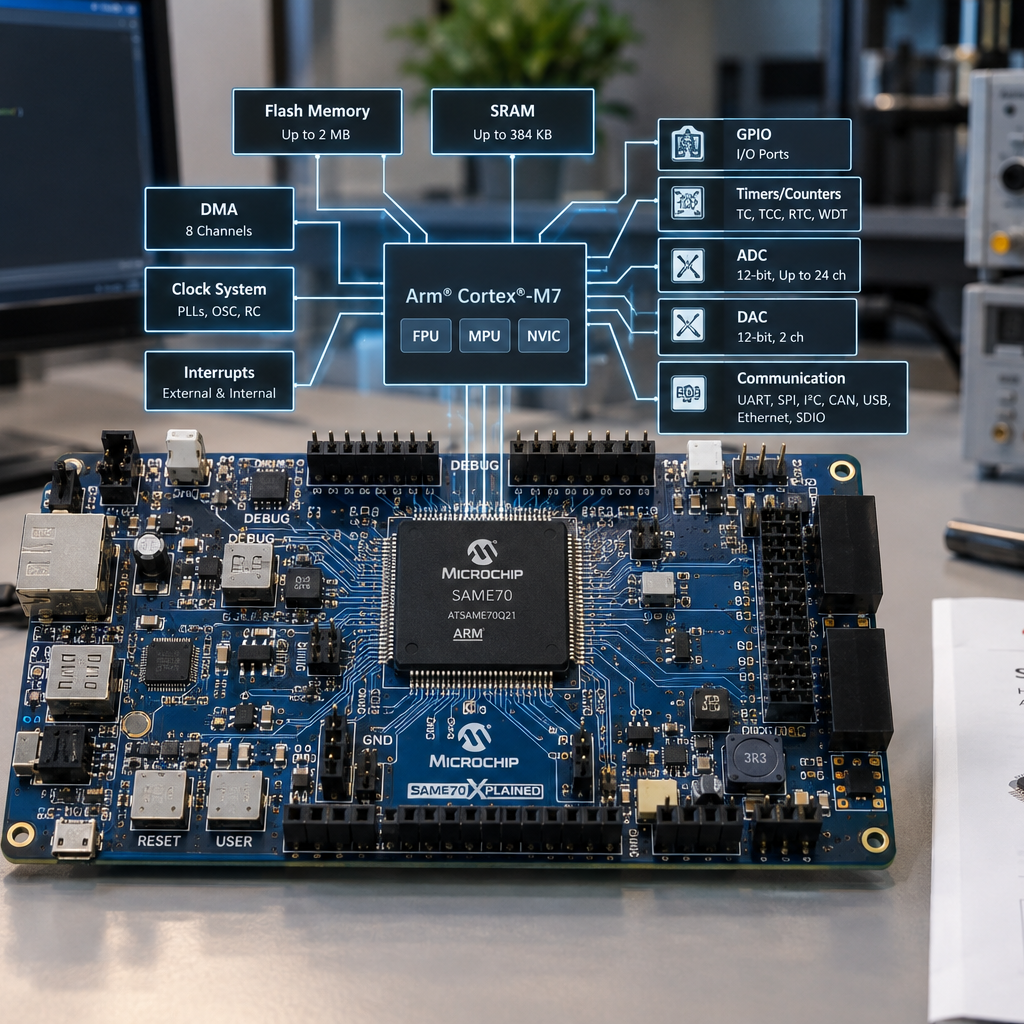
The architecture of a SAM microcontroller depends on the specific family, but most devices combine an Arm Cortex M processor with internal memory, peripheral controllers, GPIO, clock and power management, and communication interfaces.
The architecture is designed to let the CPU and peripherals work together efficiently. More advanced devices can also include features such as DMA, cache memory, tightly coupled memory, hardware security, and high speed connectivity.
ARM Cortex M CPU Core
The CPU is the central processing element of a SAM microcontroller. It executes the firmware and coordinates the operation of the device’s peripherals.
Different SAM families use different Cortex M cores. The Cortex M0+ provides a compact and power efficient option for devices such as SAM D and SAM C, while Cortex M4F and Cortex M7 provide higher processing performance and features such as floating point support.
The processor choice therefore affects the MCU’s performance, power consumption, memory architecture, and suitability for different applications.
Flash and SRAM
SAM microcontrollers use internal Flash memory to store firmware and SRAM for temporary data used while the program runs.
Memory capacity varies considerably between families. SAM D1x/2x devices can provide Flash capacities from 8 KB to 256 KB, while SAM E5x devices can provide up to 1 MB of Flash and 256 KB of SRAM. High performance SAM S70 devices can provide up to 2 MB of Flash and 384 KB of SRAM.
Some higher performance SAM devices also include cache and tightly coupled memory options to improve processor and memory performance.
GPIO and Peripherals
GPIO provides the connection between the microcontroller and external hardware. Engineers can configure these pins for digital input, digital output, or alternate peripheral functions depending on the device.
The internal peripherals expand what the MCU can control. A SAM device can combine GPIO with timers, ADCs, communication interfaces, USB, DMA, touch controllers, and other hardware. This allows one microcontroller to handle sensing, processing, communication, and control tasks within the same embedded system.
Key Features of SAM Microcontrollers
SAM microcontrollers combine a 32 bit Arm Cortex M processor with a wide range of integrated peripherals. The exact feature set depends on the SAM family and device, but common capabilities include analog interfaces, timers, communication modules, DMA, USB, touch control, and security features.
GPIO
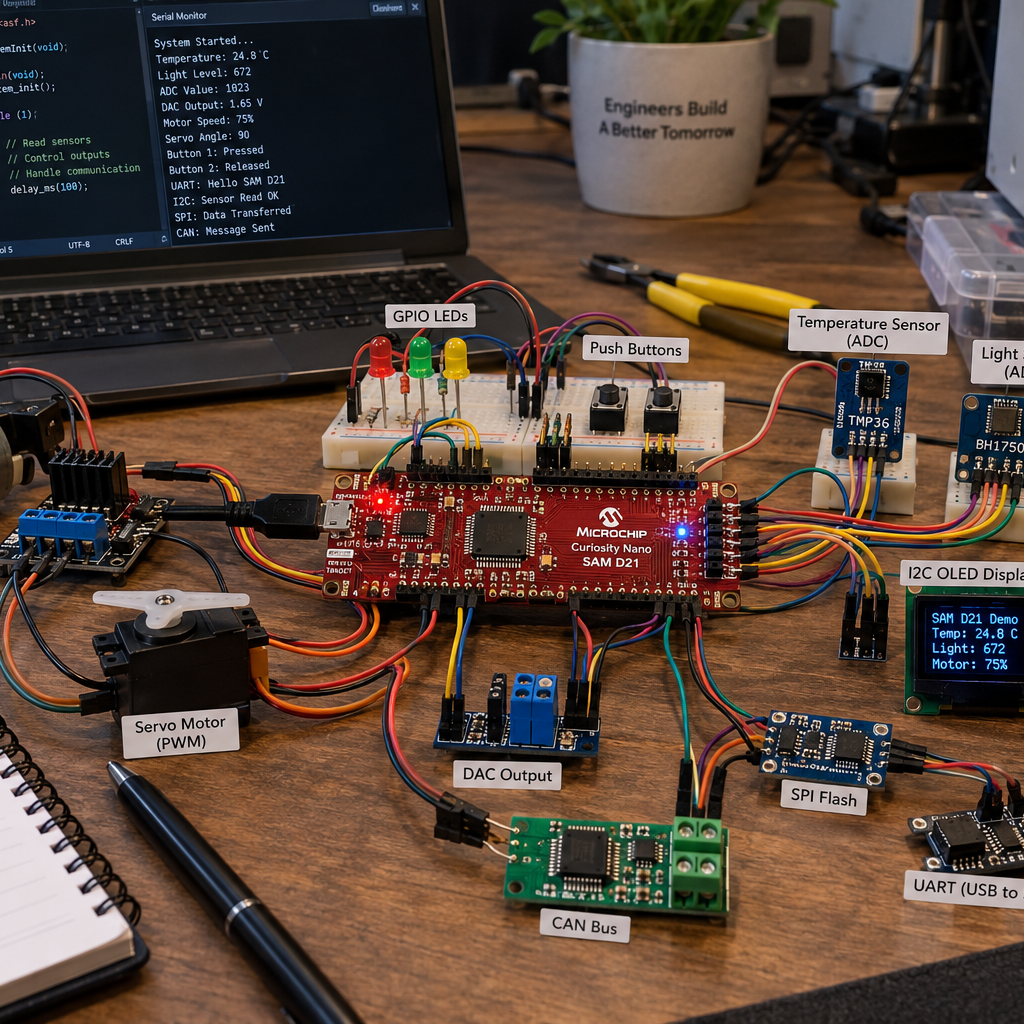
General Purpose Input/Output (GPIO) pins allow a SAM microcontroller to interact directly with external hardware. Engineers can configure pins as digital inputs or outputs and, on supported devices, assign them to alternate peripheral functions.
GPIO can connect the MCU to buttons, LEDs, sensors, displays, relays, motor drivers, and other electronic circuits. This makes GPIO one of the most important interfaces in practical embedded systems.
ADC and Analog Functions
Many SAM devices include built in Analog to Digital Converters (ADCs) for measuring signals from sensors and other analog sources. Depending on the family, SAM devices can also include DACs, analog comparators, operational amplifiers, and other analog features.
For example, SAM E5x devices provide dual 12 bit ADCs and dual 12 bit DACs, while SAM S devices offer advanced ADC and DAC capabilities for higher performance applications.
Timers and PWM
Timers and counters allow SAM microcontrollers to generate accurate timing signals, measure events, and control periodic operations. PWM outputs can control motor speed, LED brightness, servo positioning, and power electronics.
Some SAM families also provide specialized timer and motor control features, making them suitable for applications that require accurate control signals.
Communication Interfaces
SAM microcontrollers support several communication protocols depending on the device. These can include UART, USART, SPI, I2C, USB, CAN FD, and Ethernet.
The SAM E5x family, for example, includes configurable SERCOM interfaces, USB, CAN FD, Ethernet MAC, and QSPI. Higher performance SAM S70 devices add multiple UART, SPI, and I2C interfaces along with high speed USB.
Interrupts and DMA
Interrupts allow the processor to respond to important hardware events without continuously checking every peripheral. This helps embedded applications react quickly to timers, communication events, sensor inputs, and other conditions.
Direct Memory Access (DMA) can transfer data between memory and peripherals with less CPU involvement. This is particularly useful for applications that handle continuous sensor data, communication streams, or other repetitive transfers.
Low Power and Security Features
Several SAM families include dedicated features for low power operation and embedded security. SAM L devices focus strongly on energy efficient operation, while SAM L10 and L11 add features such as secure boot, TrustZone, cryptographic functions, and tamper detection.
Higher performance SAM devices can also include hardware encryption, true random number generation, and memory integrity features for applications where data protection matters.
Microchip SAM Microcontroller Families
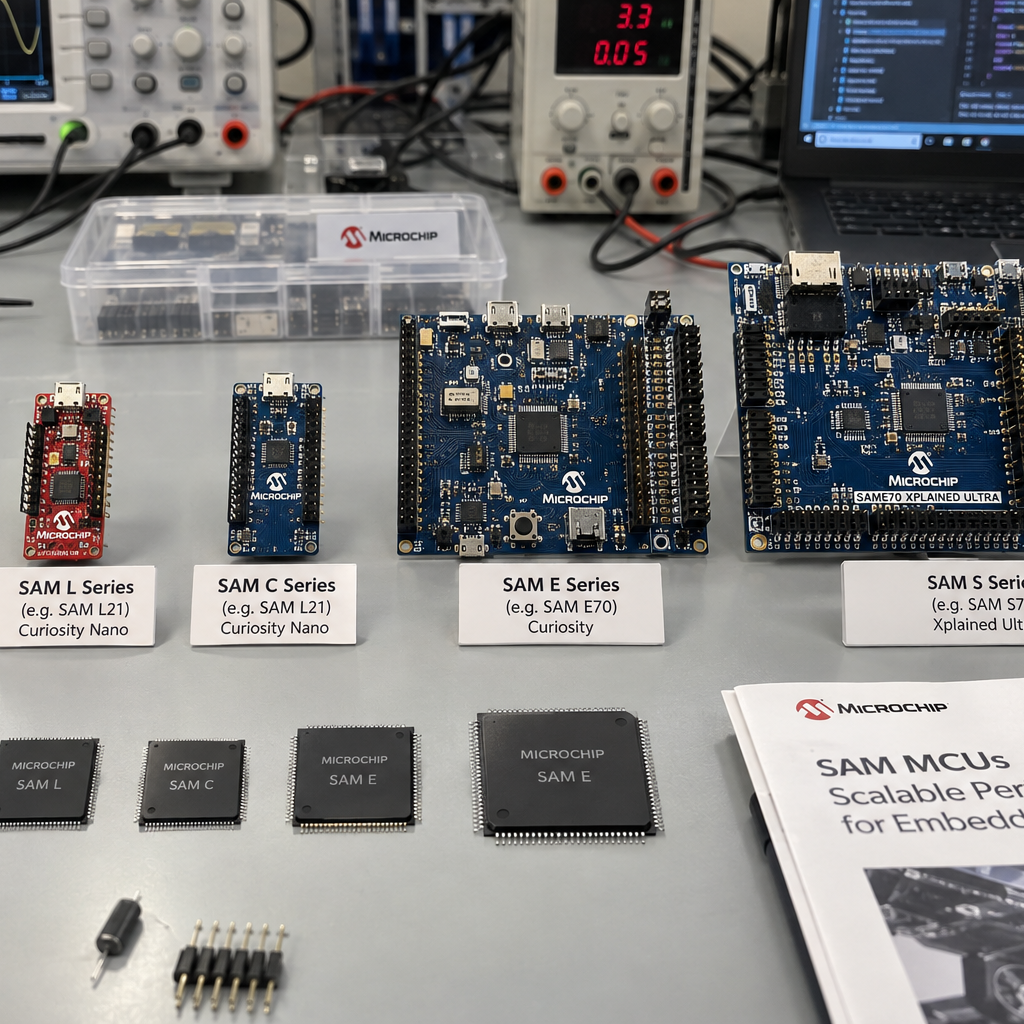
Microchip offers SAM microcontrollers across several families, allowing developers to select devices according to processing performance, power consumption, connectivity, memory, and application requirements. The official SAM family reference includes SAM D, SAM L, SAM C, SAM 4, SAM G, SAM D5x, SAM E5x, and SAM S7/E7/V7 families.
SAM D
SAM D is a broad family of general purpose 32 bit microcontrollers based mainly on Arm Cortex M0+ and Cortex M4F cores, depending on the series.
SAM D10/D11 and SAM D20/D21 devices target cost sensitive and general purpose embedded applications. SAM D21, for example, adds USB, DMA, timers, and a range of analog and communication peripherals. Higher performance SAM D5x devices use Cortex M4F processors and provide substantially more memory and processing capability.
SAM L
SAM L focuses on low power embedded applications. These devices are designed for battery powered products, IoT endpoints, sensor systems, and other applications where energy consumption matters.
The family includes devices such as SAM L10, SAM L11, SAM L21, and SAM L22. SAM L10 and L11 use Cortex M23 cores and combine low power operation with analog, touch, and security features.
SAM C
SAM C devices are designed for applications that benefit from 5 V operation, including industrial control, appliances, and automotive systems.
The SAM C2x family uses an Arm Cortex M0+ core and can provide CAN FD, LIN, ADC, DMA, Event System, and flexible serial communication interfaces.
SAM E
SAM E devices target applications that require stronger processing performance and advanced connectivity. SAM E5x devices use Arm Cortex M4F processors running up to 120 MHz and can include Ethernet, CAN FD, USB, QSPI, ADC, DAC, and multiple communication interfaces.
SAM S
SAM S devices target higher performance embedded applications. The SAM S70 family uses an Arm Cortex M7 processor running up to 300 MHz, with up to 2 MB of Flash, 384 KB of SRAM, cache memory, high speed USB, multiple serial interfaces, and advanced analog functions.
How to Program a SAM Microcontroller
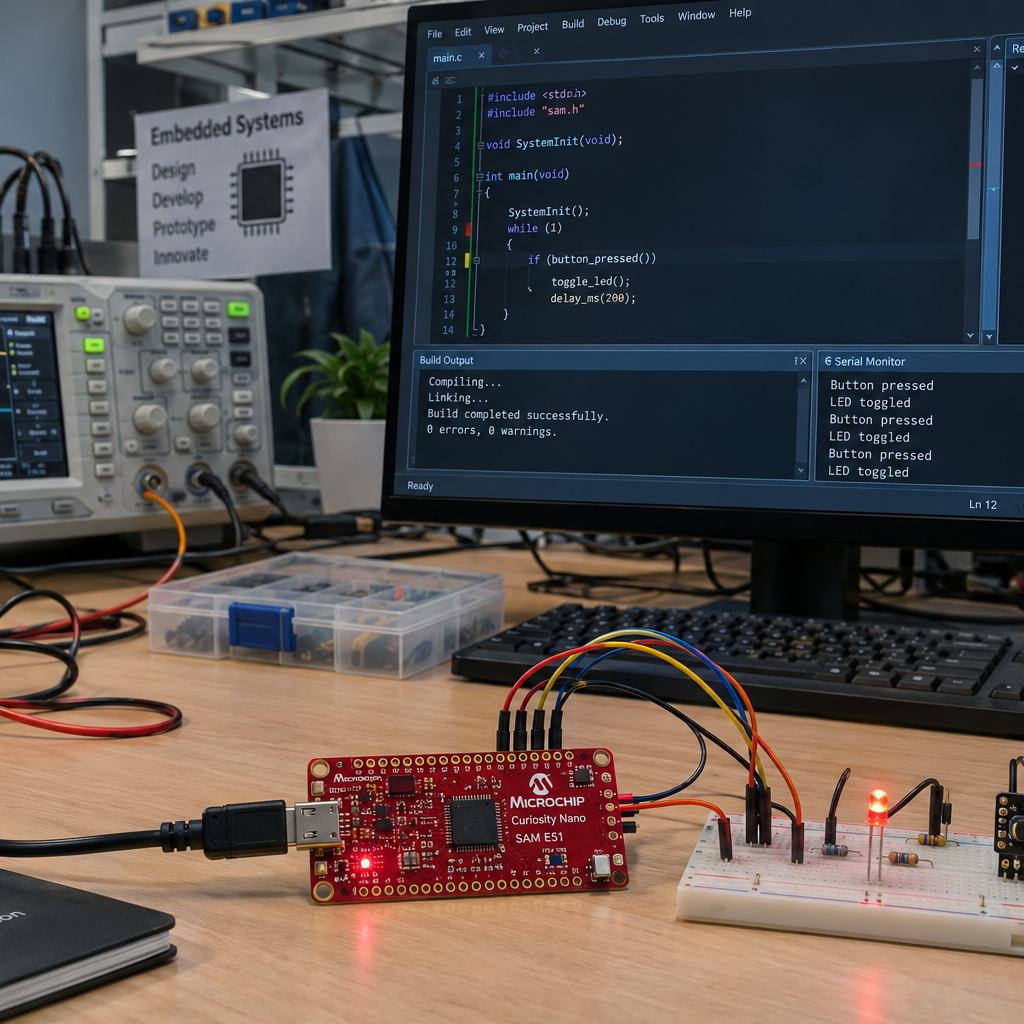
Programming a SAM microcontroller involves writing firmware that controls the processor, memory, GPIO pins, and integrated peripherals. Developers commonly use embedded C along with Microchip development tools and software frameworks. The exact workflow depends on the SAM family and the selected development board.
Embedded C Programming
C is widely used for SAM embedded development because it provides direct access to hardware while remaining practical for larger firmware projects. Developers can configure clocks, GPIO, timers, ADCs, communication interfaces, interrupts, and other peripherals through C code.
For larger projects, developers can use Microchip’s software libraries and peripheral drivers instead of configuring every hardware register manually. This can reduce development time and make firmware easier to maintain.
MPLAB X IDE and MPLAB Harmony
Microchip supports SAM development through MPLAB X IDE and the MPLAB Harmony software ecosystem. Harmony provides configuration tools, peripheral libraries, drivers, middleware, and example projects for supported SAM devices. Microchip also provides SAM development resources and application examples for different device families.
The development process generally involves selecting the MCU, configuring its peripherals, generating or creating the project, writing application code, compiling the firmware, and debugging it on the target hardware.
Programmer and Debugger
A programmer and debugger is used to transfer firmware to the SAM device and troubleshoot the application. Depending on the development board, programming and debugging hardware may already be integrated into the board.
During debugging, developers can set breakpoints, inspect variables, step through firmware, and identify problems in peripheral configuration or application logic.
SAM Development Boards
Development boards make it easier to learn and prototype with SAM microcontrollers. Instead of designing a complete PCB from the beginning, engineers can start with a board that already provides the MCU, power circuitry, programming interface, clock components, connectors, and access to important GPIO pins.
Microchip provides development and evaluation hardware across its SAM portfolio, including boards designed around different SAM families and applications.
SAM Curiosity Boards
Microchip’s Curiosity development ecosystem provides hardware for experimenting with supported microcontrollers. Depending on the specific SAM device, a development board can provide an onboard debugger, USB connection, expansion headers, and access to the MCU’s peripherals.
These boards are useful for testing firmware and hardware concepts before designing a custom PCB.
Xplained Boards
Microchip’s Xplained development platform includes evaluation boards designed to demonstrate MCU features and peripherals. SAM based Xplained boards can provide access to interfaces, sensors, expansion connectors, and other hardware needed for evaluation.
This approach allows engineers to test specific MCU capabilities before committing to a production design.
Prototyping With SAM Boards
A SAM development board can be connected to sensors, displays, motors, communication modules, and other external circuits. Developers can first verify the firmware and peripheral configuration on the evaluation hardware and then transfer the proven design to a custom PCB.
For example, a SAM D board can be used for a sensor controller, while a higher performance SAM E or SAM S board can be evaluated for applications requiring Ethernet, USB, CAN FD, or greater processing performance.
Applications of SAM Microcontrollers
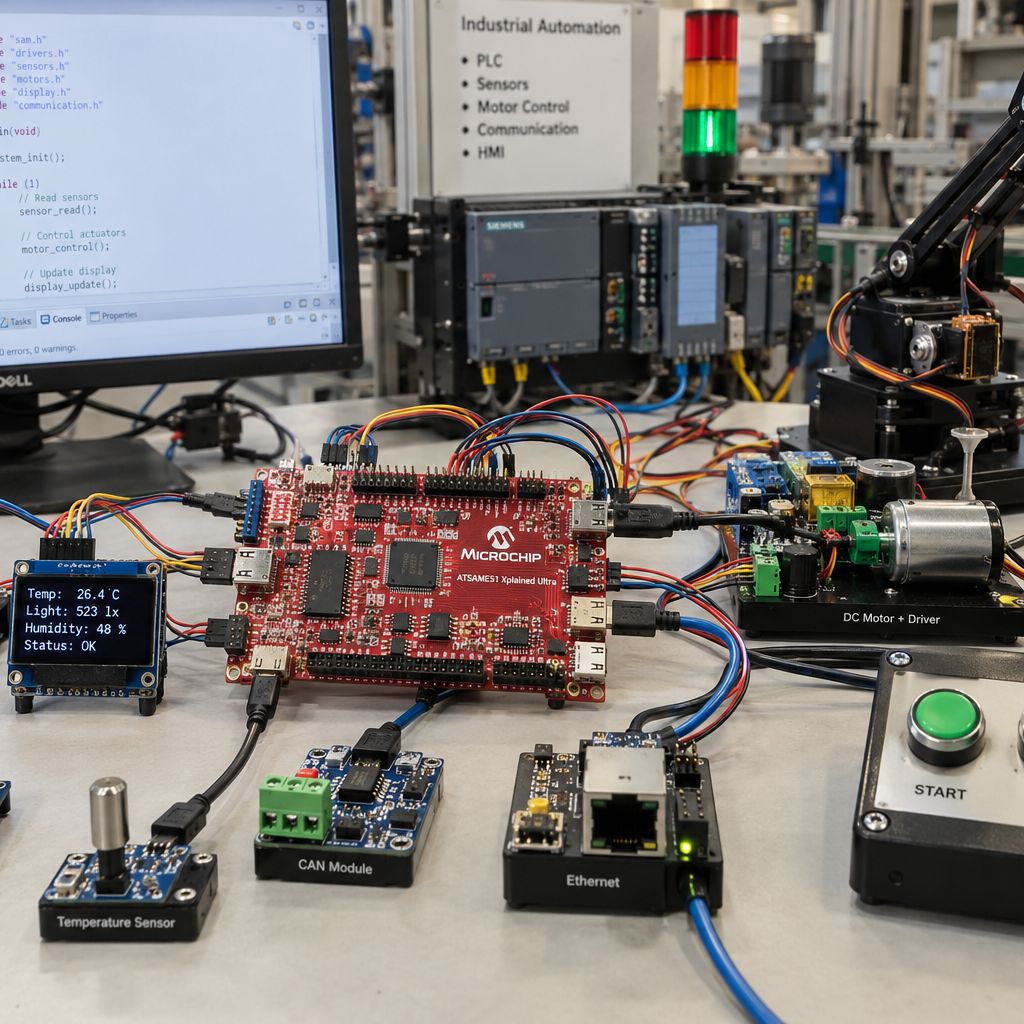
SAM microcontrollers are used across many embedded applications because the portfolio covers different combinations of processing performance, memory, power consumption, analog capability, connectivity, and security.
IoT Devices
Low power SAM devices can be used in connected sensors, smart meters, tracking devices, home automation equipment, and battery powered IoT products. SAM L devices are particularly focused on low power operation, touch interfaces, and security for IoT applications.
Industrial Automation
SAM microcontrollers can handle industrial sensing, control interfaces, communication, monitoring, and automation tasks. SAM E5x devices, for example, combine a Cortex M4F processor with Ethernet, CAN FD, USB, ADC, DAC, and other peripherals that can support connected industrial systems.
Robotics
In robotics, a SAM MCU can process sensor inputs and control motors, servos, indicators, and communication interfaces. Timers, PWM, ADC, GPIO, and communication peripherals allow one controller to coordinate several parts of a robotic system.
Sensor Systems
SAM devices can collect data from temperature, pressure, light, motion, and other sensors using integrated analog and digital peripherals. DMA and event driven features can also help move or process sensor data while reducing unnecessary CPU activity.
Motor Control
SAM microcontrollers can generate PWM signals, monitor analog feedback, handle timing functions, and communicate with motor drivers. Certain SAM families are specifically positioned for motor control and industrial drive applications.
Consumer Electronics
SAM MCUs can be used in appliances, displays, touch interfaces, smart accessories, control panels, and other consumer products. SAM L devices combine low power operation with touch and analog capabilities, while higher performance SAM devices provide additional connectivity and processing resources.
Advantages and Limitations of SAM Microcontrollers
SAM microcontrollers cover a wide range of embedded applications, so their advantages depend on the specific family and device. Low power SAM L devices, general purpose SAM D devices, and high performance SAM S and E devices target different design requirements.
Advantages of SAM Microcontrollers
One major advantage is the wide range of processor performance available within the SAM portfolio. Developers can select devices using Cortex M0+, M23, M4, or M7 cores depending on the required processing capability. For example, SAM S70 devices use a 300 MHz Cortex M7 core, while SAM D1x/2x devices use Cortex M0+ processors at up to 48 MHz.
Another advantage is peripheral integration. SAM devices can combine GPIO, ADC, DAC, timers, PWM, DMA, USB, CAN FD, Ethernet, SPI, I2C, and other interfaces in one MCU, depending on the family. This can simplify hardware design and reduce the need for additional external controllers.
Power efficiency is also important across several SAM families. SAM L devices are specifically designed for low power applications, while other families provide different combinations of performance and energy efficiency.
Microchip also provides development boards, software tools, debuggers, and the MPLAB development ecosystem for SAM devices, giving developers hardware and software resources for prototyping and development.
Limitations of SAM Microcontrollers
The large number of SAM families can make device selection more complicated for beginners. Different devices can use different Cortex M cores, memory sizes, peripherals, package options, and power features. Developers therefore need to check the specific device documentation rather than assuming that every SAM MCU provides the same capabilities.
SAM devices also range from relatively simple low power controllers to high performance MCUs with extensive peripheral sets. A more capable device can require a more detailed understanding of clocks, memory, peripherals, interrupts, and development tools.
Another consideration is software and hardware migration between families. Although SAM devices share the broader Microchip ecosystem, firmware and peripheral configurations may need changes when moving between devices with different architectures or peripheral implementations.
Frequently asked questions about SAM microcontrollers
Is SAM a 32 bit microcontroller?
Yes. Microchip describes the SAM family as a series of 32 bit Arm Cortex M microcontrollers. However, the exact processor core and capabilities vary between SAM families.
What ARM core does SAM use?
SAM devices use different Arm Cortex M cores depending on the family. Examples include Cortex M0+, Cortex M23, Cortex M4, and Cortex M7. High performance SAM S70 devices use a Cortex M7 processor running at up to 300 MHz.
What programming language is used for SAM?
Embedded C is commonly used for SAM firmware development. Developers can use Microchip development tools, libraries, drivers, and the MPLAB Harmony ecosystem to configure peripherals and build applications.
Can SAM microcontrollers be programmed with MPLAB X IDE?
Yes. Microchip’s current development ecosystem supports SAM microcontrollers through MPLAB X IDE and MPLAB Harmony, with device specific software and development resources available for supported SAM families.
What are the main SAM microcontroller families?
Microchip’s SAM family reference includes SAM D, SAM L, SAM C, SAM 4, SAM G, SAM D5x, SAM E5x, and SAM S7/E7/V7 families. These families target different combinations of low power operation, general purpose control, connectivity, security, and high performance processing.
Conclusion
Microchip SAM microcontrollers provide a broad 32 bit Arm Cortex M platform for embedded system development. The portfolio ranges from low power SAM L and general purpose SAM D devices to higher performance SAM E and SAM S families with advanced connectivity and processing capabilities.
With integrated memory, analog peripherals, timers, communication interfaces, DMA, USB, CAN, Ethernet, and other features, SAM devices can support applications in IoT, industrial automation, robotics, sensing, motor control, and consumer electronics. Development boards and Microchip’s software ecosystem also provide resources for moving from initial prototypes to custom embedded designs.
1 thought on “Microchip SAM Microcontroller: Complete Guide to Features, Architecture and Applications”