
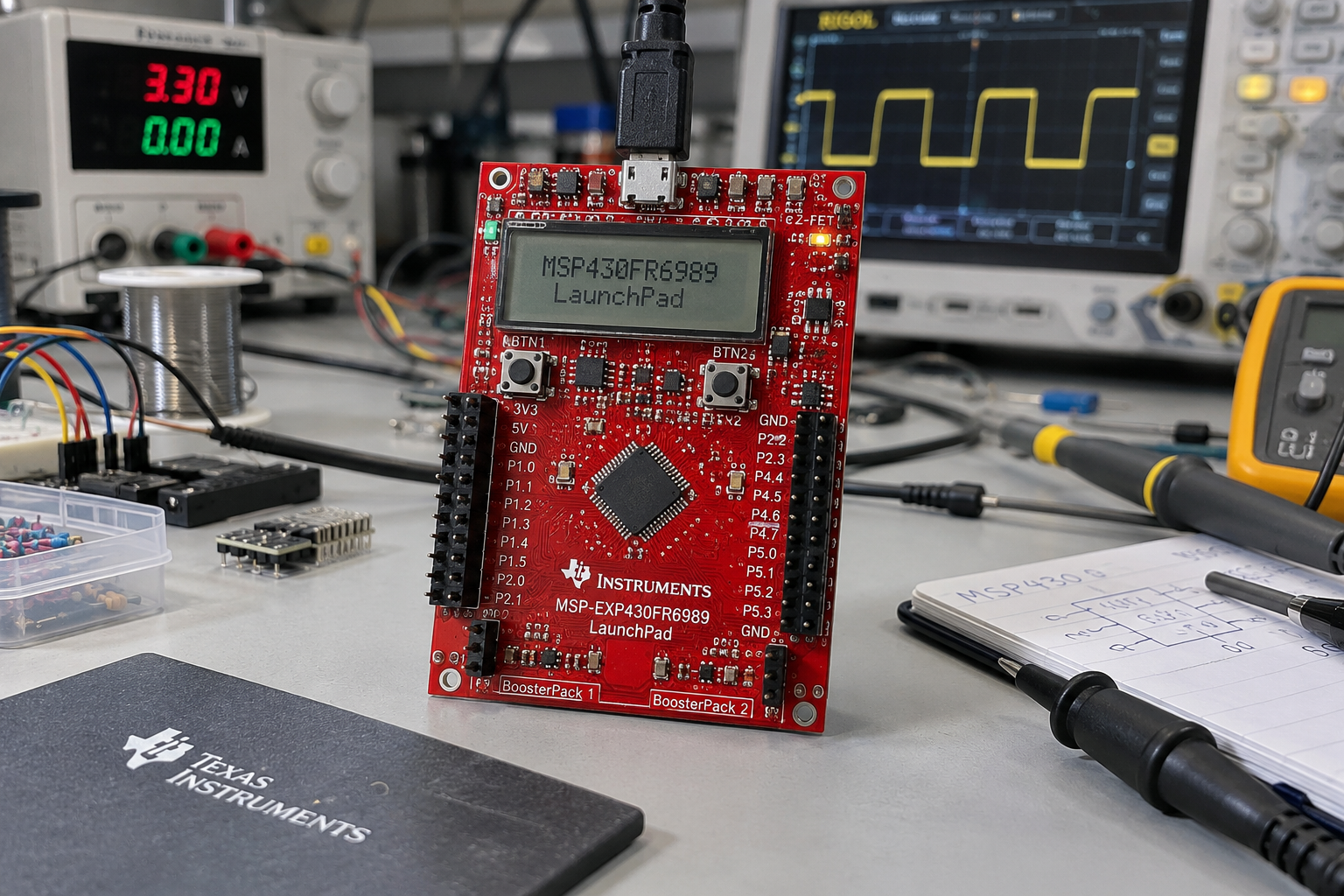
What Is a TI MSP430 Microcontroller?
The MSP430 Microcontroller is a family of ultra low power 16 bit microcontrollers from Texas Instruments. The family was designed around a 16 bit RISC CPU and extensive low power operating modes, making MSP430 devices suitable for battery powered embedded systems, sensing, measurement, and control applications.
What Does MSP430 Mean?
MSP430 refers to Texas Instruments’ family of mixed signal microcontrollers built around low power operation and efficient 16 bit processing. Different MSP430 devices provide different combinations of memory, timers, analog peripherals, communication interfaces, GPIO, and other functions.
The family includes both traditional Flash based devices and newer MSP430FR devices that use FRAM for nonvolatile memory. For example, the MSP430FR2032 provides 8 KB of FRAM, 1 KB of SRAM, a 10 bit ADC, UART, SPI, I2C, and timer functionality.
How Does an MSP430 Microcontroller Work?
An MSP430 runs firmware stored in its nonvolatile memory. The 16 bit CPU executes the program while integrated peripherals handle tasks such as timing, analog measurement, communication, and digital input or output.
One of the main characteristics of MSP430 is its low power architecture. Devices can enter low power modes when processing is not required and wake when an interrupt or other event occurs. This allows the microcontroller to spend more time consuming very little energy in battery powered applications.
Why Are MSP430 Microcontrollers Important?
MSP430 has remained relevant in embedded development because its architecture focuses heavily on low power operation, efficient processing, and integrated analog and digital functions. TI currently lists MSP430 as an ultra low power 16 bit RISC MCU family, with some devices offering standby current down to 0.7 μA.
16 Bit RISC Performance
The MSP430 architecture uses a 16 bit RISC CPU with 16 bit registers and features intended to support efficient code execution. This architecture is used across a wide range of MSP430 devices, although the exact performance and peripheral set varies by family.
The relatively simple architecture can be useful for applications that do not require the processing performance of modern 32 bit microcontrollers. MSP430 devices instead focus on efficient control, sensing, and measurement.
Ultra Low Power Operation
Low power operation is one of the defining characteristics of MSP430. Multiple low power modes allow the CPU and selected system functions to be disabled when they are not needed.
This approach is particularly useful for products that spend most of their time waiting for a sensor event, timer event, or user input. Battery powered meters, portable measurement equipment, and wireless sensor systems can therefore benefit from reduced energy consumption.
Mixed Signal Capabilities
Many MSP430 devices combine digital processing with analog peripherals. Depending on the device, these can include ADCs, comparators, operational amplifiers, DACs, and other measurement related functions.
For example, selected MSP430 devices include 10 bit or 12 bit ADCs, while some older measurement focused devices provide specialized sigma delta ADCs.
Architecture of an MSP430 Microcontroller
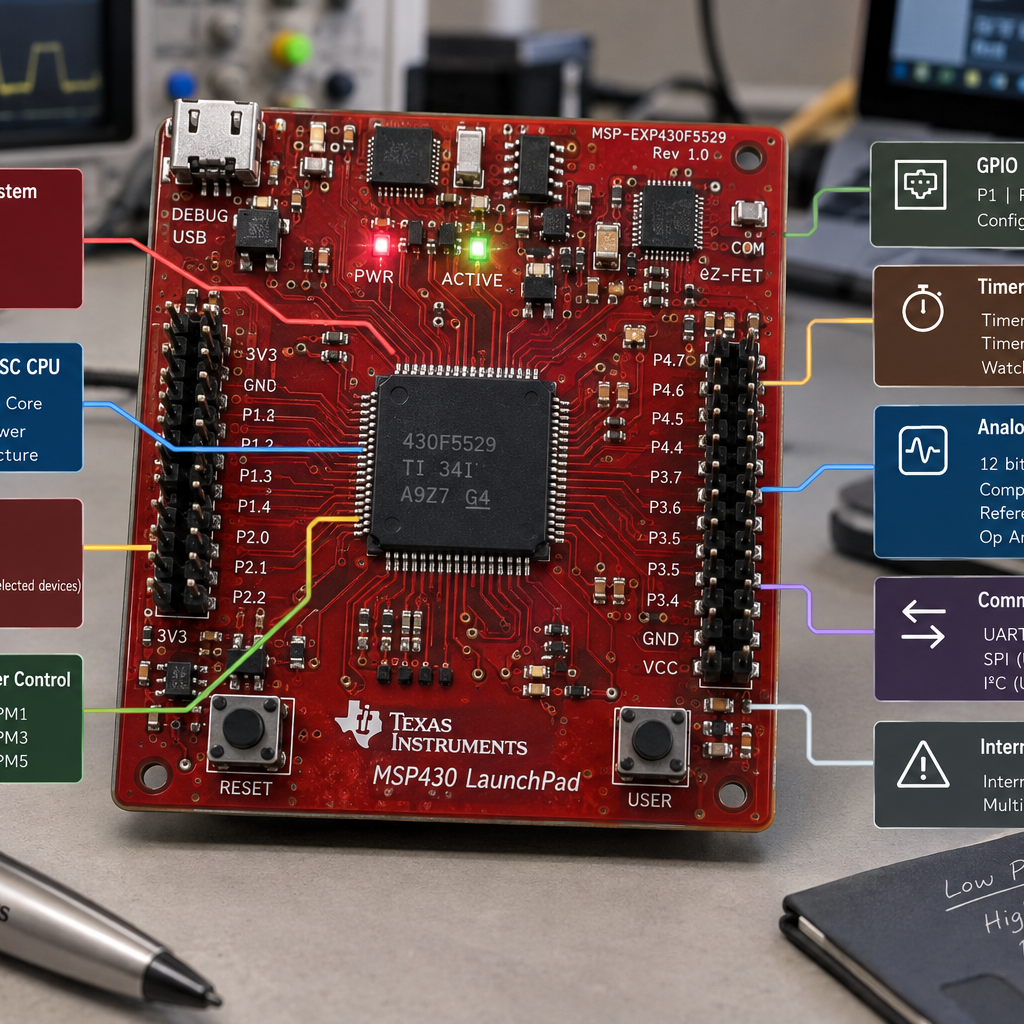
The MSP430 architecture combines a 16 bit RISC CPU with memory, clock circuitry, GPIO, timers, analog peripherals, communication interfaces, and low power control. The exact architecture differs between MSP430 families and individual devices.
MSP430 16 Bit CPU Core
The CPU is based on a 16 bit RISC architecture with 16 bit registers. The architecture includes features such as constant generators that help improve code efficiency.
MSP430 devices also use digitally controlled oscillators on many families. Depending on the device, the clock system allows the MCU to move quickly from a low power state to active operation.
Flash and FRAM Memory
MSP430 devices use different types and amounts of nonvolatile memory depending on the family. Traditional MSP430 devices use Flash, while MSP430FR devices use FRAM.
FRAM provides nonvolatile storage while supporting frequent write operations, making it useful for applications that need data logging or regular updates. Current MSP430FR devices are available with different FRAM and SRAM configurations depending on the model.
GPIO and Peripherals
GPIO pins allow the MSP430 to interact with switches, LEDs, sensors, displays, and other external circuits. Integrated timers provide timing and capture or compare functions, while communication peripherals can support interfaces such as UART, SPI, and I2C.
The exact number of GPIO pins and peripheral modules depends on the device. For example, the MSP430FR2032 provides up to 60 GPIOs along with UART, SPI, I2C, ADC, timers, and capacitive touch capable I/O.
Key Features of MSP430 Microcontrollers
MSP430 devices combine low power processing with integrated analog, timing, memory, and communication peripherals. The exact feature set varies between device families, but many current MSP430FR devices include FRAM, timers, ADCs, serial interfaces, RTC functions, and flexible clock systems.
GPIO and Digital Control
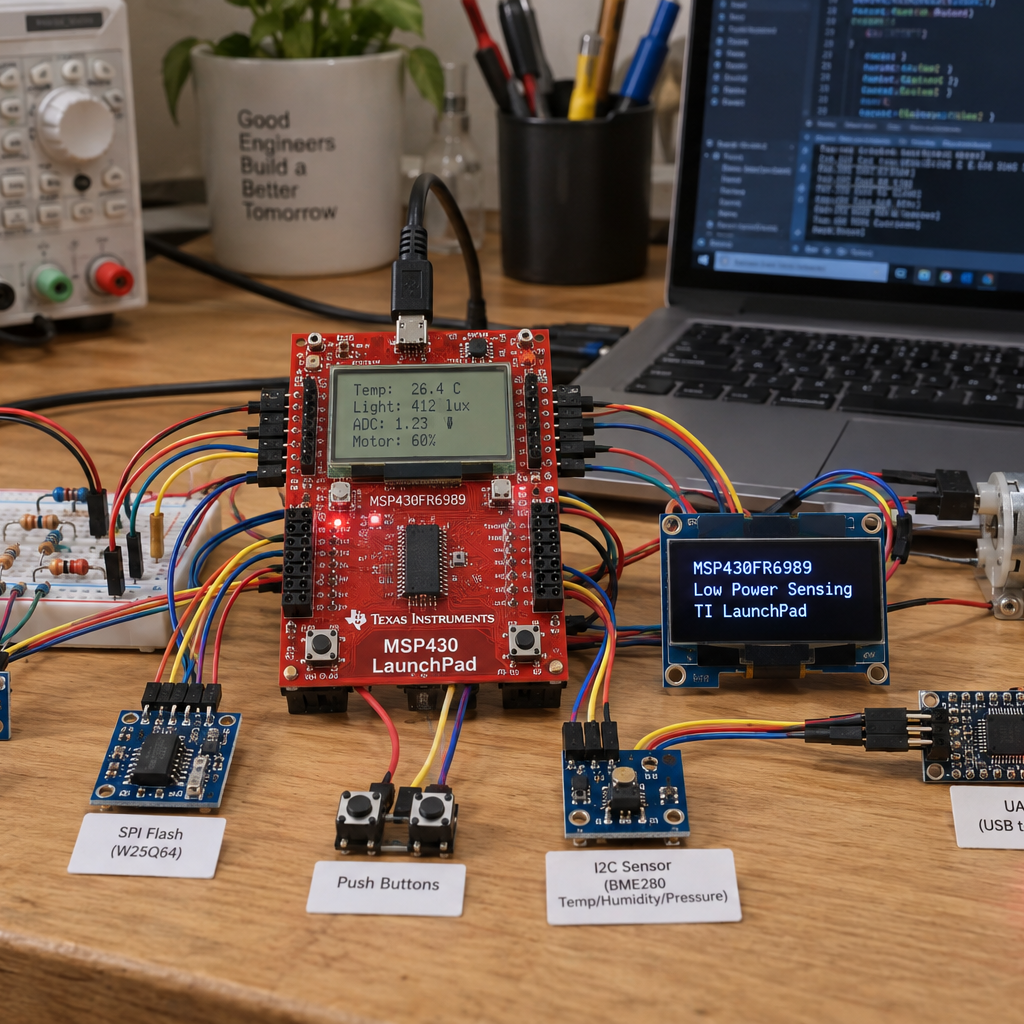
General purpose I/O pins allow MSP430 devices to communicate with external components such as LEDs, buttons, relays, displays, and digital sensors. Depending on the device, MSP430 MCUs can provide a large number of configurable GPIO pins.
These pins can also support alternate peripheral functions, allowing the same physical pin to be used for communication, timer signals, interrupts, or other hardware functions.
ADC and Analog Functions
Analog peripherals are an important part of the MSP430 platform. Depending on the model, devices can include 10 bit or 12 bit ADCs, analog comparators, internal voltage references, and other measurement related circuitry.
This makes MSP430 useful for applications that need to measure temperature, voltage, current, light, pressure, or other sensor signals. Some specialized MSP430 families also provide more advanced analog functions for precision measurement applications.
Timers and PWM
MSP430 microcontrollers include hardware timers that can perform accurate timing, capture, compare, and PWM functions. Current MSP430FR devices can provide multiple 16 bit timers, with the number and configuration depending on the specific device.
PWM signals can be used to control LED brightness, generate periodic signals, drive actuators, and control other external hardware. Hardware timers also allow many timing tasks to operate without requiring continuous CPU processing.
Communication Interfaces
MSP430 devices support common serial communication protocols including UART, SPI, and I2C. The exact number of communication modules varies between devices.
These interfaces allow the MCU to communicate with sensors, displays, memory chips, wireless modules, and other controllers. Some devices also support IrDA or additional serial interfaces for specialized applications.
Low Power Modes
Low power operation is one of the most important MSP430 features. Devices can enter several low power modes that reduce CPU and peripheral activity when the system is waiting for an event.
For example, the MSP430FR2032 supports standby and shutdown modes with very low typical current consumption, while still providing wake up functionality for selected events.
This behavior is particularly useful in battery powered products where the microcontroller may spend most of its operating time in an inactive state.
FRAM Memory
Many newer MSP430FR devices use ferroelectric RAM instead of traditional Flash memory. FRAM provides nonvolatile storage with fast writes and very high write endurance.
For example, TI specifies up to 10¹⁵ write cycles for several MSP430FR devices, while the memory can be used for program code, constants, and data storage.
MSP430 Microcontroller Families
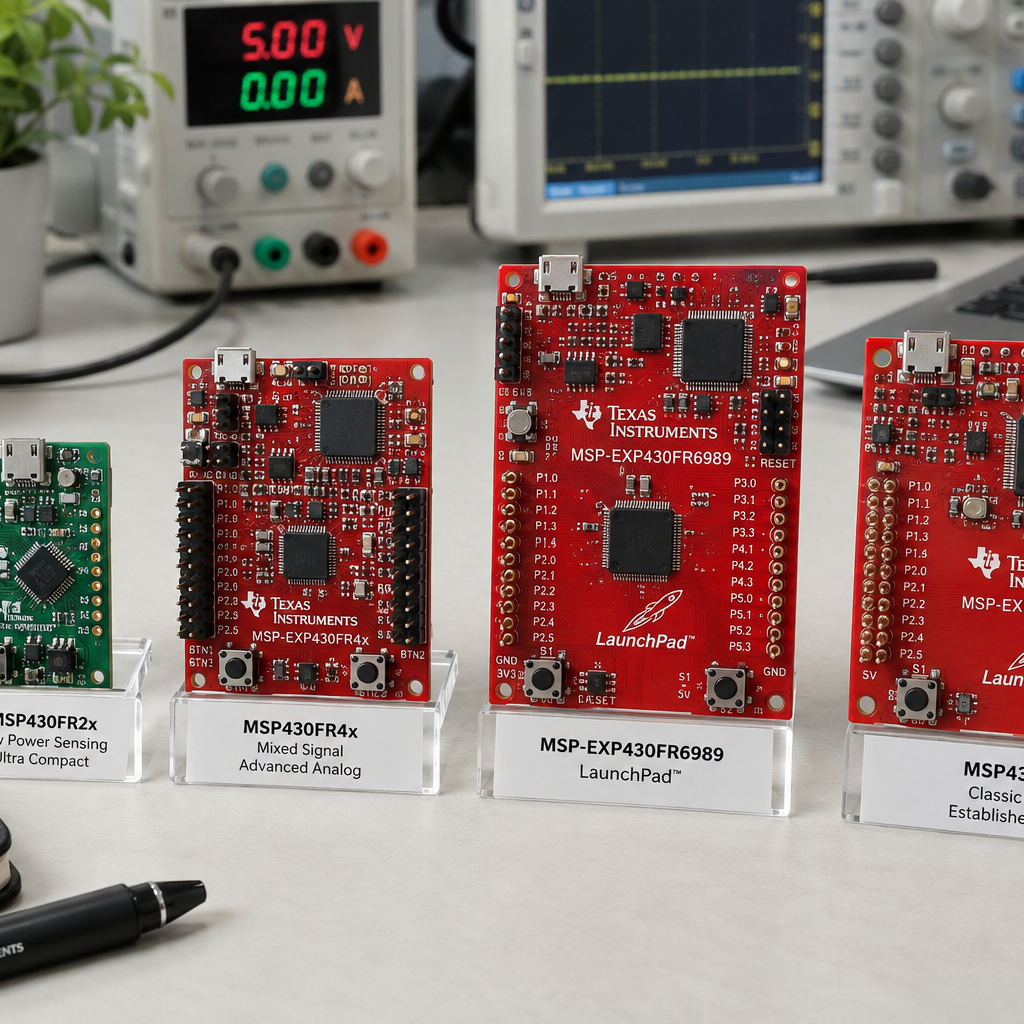
The MSP430 portfolio contains several families designed around different combinations of low power operation, analog capability, memory, display support, and peripheral requirements. The exact features depend on the individual device.
MSP430FR Series
The MSP430FR series uses FRAM as its nonvolatile memory technology. These devices combine the MSP430 16 bit CPU with low power operation and peripherals such as ADCs, timers, communication interfaces, RTCs, and DMA on selected models.
The range includes smaller devices for simple sensing and control as well as higher memory devices such as the MSP430FR6987, which provides up to 128 KB of FRAM and additional digital peripherals.
MSP430F Series
The traditional MSP430F series uses Flash memory and includes a broad selection of devices for embedded control and measurement applications. Different models provide different memory sizes, ADC configurations, timers, communication interfaces, and GPIO options.
Some MSP430F devices are designed for applications involving analog measurement, industrial control, metering, and portable instruments.
MSP430FR2x and FR4x Families
The smaller MSP430FR2x devices target compact, low power applications where a modest amount of memory and peripheral hardware is sufficient. For example, the MSP430FR2000 provides 16 bit processing, FRAM, an ADC, timer, comparator, RTC, and serial communication features in a compact device.
The MSP430FR4x family adds features suited to applications such as sensing, measurement, and low power displays. Selected devices such as the MSP430FR4133 include a low power LCD driver alongside ADC, timers, FRAM, and communication peripherals.
How to Program an MSP430 Microcontroller
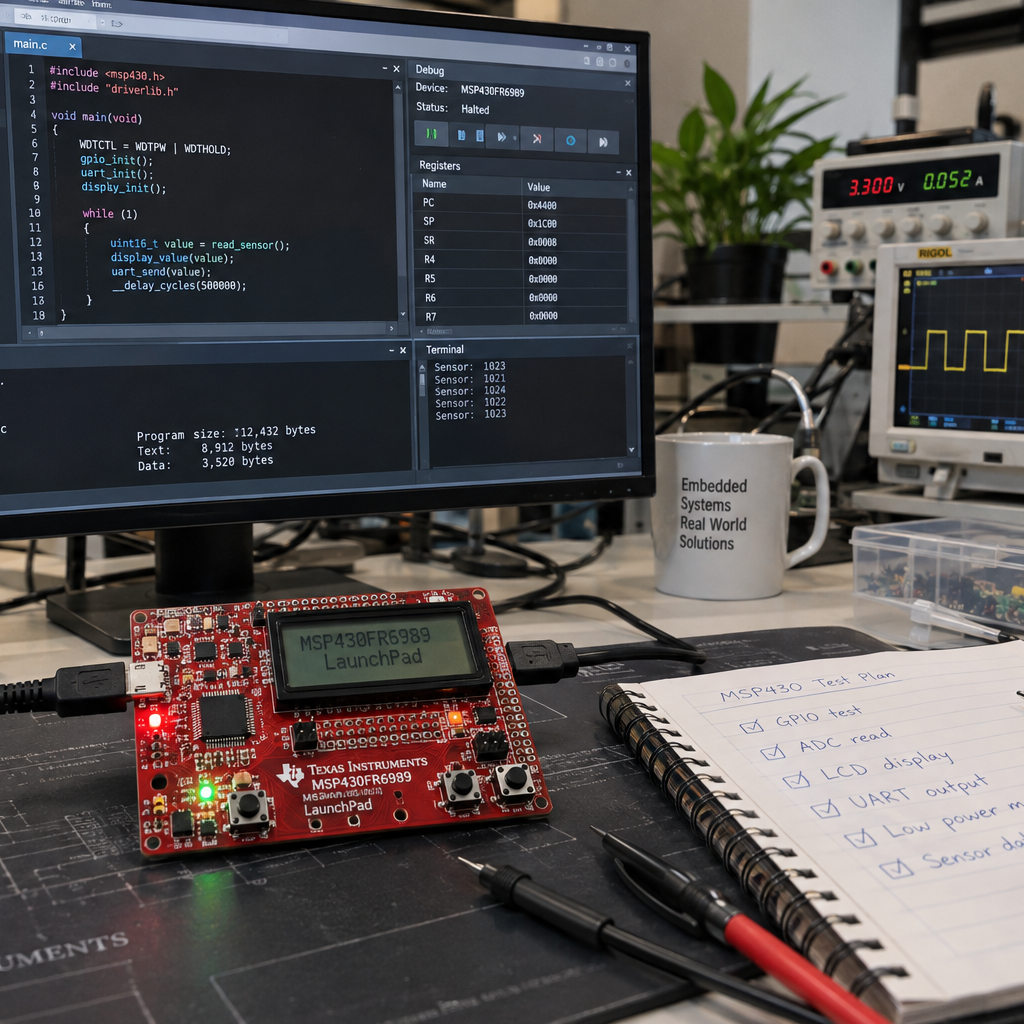
MSP430 development typically involves writing embedded firmware, configuring the MCU peripherals, compiling the program, and transferring it to the microcontroller through a compatible debugging and programming interface.
Embedded C Programming
Embedded C is commonly used to develop MSP430 firmware. Developers can configure GPIO, timers, ADCs, communication interfaces, interrupts, and low power modes through software.
A typical program may read a sensor through the ADC, process the measurement, transmit the result through UART or I2C, and then place the MCU into a low power mode until another event occurs.
Code Composer Studio
Texas Instruments provides Code Composer Studio as a development environment for its microcontrollers. Developers can use it to write, compile, debug, and program MSP430 applications.
TI also provides device specific software resources, examples, documentation, and development tools that help developers work with individual MSP430 families.
Programmer and Debugger
MSP430 development boards and programming tools provide ways to load firmware and debug applications. During development, engineers can set breakpoints, inspect variables, step through code, and examine peripheral behavior.
This debugging process is particularly useful when developing low power applications because engineers need to verify both functional behavior and the transitions between active and low power operating modes.
MSP430 Development Boards
Texas Instruments provides several development boards for MSP430 microcontrollers. These boards make it easier to test peripherals, write firmware, measure power consumption, and prototype applications before designing custom hardware. TI’s MSP430 ecosystem includes LaunchPad development kits, BoosterPack modules, and application specific evaluation modules.
MSP430 LaunchPad Development Kits
MSP430 LaunchPad kits are compact development platforms designed for evaluating specific MSP430 devices. The MSP EXP430FR6989, for example, includes onboard programming and debugging, energy measurement support, buttons, LEDs, a segmented LCD, and 40 pin BoosterPack headers.
Other LaunchPad boards are available for devices such as the MSP430FR2433, MSP430FR2355, MSP430FR4133, MSP430FR5994, and MSP430F5529. This range allows developers to select a board based on the required memory, peripherals, analog features, and application requirements.
MSP430 Evaluation Modules
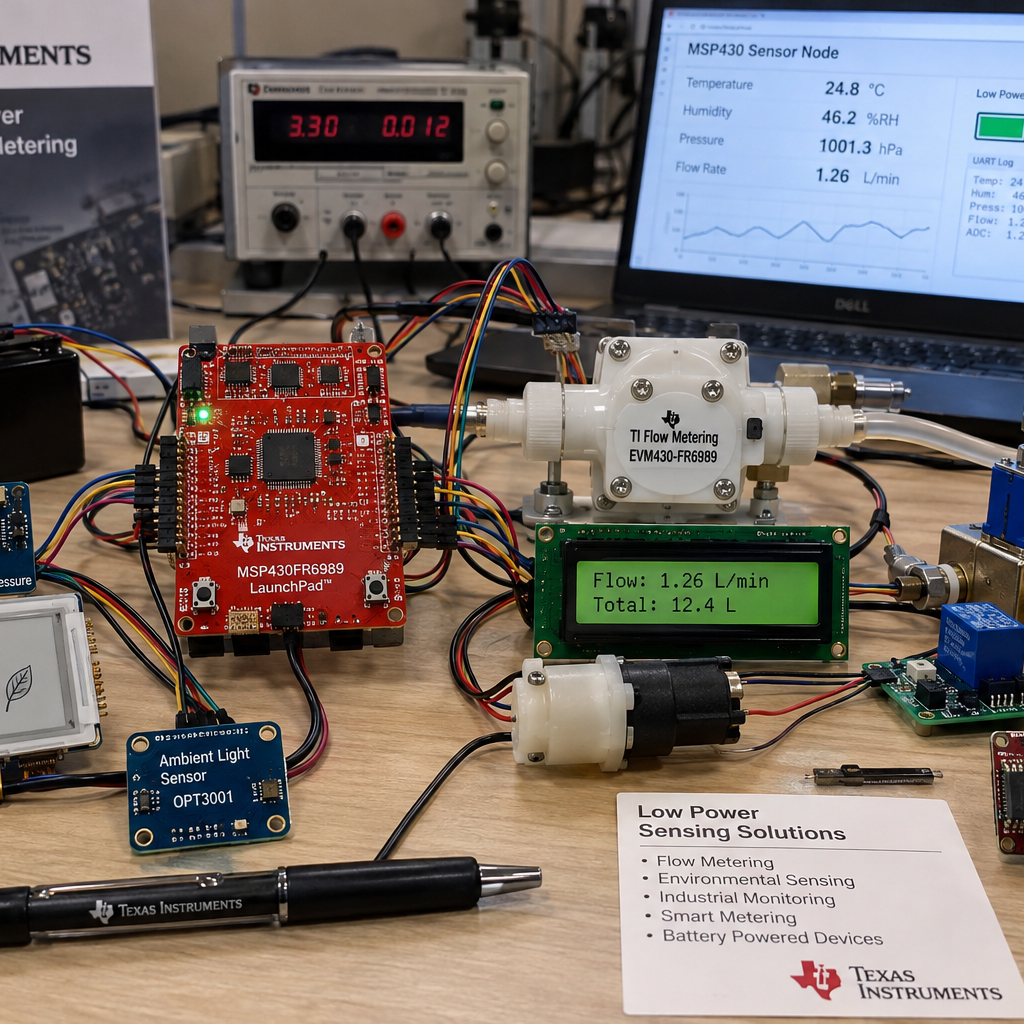
Texas Instruments also provides application specific evaluation modules for MSP430 devices. The EVM430 FR6989, for example, combines a main board with sensor and motor boards and is designed to demonstrate ultra low power flow metering using the Extended Scan Interface.
These evaluation platforms can be useful when developers need to evaluate a particular sensing technology or peripheral before creating a custom circuit.
Prototyping With MSP430
An MSP430 prototype can combine a LaunchPad board with sensors, displays, communication modules, and BoosterPack expansion boards. Developers can first test firmware and peripheral functions on the evaluation hardware and then transfer the design to a custom PCB.
The BoosterPack ecosystem also provides a practical way to add wireless connectivity, environmental sensing, displays, and other functions to compatible LaunchPad boards.
Applications of MSP430 Microcontrollers
MSP430 microcontrollers are particularly suitable for embedded systems where low power consumption, sensing, measurement, and reliable control are important. Their applications include portable electronics, metering, industrial sensing, building automation, and battery powered devices.
Battery Powered Devices
Low power operation makes MSP430 useful in products that need to operate for long periods from batteries. A device can remain in a low power state and wake when a timer, sensor, or external event requires processing.
This approach can be useful for portable instruments, remote sensors, electronic meters, and other products where reducing energy consumption is an important design requirement.
Sensor and Measurement Systems
MSP430 devices combine digital processing with analog peripherals on many models, making them suitable for sensor based applications. ADCs, comparators, timers, communication interfaces, and specialized sensing peripherals can be used together to collect and process measurements.
The MSP430FR6989 evaluation platform, for example, is specifically designed around low power flow metering and Extended Scan Interface technology.
Industrial and Building Automation
MSP430 microcontrollers can be used in control and monitoring systems that require sensor inputs, timing, communication, and low power operation. Possible applications include environmental monitoring, control panels, smart meters, and building sensors.
The exact suitability depends on the required processing performance, number of peripherals, communication interfaces, and memory capacity of the selected MSP430 device.
Portable Electronics
Portable products can benefit from MSP430’s combination of low power modes, compact device options, analog functions, timers, and communication interfaces. These features can support products such as handheld measurement equipment, simple user interfaces, and battery powered monitoring devices.
Metering Applications
Measurement is an important MSP430 application area. TI provides MSP430 devices and evaluation hardware for applications including water flow metering and other sensing systems. The EVM430 FR6989 specifically supports development of ultra low power water flow metering applications.
Advantages and Limitations of MSP430 Microcontrollers
MSP430 devices provide a distinctive combination of 16 bit processing, low power operation, analog peripherals, and development resources. However, their capabilities should be evaluated against the requirements of the specific embedded application.
Advantages of MSP430 Microcontrollers
The main advantages include very low power operating modes, a mature 16 bit architecture, integrated analog peripherals, timers, communication interfaces, and FRAM based memory on many newer devices.
FRAM based MSP430 devices can also provide high write endurance and fast nonvolatile memory access. TI’s MSP430FR6989, for example, provides 128 KB of FRAM and multiple integrated peripherals.
The development ecosystem is another useful feature. LaunchPad boards, BoosterPack modules, Code Composer Studio, debugging tools, documentation, and software resources provide several options for development and prototyping.
Limitations of MSP430 Microcontrollers
The 16 bit architecture and relatively modest processing resources make MSP430 better suited to low power control, sensing, and measurement than applications requiring high computational performance or complex 32 bit processing.
Another consideration is the large number of MSP430 devices. Different models can have substantially different memory sizes, analog peripherals, communication modules, packages, and power characteristics. Developers therefore need to select the exact device according to the application’s hardware and software requirements.
For more demanding applications involving advanced processing, extensive connectivity, or complex operating systems, engineers may need to consider other MCU architectures within the broader Texas Instruments portfolio.
Frequently Asked Questions About MSP430 Microcontrollers
MSP430 covers a broad range of low power 16 bit microcontrollers, so the exact capabilities depend on the selected device. These common questions help clarify the architecture, memory, power features, and development ecosystem.
Is MSP430 a 16 Bit Microcontroller?
Yes. MSP430 is a 16 bit microcontroller family based on a 16 bit RISC CPU architecture. Many devices also use 16 bit registers and integrated peripherals designed for low power embedded applications.
What Is MSP430 Mainly Used For?
MSP430 is commonly used in low power sensing, measurement, portable electronics, metering, battery powered products, and other embedded control applications. TI specifically describes the platform as optimized for applications where extended battery life is important.
Does MSP430 Use FRAM?
Many newer MSP430FR devices use integrated FRAM instead of traditional Flash memory. FRAM provides nonvolatile storage with fast writes and high write endurance. For example, the MSP430FR6979 provides up to 128 KB of FRAM and specifies 10¹⁵ write cycle endurance.
However, not every MSP430 uses FRAM. Traditional MSP430F devices use Flash memory, so the exact memory technology depends on the device family.
How Low Is MSP430 Power Consumption?
Power consumption varies significantly between devices and operating modes. For example, TI specifies approximately 100 µA/MHz active current and 0.4 µA typical standby current for the MSP430FR6979, while its shutdown mode is specified at 0.02 µA typical.
Actual system power consumption depends on the clock configuration, active peripherals, supply voltage, external components, and time spent in each operating mode.
What Software Is Used to Program MSP430?
MSP430 devices can be developed using Texas Instruments tools such as Code Composer Studio and MSP430Ware. TI also provides device specific examples, documentation, development boards, and debugging resources.
Embedded C is commonly used for application firmware, while the development environment handles compilation, debugging, and device programming.
What Are MSP430 LaunchPad Boards?
MSP430 LaunchPad boards are development platforms designed to help engineers evaluate MSP430 devices and build prototypes. Different LaunchPad models are available for different MSP430 families and devices.
For example, the MSP EXP430FR6989 provides onboard development and debugging features, LCD hardware, GPIO access, and BoosterPack compatible expansion.
Conclusion
The TI MSP430 is a 16 bit microcontroller family built around low power operation, efficient processing, integrated peripherals, and sensing capabilities. Its architecture combines a 16 bit RISC CPU with GPIO, timers, ADCs, communication interfaces, and low power operating modes.
The newer MSP430FR families add FRAM technology, providing nonvolatile memory with fast writes and high endurance. Selected devices also include features such as DMA, hardware multiplication, RTC functions, LCD controllers, and enhanced analog peripherals.
MSP430 development is supported by Texas Instruments through Code Composer Studio, MSP430Ware, LaunchPad development boards, evaluation hardware, documentation, and software examples. These resources allow developers to move from basic firmware experiments to practical sensing, measurement, metering, and battery powered embedded systems.