Introduction
Could a real person ever wear Spider-Mans suit swing between buildings, climb walls or deploy high-strength web shooters? While Marvels friendly neighborhood superhero lives in a world of comic-book fiction, many of the technologies behind real life Spider-Man suit technology are surprisingly connected to ongoing scientific research. Modern Spider-Man suit technology is increasingly inspired by real advances in robotics, artificial intelligence, biomimicry, and wearable electronics.
and advanced materials have already transformed ideas that once seemed impossible into working prototypes and commercial products.
This article explores the science behind Peter Parkers most iconic inventions by comparing them with modern engineering breakthroughs. We’ll examine whether Spider-Man’s web fluid is scientifically possible, how close researchers are to building SpiderMan gadgets and whether concepts like the Iron Spider suit’s real-world nanotechnology wall-climbing systems, AIpowered heads-up displays, and mechanical spider legs have practical counterparts today Along the way, you’ll discover where current technology matches Marvel’s imagination, where it still falls short, and which innovations could become reality over the next decade. Whether you’re a Marvel fan, an engineering student, or simply curious about future technology, this guide separates cinematic fiction from scientific fact with clear, evidence-based explanations.
Why Spider-Man’s Technology Fascinates Scientists and Engineers
Spider Mans technology has captivated audiences for decades because it is grounded in scientific concepts that researchers actively explore today Unlike many superheroes whose abilities rely entirely on fantasy Peter Parkers inventions are often portrayed as engineering solutions created through intelligence, experimentation, and innovation. This realistic foundation makes Parker Tech especially appealing to scientists, robotics engineers materials researchers and AI developers Many of the ideas featured in the films and comics such as wearable electronics, advanced materials, smart sensors, and bio inspired robotics already exist in early or commercial forms making the gap between fiction and reality smaller than many people realize.
Beyond entertainment Spider Man has inspired generations of students to pursue careers in STEM fields. Universities and research laboratories frequently reference biomimicry, smart materials, and robotic mobility systems that resemble concepts seen in Marvels universe. While todays technology cannot fully recreate Spider Mans abilities many of the underlying principles are actively shaping the future of wearable technology robotics and human augmentation.
Fiction Inspired by Real Scientific Principles
One reason Spider Man remains scientifically interesting is that his gadgets are based on believable engineering rather than unexplained magic His web shooter function as mechanical devices, his suit incorporates advanced sensors and communication systems, and the Iron Spider armor demonstrates concepts related to robotics artificial intelligence and adaptive materials. Although these technologies are significantly more advanced than what exists today they reflect real engineering disciplines that continue to evolve.
Modern researchers are developing wearable computers AI powered smart glasses lightweight composite materials robotic exoskeletons, and high strength synthetic fibers. Each breakthrough moves society a little closer to technologies that resemble Parkers inventions. Instead of asking whether Spider Mans equipment is possible, many scientists now focus on determining which features can realistically be achieved with current or near-future engineering.
Biomimicry When Nature Becomes Engineering
Many of Spider Mans abilities originate from observing nature, making biomimicry one of the most fascinating aspects of Parker Tech. Biomimicry is the practice of designing technologies inspired by biological systems that have evolved over millions of years. Scientists study organisms such as spiders, geckos, insects, and octopuses to develop innovative materials, climbing mechanisms, robotic movement, and energy efficient designs.
For example researchers have created adhesive materials inspired by gecko feet, synthetic fibers modeled after spider silk, and agile robots that mimic the movement of insects. These bio inspired innovations are being explored for applications in disaster response, industrial inspection, healthcare, aerospace, and advanced manufacturing. While humans cannot yet replicate Spider Mans full range of abilities, biomimicry continues to bridge the gap between natural evolution and cutting edge engineering bringing several elements of Parker Tech closer to reality.
Can We Build Spider-Man Suit Technology in Real Life Today?
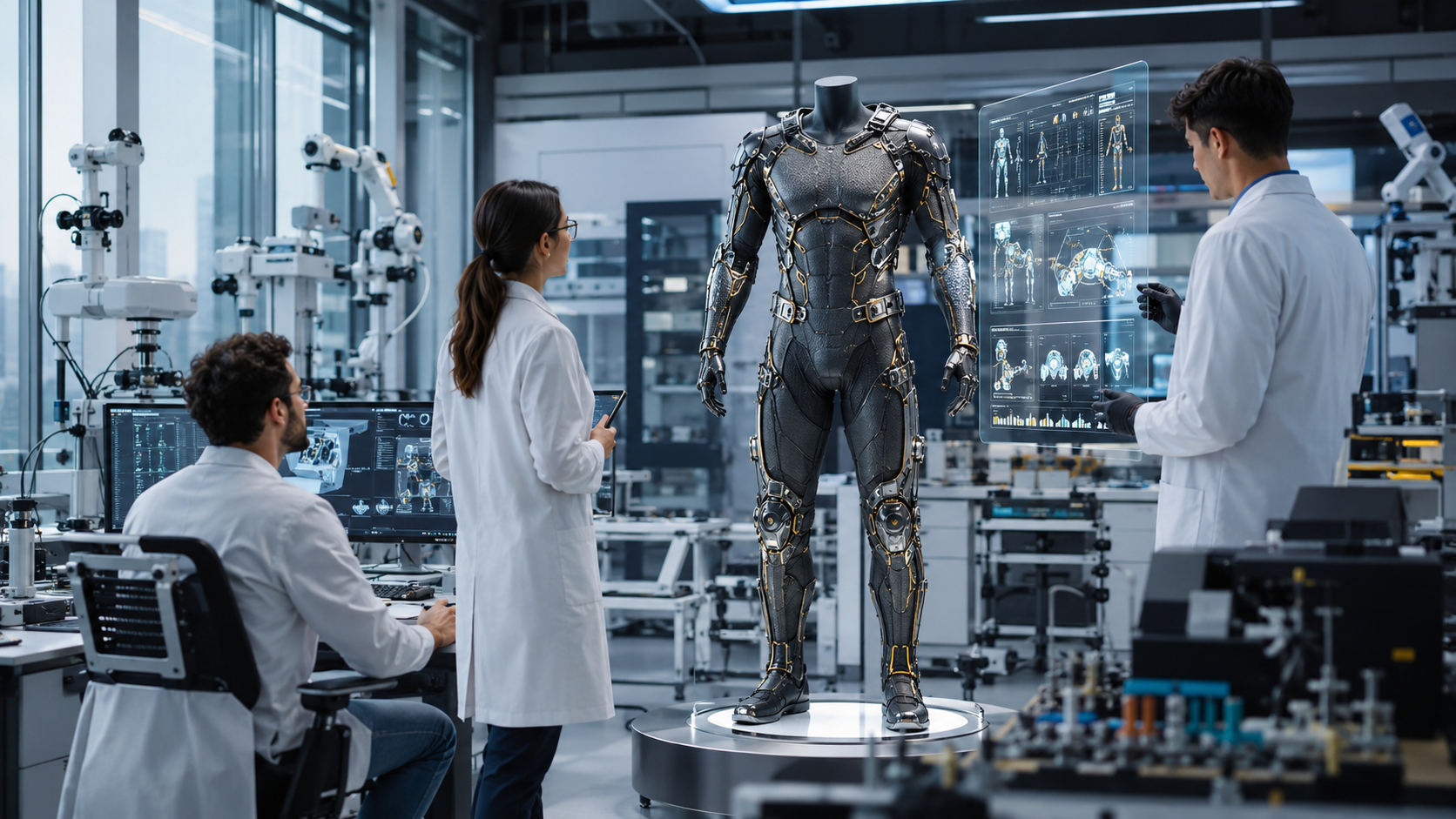
The idea of wearing a suit that enhances strength, agility, awareness, and protection has fascinated engineers for years While today’s real life Spider Man suit technology cannot replicate Peter Parker’s superhuman abilities, several of its core features already exist in military equipment industrial wearables, sports technology, and medical robotics. Modern smart suits combine advanced materials, embedded electronics, and artificial intelligence to improve human performance, making them the closest real world equivalent to Parkers iconic costume.These advances represent some of the most practical examples of Spider Man suit technology becoming possible in the real world.
Instead of relying on fictional radioactive mutations, engineers focus on integrating lightweight protection, intelligent sensors, wearable computing, and AI-assisted decision making into clothing. These innovations are transforming how soldiers, first responders, healthcare professionals, and industrial workers perform demanding tasks proving that Spider Mans suit is becoming less like fantasy and more like an engineering roadmap.
Smart Fabrics and Advanced Protective Materials
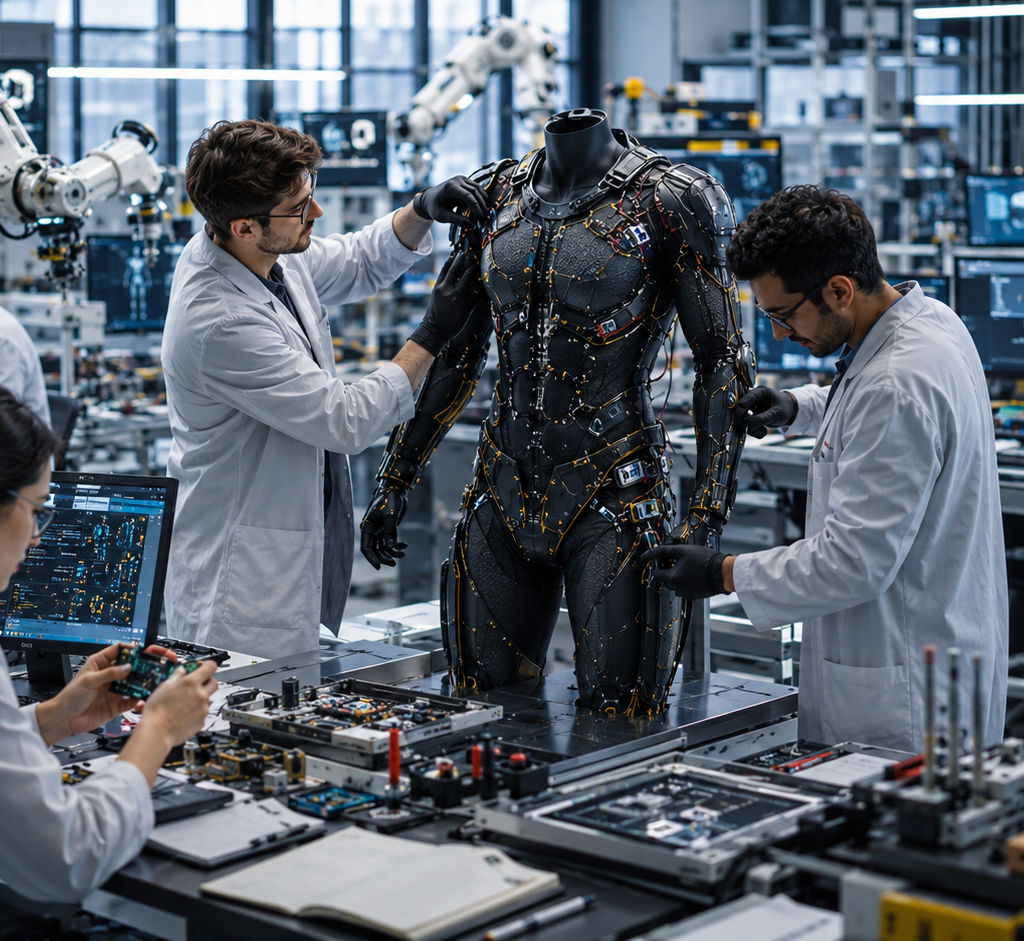
One of Spider Man’s suits most practical features is its flexibility without sacrificing durability. Modern engineers are pursuing the same goal using advanced textiles made from materials such as Kevlar, Dyneema, carbon fiber composites, graphene-enhanced fabrics, and high performance polymers. These materials offer excellent resistance to abrasion, impacts, and cuts while remaining lightweight enough for everyday movement.
Researchers are also developing smart textiles that incorporate conductive fibers capable of monitoring body temperature, heart rate, muscle activity, hydration levels, and movement. Some experimental fabrics can even respond to environmental changes by adjusting insulation or detecting damage. Although they cannot instantly repair themselves like fictional superhero suits, these innovations demonstrate how wearable materials are becoming increasingly intelligent and adaptive.
Wearable Sensors and Embedded Electronics
A modern Spider Man suit would require constant awareness of its surroundings, and wearable electronics are already making this possible. Tiny sensors, including accelerometers, gyroscopes, pressure sensors, GPS modules cameras, microphones, and inertial measurement units, are commonly integrated into wearable devices to collect real-time environmental and body-motion data.
These technologies are widely used in smartwatches, fitness trackers augmented reality headsets, and industrial safety equipment. In more advanced applications, sensor-equipped suits help firefighters navgate smoke-filled buildings, monitor worker fatigue, and provide real-time health diagnostics. While these systems do not create a true Spider Sense, they illustrate how continuous environmental monitoring is becoming an essential part of next-generation wearable technology.
AI Integration Inside Modern Smart Suits
Artificial intelligence is the feature that brings todays wearable technology closest to Parker Tech. AI systems can process sensor data, recognize movement patterns, detect hazards, provide navigation assistance, and generate real time recommendations. Combined with computer vision and edge AI processors, smart suits can identify obstacles, monitor surroundings, and deliver instant feedback without relying on cloud connectivity.
Industries including manufacturing, defense, logistics, and healthcare are already experimenting with AI powered wearable systems that improve efficiency and safety. Although current AI lacks the advanced conversational intelligence and autonomous decision-making seen in Marvels universe, rapid progress in machine learning edge computing and wearable processors suggests that increasingly intelligent smart suits are well within reach over the coming decade.
Is Spider Man’s Web Fluid Scientifically Possible?
Among all of Spider Man’s inventions the web shooters and web fluid remain the most iconic and the most difficult to recreate. Fans have long wondered “Is Spider-Man web fluid scientifically possible?” The short answer is partially. While scientists have developed incredibly strong fibers inspired by spider silk, no existing material can be stored in a small wrist mounted device, fired over long distances, instantly solidify, safely support a person weight, and then naturally dissolve within hours as depicted in Marvel stories.
Even so, breakthroughs in materials science, polymer chemistry, and biomimicry are bringing certain aspects of Spider Man web technology closer to reality. Researchers continue to develop high strength synthetic fibers bioengineered spider silk, and experimental launch systems that demonstrate how fiction can inspire genuine scientific innovation.
How Spider-Man’s Web Shooters Work in Marvel
In Marvel comics and films, Peter Parker designs compact wrist-mounted devices that eject a specially formulated liquid polymer. Once exposed to air, the fluid rapidly transforms into ultra-strong elastic strands capable of supporting enormous loads while remaining flexible enough for swinging and combat. The web can also change its shape, forming ropes nets, parachutes, or impact cushions depending on the situation.
From an engineering perspective, this system combines several advanced technologies into one incredibly compact package. It would require a high pressure propulsion mechanism, programmable polymer chemistry, precise targeting, rapid curing, and exceptional energy efficiency. While individual components of this concept exist in modern laboratories integrating them into a wearable device the size of Spider Man web shooters remains far beyond todays engineering capabilities.
Synthetic Spider Silk vs Real Spider Silk
Spider silk is one of nature most remarkable materials. Pound for pound, certain types of natural spider silk rival or even surpass high grade steel in tensile strength while remaining exceptionally lightweight and flexible. However, farming spiders on a commercial scale is impractical because they are territorial and often cannibalistic, making large scle silk production extremely challenging.
To overcome this limitation, scientists are developing synthetic spider silk using genetically engineered bacteria, yeast, plants, and even silkworms. These bioengineered fibers aim to replicate the strength, elasticity and durability of natural spider silk for applications in medical sutures, protective equipment, aerospace components, and advanced textiles. Although current synthetic fibers are impressive, they still cannot match every property required for Spider Man fictional web fluid, particularly its instant deployment and rapid solidification.

Current Research in High-Strength Fibers
The search for stronger and lighter materials extends far beyond synthetic spider silk. Researchers are also investigating carbon nanotubes, graphene-based composites, ultra high molecular weight polyethylen, and other advanced polymers capable of delivering exceptional strength to weight ratios. Many of these materials already appear in aerospace engineering, military protection systems, high performance sporting equipment, and space exploration.
At the same time, scientists are experimenting with new manufacturing techniques such as 3D printing advanced composites and designing programmable materials that respond to heat, pressure, or electrical stimulation. While these breakthroughs will not produce Spider Mans web fluid overnight, they represent significant progress toward lightweight, durable materials that could one day power wearable launch systems or advanced rescue equipment inspired by Parkers inventions.
Can Humans Actually Climb Walls?
Wall crawling is one of Spider Mans most recognizable abilities but it is also one of the most challenging to reproduce in the real world. Scientists have spent decades studying how animals such as geckos insects, and spiders effortlessly climb vertical surfaces. Their discoveries have inspired new adhesive technologies that allow robots and in some cases even humans to scale walls without using glue or permanent adhesives. Alhough current systems cannot match Spider Man speed or agility they prove that controlled wall climbing is scientifically achievable under the right conditions.
Todays climbing technologies rely on advanced physics, materials science, and biomimicry rather than supernatural abilities. Researchers continue to refine these systems to make them lighter stronger, and more practical for applications in rescue operations, industrial maintenance defense,and space exploration.
H3: Gecko Adhesion vs Synthetic Spider Silk Technology
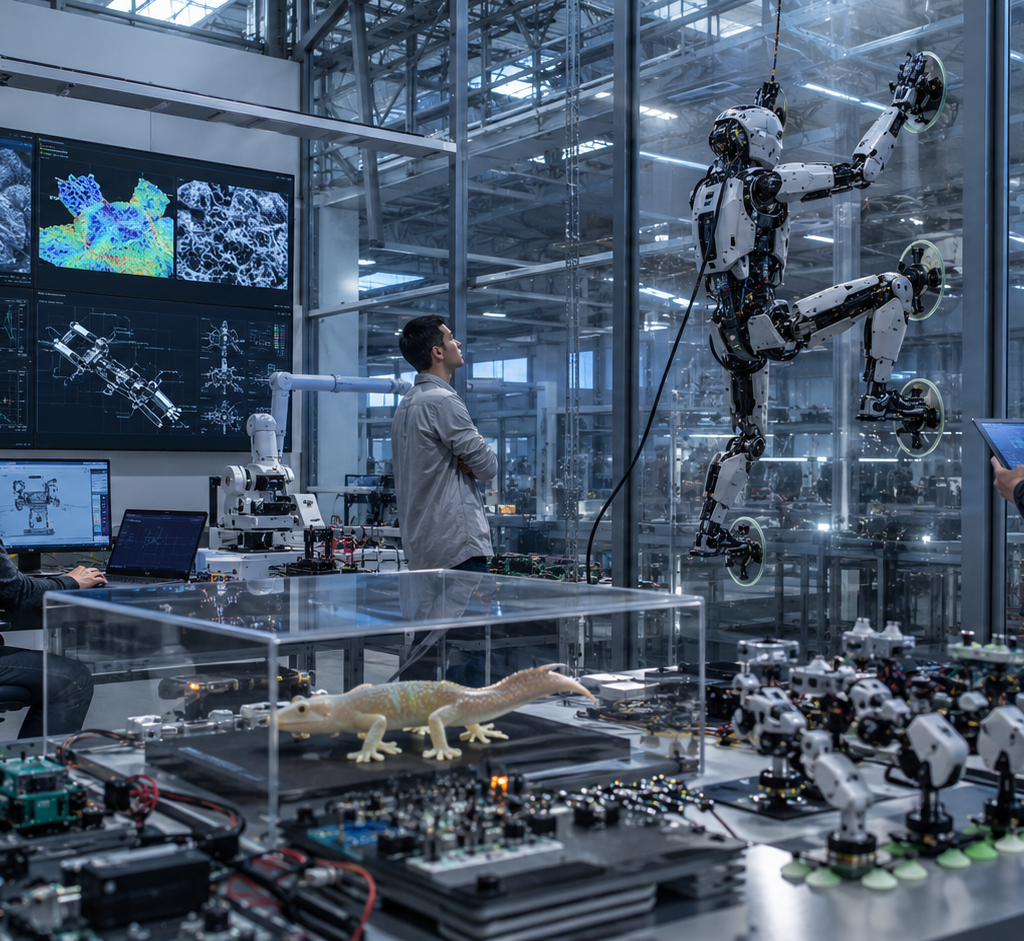
One of the most promising approaches to wall climbing comes from geckos. Unlike spiders, geckos do not use sticky glue to cling to surfaces. Instead, millions of microscopic hair like structures called setae on their feet generate extremely weak molecular attractions known as van der Waals forces. Individually these forces are tiny, but together they create enough adhesion to support the animal’s body weight while allowing it to release its grip instantly.
Engineers have successfully replicated this principle by creating synthetic adhesive materials with microscopic surface patterns. While synthetic spider silk is being developed primarily for its strength and flexibility, gecko inspired adhesives focus on controlled attachment and detachment. Together these technologies represent two complementary branches of bioimicry that could eventually contribute to future climbing equipment and wearable mobility systems.
Electroadhesion and Micro-Suction Systems
Another promising solution is electroadhesion, which uses small electric fields to temporarily increase the attraction between a device and a surface. Unlike conventional adhesives, electroadhesion can be activated and deactivated almost instantly, making it useful for robotic grippers manufacturing automation, and climbing robots. Researchers are investigating how this technology can help machines move across walls, ceilings and other difficult surfaces with greater stability.
Micro suction technology takes a different approach by using thousands of tiny suction chambers that create temporary holding forces on smooth surfaces. Similar systems are already found in reusable adhesive pads and specialized industrial tools. While these technologies are effective in controlled environments, they still struggle with dusty, rough, or wet surfaces, highlighting one of the biggest engineering challenges in developing a practical Spider-Man-style climbing system.
Can Humans Actually Climb Walls with Micro-Suckers?
The answer is ye but with important limitations. Several research teams have demonstrated climbing devices that allow humans to ascend smooth vertical walls using gecko inspired adhesives or vacuum-assisted systems. These prototypes typically require large hand and foot pads, carefully prepared surfaces, and slow, deliberate movements to maintain a secure grip.
Unlike Spider Man, humans cannot sprint across skyscrapers leap between buildings, or cling effortlessly to every surface. Current climbing systems remain bulky, energy-intensive, and highly dependent on surface conditions. Nevertheless, continuous advances in materials science, lightweight composites, and bio inspired engineering suggest that future wall-climbing equipment could become significantly more practical for emergency responders maintenance crews and specialized industrial applications.
How Close Are We to Building Spider-Man Gadgets?
Spider Mans gadgets are more than flashy superhero accessories they represent a combination of artificial intelligence, wearable computing, advanced sensors, and real-time data processing. While Hollywood exaggerates their capabilities, many of these technologies already exist in different forms. From augmented reality glasses to AI-powered vision systems and edge computing devices, modern engineers are steadily developing tools that resemble Parker Tech. The question is no longer “How close are we to building Spider-Man gadgets?” but rather which gadgets are already possible and which still require major technological breakthroughs.
Today’s wearable electronics can collect environmental data, recognize objects, monitor movement, and assist users in real time. Although they cannot yet match Spider Mans instant reactions or fully autonomous decision-making, they demonstrate how rapidly wearable intelligence is evolving.
AI Glasses and Heads-Up Displays
One of Spider-Man’s most recognizable suit features is its intelligent heads-up display (HUD), which overlays navigation, target tracking, environmental analysis, and communication directly into his field of view. Modern augmented reality glasses are beginning to offer similar capabilities by projecting digital information without requiring users to look at a separate screen.
Current AR devices can display maps, notifications, translations, equipment diagnostics, and step bystep instructions while leaving the user’s hands free. When combined with AI and computer vision these systems can identify objects, recognize faces, interpret surroundings, and provide contextual information in real time. Although todays AR glasses remain far less advanced than Spider Man s interface, they represent an important step toward intelligent wearable displays.
Motion Tracking and Spider-Sense Technology
Spider-Man’s legendary “Spider-Sense” warns him of danger before it happensa fictional ability that has no direct scientific equivalent. However, modern sensor technology can detect movement, impacts, proximity, and environmental hazards with remarkable accuracy. Devices equipped with accelerometers, gyroscopes, radar sensors, LiDAR, cameras, and inertial measurement units continuously monitor motion and surrounding conditions.
Artificial intelligence further enhances these systems by analyzing incoming sensor data to predict collisions, detect abnormal movement, or identify potential risks. Similar technologies are already used in autonomous vehicles, industrial safety equipment, drones, and advanced driver-assistance systems. While they cannot predict danger through instinct like Spider-Man, they can significantly improve situational awareness by reacting faster than traditional monitoring systems.
Wearable Computers and Edge AI
Perhaps the closest real-world equivalent to Parker Tech is the rise of wearable computers powered by Edge AI. Unlike cloud-based systems, Edge AI processes information directly on the device, reducing latency and enabling instant decision-making without a constant internet connection. This is essential for applications where speed, privacy, and reliability are critical.
Industries such as healthcare, manufacturing, logistics, defense, and emergency response are increasingly adopting wearable AI systems that assist users with navigation equipment diagnostics, voice control predictive maintenance, and real-time decision support. As processors become smaller and more energy efficient, future smart suits could integrate computer vision, voice assistants, environmental monitoring, and intelligent automation into a single wearable platformbringing us one step closer to the sophisticated technology seen in Spider-Man’s suit.
Iron Spider Suit vs Real-World Nanotechnology
The Iron Spider suit represents one of the most advanced pieces of technology in the Marvel Universe. Designed by Tony Stark, it features instant deployment, intelligent armor, integrated artificial intelligence, enhanced protection, and four robotic spider legs that assist Peter Parker in combat and mobility. While this futuristic design appears far beyond today’s engineering, several of its individual components already exist in research laboratories and commercial applications. The biggest challenge is integrating them into a lightweight, self contained wearable system.
When discussing Iron Spider suit real world nanotechnology, it’s important to separate genuine scientific progress from cinematic fiction. Modern nanotechnology has transformed medicine, electronics, and materials science, but it is still far from creating shape-shifting armor that can appear instantly at the push of a button.
Can Nanotechnology Build Armor?
Nanotechnology involves manipulating materials at the molecular and atomic scale to create structures with enhanced properties. Scientists have already developed nanomaterials that improve strength, flexibility, conductivity, corrosion resistance, and thermal performance. These materials are used in aerospace engineering sports equipment, electronics, protective coatings, and medical devices.
However, the Iron Spider suit takes nanotechnology far beyond current scientific capabilities. In Marvel films, billions of microscopic machines instantly assemble into a complete suit around Peter Parker’s body. Today’s nanotechnology cannot self organize into complex mechanical systems or generate energy for large scale transformation. Researchers are making steady progress in programmable materials and self healing coatings, but truly autonomous, shape-changing armor remains a concept for future generations.
Mechanical Spider Legs and Bio-Inspired Robotics
The Iron Spiders four robotic legs are one of its most distinctive features, providing additional mobility, stability, lifting power, and combat capabilities. Although wearable robotic limbs of this complexity do not yet exist for everyday use, bio inspired robotics has made remarkable progress. Engineers have developed robotic arms, quadruped robots, and multi legged inspection machines capable of navigating challenging environments with precision.
Wearable robotic appendages are also being explored to assist workers in manufacturing, healthcare, and logistics. Some experimental systems function as third arms helping users hold tools or stabilize heavy objects while keeping both hands free. While these prototypes are far less agile than the Iron Spider’s mechanical legs, they demonstrate how additional robotic limbs could eventually become practical for specialized industrial and medical applications.
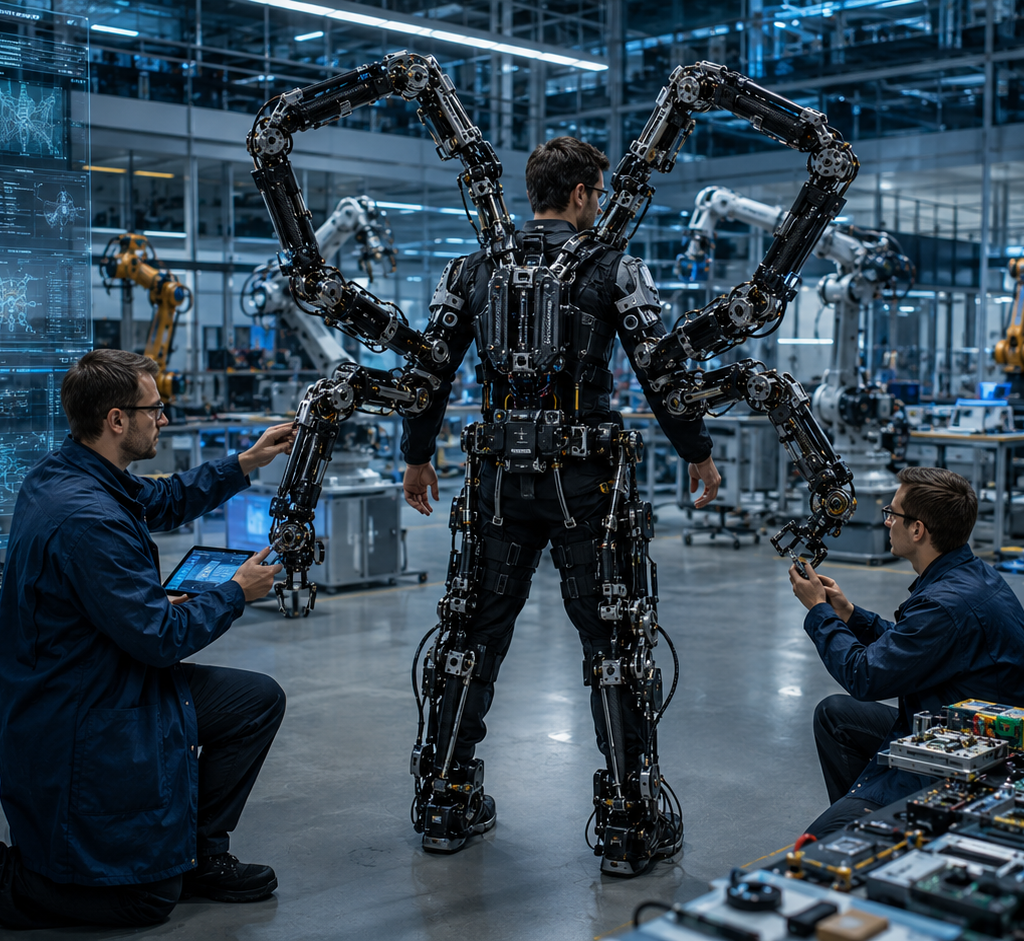
Military Exoskeletons Compared to the Iron Spider Suit
Perhaps the closest real-world equivalent to the Iron Spider armor is the powered exoskeleton. Military organizations, research institutions, and private companies have developed wearable robotic frameworks that enhance lifting capacity, reduce fatigue, improve endurance, and support rehabilitation after injuries. These systems use electric motors, hydraulic mechanisms, and sophisticated control software to augment human movement.
Despite these impressive achievements, current exoskeletons remain considerably larger, heavier, and less versatile than Spider Mans suit. Battery life, mobility, cost, and mechanical complexity continue to limit widespread adoption. Nevertheless, continuous improvements in lightweight materials, compact actuators artificial intelligence, and energy storage suggest that future exoskeletons will become more capable, bringing certain aspects of the Iron Spider suit closer to practical reality.
The Science Behind Spider-Man’s Mechanical Web Shooters
Spider-Man’s mechanical web shooters are among the most ingenious gadgets in comic book history because they rely on engineering rather than supernatural powers. In Marvels universe, Peter Parker designs compact wrist-mounted launchers capable of firing high strength web fluid with incredible precision. Although no real device can replicate this performance today, researchers have developed several technologies that mirror parts of the concept, including compressed-gas launchers, high strength fiber deployment systems, and emergency rescue devices.
The biggest engineering challenge is combining power, precision, safety, and portability into a device small enough to fit on a person’s wrist. Current prototypes demonstrate that individual components are possible but integrating them into a practical, reusable system remains a significant scientific hurdle.
Existing Web Shooter Prototypes
Several universities and independent engineers have experimented with wearable web-shooter concepts inspired by Spider Man. One of the best-known examples is the Real Life Web Shooter Prototype developed by researchers and engineering enthusiasts, including demonstrations inspired by work associated with Tufts University. Most of these devices use compressed air, CO₂ cartridges, or spring-loaded mechanisms to launch lightweight cords or grappling lines rather than sticky web fluid.
Outside of entertainment, similar launch systems are already used in rescue operations, marine safety equipment, climbing tools, and industrial applications. Line throwing devices can accurately deploy ropes across long distances, allowing workers or rescue teams to establish secure connections in hazardous environments. While these technologies lack Spider Man’s speed and flexibility, they prove that compact projectile based deployment systems are already practical for specialized tasks.
Engineering Challenges That Still Exist
Creating a true Spider Man style web shooter requires solving several engineering problems simultaneously. First, scientists would need a material that is lightweight, incredibly strong, highly elastic and capable of transitioning almost instantly from liquid to solid. Second, the launcher must generate enough force to project the material accurately over long distances without creating dangerous recoil or excessive weight. Finally, the entire system would need a compact power source capable of supporting repeated use while remaining safe for the wearer.
Additional challenges include precise targeting, environmental durability, cartridge capacity, and user safety. Any material capable of supporting a human’s weight must also withstand wind, moisture, temperature changes, and dynamic forces without failing. Although advances in polymer chemistry, advanced composites, and portable launch systems continue to narrow the gap, todays technology is still years away from producing a wearable device that matches Spider-Man’s fictional web shooters.
Technologies That Already Exist Today
While many elements of Parker Tech remain fictional, several underlying technologies are already available in commercial products or advanced research laboratories.
The comparison shows that modern engineering has already achieved many individual technologies associated with Spider Man. However, combining them into a lightweight, affordable, energy efficient superhero suit remains one of the greatest engineering challenges of the future.
What Still Belongs to Science Fiction?
Despite remarkable advances in robotics, artificial intelligence, and materials science, several aspects of Spider-Man’s technology remain firmly in the realm of science fiction. The most obvious example is the Iron Spider suits instant nanotech transformation. Current nanotechnology focuses on improving material properties at the microscopic level rather than creating billions of autonomous nanobots capable of assembling a complete suit in seconds. Likewise, no compact power source exists today that could safely operate advanced armor, AI systems mechanical limbs, and web shooters simultaneously for extended periods.
Spider Mans superhuman agility and reflexes also rely on biological abilities that modern science cannot reproduce. While powered exoskeletons can enhance strength and reduce fatigue, they cannot grant acrobatic movement, lightning fast reactions, or effortless wall-to-wall traversal. Unlimited web cartridges, instant self repairing suits, and perfectly intelligent autonomous AI assistants are equally beyond current engineering capabilities. These concepts continue to inspire researchers, but they remain ambitious long-term goals rather than near-future technologies.
The Future of Parker Tech
Although a complete Spider-Man suit is still impossible, the technologies behind Parker Tech are evolving faster than ever. Artificial intelligence is becoming smaller and more efficient through edge computing allowing wearable devices to process information instantly without relying on cloud servers. At the same time, breakthroughs in biomimicry are enabling scientists to design stronger adhesives, smarter materials, and more agile robotic systems inspired by spiders geckos and insects.
Future developments in soft robotics, brain computer interfaces, programmable materials, lightweight batteries, and advanced composites could dramatically expand the capabilities of wearable technology. Engineers also envision smart suits capable of monitoring health, assisting physical movement, enhancing worker safety, and providing real-time environmental awareness. While Marvels version of Parker Tech remains fictional, many of its underlying ideas are steadily becoming engineering reality, making Spider Man one of the most scientifically inspiring superheroes ever created.
Frequently Asked Questions (FAQ)
Can we build Spider-Man’s suit using today’s technology?
Not completely. Modern technology can replicate individual features such as smart fabrics, wearable sensors, AI assisted systems, and powered exoskeletons. However, combining all these technologies into a lightweight suit with Spider-Man’s agility, strength, and versatility is still beyond current engineering capabilities.
How do real-life web shooters work?
Real-world web shooter prototypes generally use compressed air, cartridges, or mechanical launch systems to deploy lightweight cords or grappling lines. They do not fire liquid web fluid that instantly solidifies like Spider-Man’s fictional invention.
Is synthetic spider silk stronger than steel in real life?
Natural spider silk has an exceptional strength to weight ratio, and many forms of synthetic spider silk closely replicate these properties. While certain fibers can outperform steel by weight they do not yet possess all the characteristics needed to function as Spider Mans web fluid.
How close are scientists to creating real nanotech suits?
Scientists are making significant progress in nanomaterials, self healing coatings and smart materials, but true nanotech suits that assemble instantly from microscopic machines remain science fiction. Current research focuses on improving material performance rather than building fully autonomous wearable armor.
How does gecko technology allow wall crawling?
Gecko inspired climbing systems use millions of microscopic structures that generate weak molecular attractions known as van der Waals forces. Engineers replicate this principle to develop reusable adhesives that allow robots and experimental climbing devices to grip smooth surfaces without traditional glue.
Conclusion
The science behind Spider Mans technology is far more realistic than many people realize. Smart textiles, wearable electronics, artificial intelligence, augmented reality, powered exoskeletons, bio-inspired robotics, and synthetic spider silk have already brought several elements of real life Spider Man suit technology into laboratories factories, and commercial products. While these innovations cannot yet recreate Peter Parkers extraordinary abilities, they demonstrate how modern engineering continues to transform science fiction into practical technology.
At the same time, concepts such as instant nanotech armor, selfrepairing suits, compact web shooters with programmable web fluid, and effortless wallcrawling remain significant engineering challenges. As research in AI, robotics, biomimicry, advanced materials, and human augmentation accelerates, the gap between Parker Tech and real-world science will continue to narrow. For engineers, researchers and Marvel fans alike, Spider-Man serves as a powerful reminder that today’s imagination often becomes tomorrow innovation.